
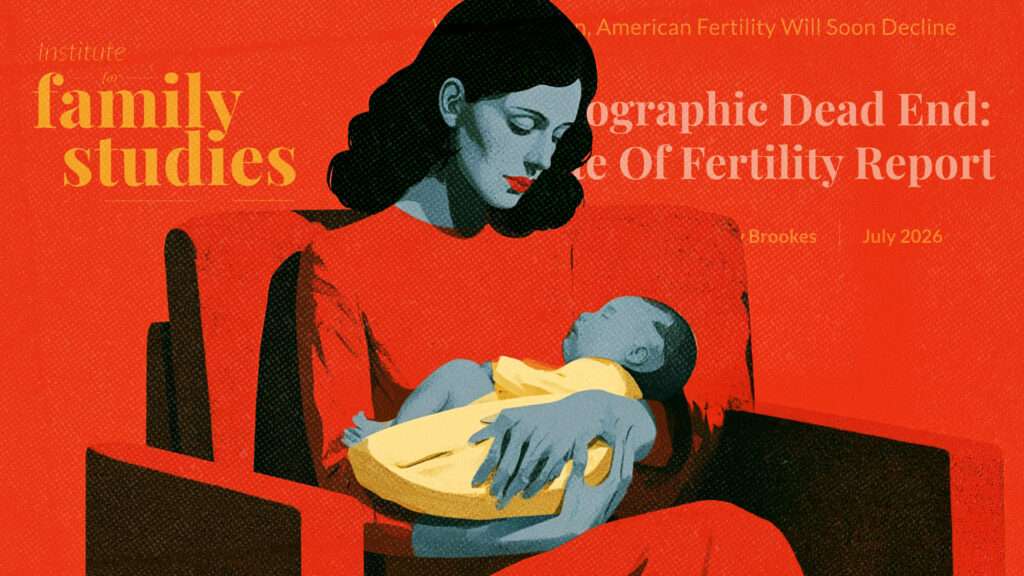
The Institute for Family Studies aims to boost America’s birth rate. Some proposals border on the extreme.
Imagine a Sunday where you plan to head into town to run errands or maybe meet friends at a bar, but you stay home because blue laws forbid businesses from opening on the Sabbath. You think about browsing the web, yet a data tax and the blocking of all nonessential sites keep you offline for the day. You have nonetheless received an invitation to a city-sponsored talk by a minor celebrity discussing the case for lifting the fertility rate. Do you feel like starting a family today? Are you in the mood?
This may sound like a premise straight out of a dystopian novel or a satirical take on activism, but several of these measures—reinstating blue laws, curtailing internet access, and enlisting celebrities to advocate for larger families—are real proposals put forth by the pronatalist nonprofit Institute for Family Studies (IFS) in its 2026 State of Fertility Report released on Tuesday.
With U.S. birth rates dipping to well under 1.6 children per woman, IFS argues that cultural and sometimes political interventions are essential to raise the fertility rate, claiming that “the future of liberty for all of us depends on the future of family.” Pursuing this notion of “the future of liberty,” IFS lays out a series of social-engineering policies that would curtail freedom while expanding governmental reach.
Many of the policy recommendations are familiar and resemble the pro-family, big-government agenda associated with Sen. Josh Hawley (R–Mo.): handing out baby bonuses and caregiver credits, removing marriage penalties from tax and benefit programs, and incentivizing more housing. As Reason’s Elizabeth Nolan Brown has observed, many of these top-down pro-natalist measures frequently fail to meaningfully raise birth rates.
Beyond individual policies, IFS envisions a sweeping revision of how laws are crafted, proposing that Congress and state legislatures assess bills by their effects on marriage and fertility, “reminding legislators that their choices have consequences for the physical survival of the nation, not merely its fiscal balance.”
The other IFS ideas about altering societal fertility norms are even more outlandish, including recruiting celebrities to persuade the public to have children. One of the IFS graphics asserts that “when celebrities have more children, their fans want more children.” This claim isn’t particularly scientific; it merely shows a link between a fan’s desire for parenthood and a celebrity’s own offspring, implying that fans who favor family-friendly celebrities are more inclined toward larger families.
According to the IFS method, researchers asked people to name a public figure they admired and explain why. They then aggregated the numbers of children that figure had using public information. They found that “each additional child of an admired public figure predicts a higher desired family size for the respondent,” with the effects more statistically robust for women.
The chart in the IFS report notes controls for factors such as college attainment, recent changes in household finances, overall income, gender, age, and satisfaction with the division of housework. Notably, the celebrity analysis appears not to account for a key predictor of childbearing: religiosity, a factor that past IFS studies have shown to correlate with higher fertility among religious Americans. The report elsewhere acknowledges religiosity as a possible confounding variable, but this is not addressed within the celebrity model. Political affiliation could also act as a confounder, yet it is not mentioned in the celebrity analysis.
Based on this observed association—which could stem from fans already sharing values with their favorite celebrity—IFS contends that enlisting celebrities to promote American family life could prove effective. The organization even suggests that governments interested in bolstering fertility should consider partnering with celebrities who enjoy popularity in their jurisdictions, or perhaps finding ways to discreetly encourage those celebrities to marry and have more children.
What would this type of social engineering look like? Would taxpayers fund bland public-service announcements featuring figures like Abby Shapiro urging viewers to raise the fertility rate for the nation’s benefit? Could such campaigns outperform messages from officials like Eric Adams, who urged New Yorkers to have children during a snowstorm? Might a government official secretly recruit celebrities to start families?
Any government-endorsed baby-making propaganda apparatus would need to select its celebrity ambassadors with care if IFS’s own standards are to be followed. The recruitment team would likely steer clear of figures such as Alex Cooper, whom an IFS contributor labels a “grifter and a liar” for promoting hookup culture and then marrying and having a child, even though her life path is relatively conventional.
IFS also proposes some more “creative options” to push fertility upward, including compelling businesses to close on Sundays to foster “in-person community.” It even floats restricting access to non-essential digital services at certain times to drive people offline and encourage real-world socializing. The group claims these approaches might lift fertility, arguing that research shows iPhones, pornography, and social media negatively impact U.S. fertility. Yet, as Reason has noted, the evidence supporting a direct link between smartphones and falling birth rates is contested. And if the digital revolution is blamed for declining fertility, such measures would amount to curbing internet freedom. A nonprofit solely devoted to increasing the population sees no issue with censorship—though many Americans would object to such measures.
In its report, IFS concedes that restoring the birth rate is largely a cultural and social challenge. Yet it endorses a suite of government-imposed policies—some of which read like a Nathan for You-style stunt—to raise fertility. This approach fails to recognize that Americans generally distrust their government and are unlikely to welcome being manipulated into having children by technocratic policymakers.
