
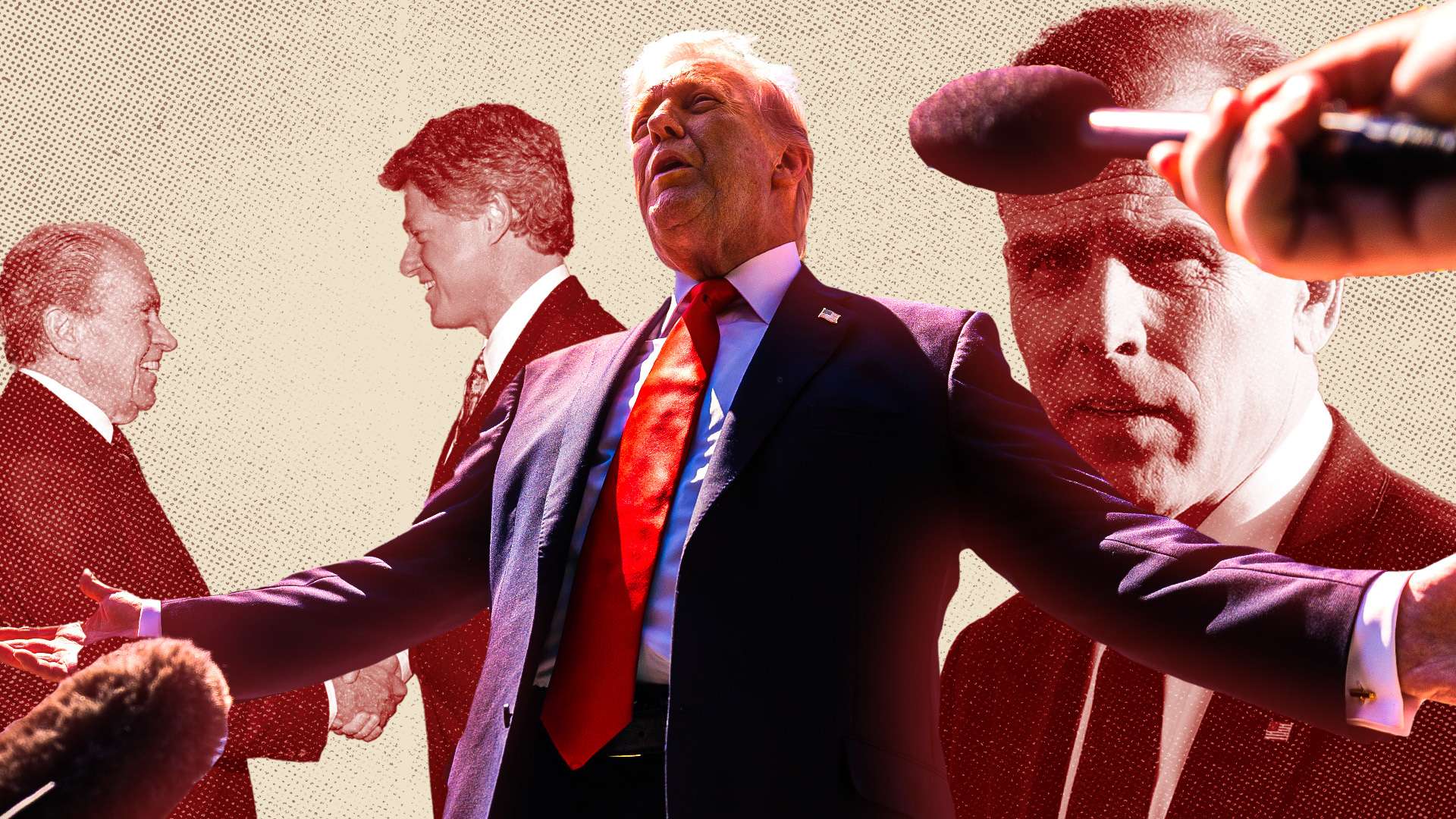
Looking back through the biggest scandals in American history through the lens of Trump 2.0.
Pose the question to historians or the general public alike: which presidential pardon in roughly two centuries of American leadership stands out as the most shamelessly corrupt? Most people would likely point to the same name— Marc Rich.
Rich, a globe-trotting, morally flexible oil trader who specialized in skirting sanctions to do business with regimes such as Nicolae Ceaușescu and Ayatollah Ruhollah Khomeini, fled to Switzerland in 1983 rather than face a potential life sentence and $1.6 million in fines on 65 charges of wire fraud, trading with the enemy, and tax evasion. (It was the largest tax-evasion case in U.S. history up to that point, totaling $48 million—roughly $150 million in today’s money.) Yet Bill Clinton, in the final moments of his tenure, bestowed upon Rich a midnight pardon.
All standard pardon protocols had been bypassed. The Justice Department had been blindsided, and the long-time fugitive—a veteran of the FBI’s Most Wanted List—had never expressed the customary remorse. Reporting soon revealed that Rich’s ex-wife, the songwriter Denise Rich, had contributed $1.1 million (roughly $2.3 million in 2026 dollars) to Democratic causes during the Clinton era, including (in nominal dollars) $450,000 to the Clinton Library, $120,000 for Hillary Clinton’s Senate campaign, and $25,000 to Al Gore’s Florida recount effort. “Not just a large donor,” Sen. Russell Feingold (D–Wisc.) noted at the time, but “a major donor.”
Rich’s final-minute clemency drew broad bipartisan condemnation. “Disgraceful,” judged former President Jimmy Carter. Added New York Mayor Rudy Giuliani: “The fact that Bill Clinton and Eric Holder engineered a pardon for him—without input from me, as the U.S. Attorney who prosecuted him, or Janet Reno, as Attorney General, will forever be a blemish on our justice system.”
Most readers are unfamiliar with Trevor Milton, yet in a few key respects his 2025 pardon from President Donald Trump was even more troubling. Milton, the founding CEO of electric-vehicle maker Nikola Corporation, in 2022 was convicted on three counts of investor fraud that could have yielded four years in prison and restitution to shareholders amounting to $676 million. One of his more infamous stunts was a 2018 promotional video of a supposedly functional Nikola truck that in fact wasn’t operational but had been rolled down a desert hill. Represented in court by the brother of then–Attorney General Pam Bondi, Milton was still awaiting sentencing when Trump phoned with an unconditional pardon, no restitution (or remorse) required. When questioned about the clemency, the president said: “They say the thing that he did wrong was he was one of the first people that supported a gentleman named Donald Trump for president….He supported Trump. He liked Trump.” Milton and his wife, The Wall Street Journal reported, had donated “at least $3.2 million to Trump’s 2024 election and to political groups and people in Trump’s orbit.” The couple had not previously demonstrated a financial stake in politics.
Milton’s relatives contributed more to politics than Rich did. He faced far larger fines and restitution that were wiped away, and since receiving clemency he has spent his post-pardon life not in disgraceful exile but amid lavish Washington circles, mingling with the president and Cabinet officials at investment forums and black-tie events to drum up interest in his latest ventures. This is not an exception but a rule: when pay-for-play pardons surface, Trump in his second term makes Bill Clinton and every other president look tame by comparison.
Paul Walczak, a nursing-home executive who had pleaded guilty to diverting payroll taxes to fund items like a $2 million yacht, stood on the cusp of beginning an 18-month sentence and paying $4.4 million in fines in May 2025 when Trump issued his pardon. In his pardon application, Walczak highlighted that his mother, Elizabeth Fago, had raised millions for Trump and the GOP in 2024 and had also aided the president by publicizing embarrassing entries from Ashley Biden’s diary. Less than three weeks before the pardon, Fago accepted an invitation to attend a Mar-a-Lago fundraiser with a price tag of a million dollars per guest, topped by a private audience with the president.
Trump’s second-term pardons and sentence commutations have erased more than $2 billion in fines and restitutions. The Wall Street Journal reported in December 2025 that the president’s forgiveness spree “has spawned a pardon-shopping industry where lobbyists say their going rate is $1 million.” The Atlantic in June 2026 put the going price at $2 million. While Bill Clinton conceded within 15 months that the Marc Rich clemency had been a mistake (even as he insisted that political donations played no part—he claimed to have been persuaded by testimony from prominent Israelis such as Ehud Barak), the unabashed Trump rarely pretends to care about the process, even as his kin and his Cabinet engage in deals with the ex-cons and their companies.
Asked by 60 Minutes in October 2025 why he had just pardoned Changpeng Zhao—the founder of the cryptocurrency exchange Binance, who had already served four months in prison and whose company paid $4.3 billion to settle money-laundering charges—Trump replied: “I have no idea who he is.” The president may have turned to his son Don Jr., who had recently introduced Zhao’s pardon lobbyist to his father and, in recent months, had contracted Binance to exclusively host and build the blockchain technology for the Trump family crypto trading platform World Liberty Financial. (That company’s stablecoin, USD1, was used in May 2025 as the currency for a $2 billion investment into Binance by the United Arab Emirates company MGX, a transaction that, according to The Wall Street Journal, “rocketed USD1 up the rankings of largest stablecoins,” thereby “pushing its market capitalization up from $127 million to over $2.1 billion.”) When questioned about the clemency, White House Press Secretary Karoline Leavitt issued a blanket denial: “Neither the president nor his family have ever engaged, or will ever engage, in conflicts of interest.”
Say what you will about Clinton’s controversial Marc Rich pardon, yet it was not preceded by Rich linking up with a company owned by the president and managed by his daughter. But we are in Trump’s second term, awash in transactions with dubious appearances, so much so that attempting to gauge the total scope of corruption feels almost futile. The numbers are astronomical, the entanglements brazen, and the cases numerous.
In a companion piece to this article, Senior Editor Jacob Sullum delves into the sordid specifics of the president’s most brazen self-dealings, from letting the federal government settle his own lawsuits to selling access to himself and his memecoin in a dinner that reportedly raised about $148 million. Here, to illustrate the overall problem’s contours, we categorize the era’s biggest scandals and then evaluate Trump 2.0 against them. The pattern becomes clear: the 47th president has outpaced the most infamous episodes of U.S. corruption while provoking only a fraction of the public outcry.
Molehills From Teapot Dome
At heart, the Teapot Dome affair of the 1920s—an intricate, multi-stage scandal that, before Watergate, stood as the pinnacle of federal corruption—revolved around secret bribes paid to a high-ranking official that lubricated favorable regulatory outcomes. In 1921, Interior Secretary Albert Fall discreetly accepted $404,000 ($7.6 million in today’s money) in cash and interest-free loans from two oil executives, who subsequently obtained no-bid leases to exploit oil fields at California’s Elk Hills and Wyoming’s Teapot Dome. As part of the scheme, Fall had previously persuaded the Secretary of the Navy to transfer control of those lands to the Interior Department. The no-bid contracts were legal (at the time, anyway); the bribes were not, and the covertness exploded when exposed.
Fast-forward a century. Four days before Trump’s second inauguration, Aryam Investments 1 struck a deal with the president-elect’s son Eric to acquire a 49 percent stake in World Liberty Financial for a reported $500 million, half of it upfront in cash. The Trump family received about $187 million overnight, and the family of World Liberty Financial co-founder Steve Witkoff, who by then was handling delicate Middle East diplomacy for the incoming administration, received an additional $31 million, according to The Wall Street Journal. Remarkably, the transaction remained secret, only coming to light a year later.
Did Aryam Investments have significant regulatory matters before the U.S. government? Indeed. The firm is owned by Sheikh Tahnoon bin Zayed Al Nahyan, the UAE’s national security adviser, brother of the nation’s president, and head of the country’s $800 billion sovereign wealth fund. Tahnoon’s artificial-intelligence company G42 had been blocked by the Biden administration from acquiring advanced Nvidia chips due to national-security concerns about sharing the tech with China. That decision was reversed in May 2025, when Tahnoon received what The Wall Street Journal called “a coup for the U.A.E.’s ruling family”—an agreement to send the UAE 500,000 high-powered AI chips annually, including to G42. “Enough to build one of the world’s biggest AI data center clusters,” the Journal observed.
So a foreign official’s covert $500 million deal that enriched the president and his family, plus a key Middle Eastern diplomat and his relatives, was followed by a sweeping regulatory reversal six months earlier that would further enrich that official and his country. And there’s more. In December 2024 Tahnoon’s asset-management outfit Lunate was among the two entities that injected $1.5 billion into the investment firm controlled by Trump’s son-in-law, Jared Kushner (who has co-led Middle East diplomacy with Witkoff). And we are not done yet. Recall the aforementioned $2 billion Trumpcoin-backed investment into Binance by MGX in May 2025, just before the UAE chip deal? MGX is owned by none other than Sheikh Tahnoon bin Zayed Al Nahyan.
Albert Fall was found guilty of bribery and served a year in prison. The Supreme Court voided the oil leases on grounds that they had been corruptly secured. President Warren G. Harding was unaware of the Teapot Dome plot, yet he nonetheless bore the stain after his death as an accomplice to corruption. The Trump family’s net worth surged by more than $1 billion due to Tahnoon’s intense and sometimes secret investments in the run-up to a hard-won diplomatic victory for his nation. Will future students remember the name World Liberty Financial?
From Billy Beer to Burisma to Billions
In 1938, The Saturday Evening Post published an exposé of James Roosevelt, son of President Franklin Delano, under the headline “Jimmy’s Got it.” What Jimmy had was a family name and connections he could leverage by selling insurance policies to prominent individuals (such as oil magnate Harry Sinclair) and corporations (such as CBS), even while holding a number of key positions in the White House. “My name got me into a lot of places I might not have got into if my father hadn’t been President,” he acknowledged in response, while releasing tax returns showing annual compensation from 1933–1937 that averaged an inflation-adjusted $850,000 per year. “And that’s all right, too….If you want to do business with a man you get in to see him by whatever legitimate means you can.” Defiance notwithstanding, Roosevelt resigned from government by the end of 1938.
Billy Beer was more punchline than scandal, but it was still deemed inappropriate that the wayward brother of the principled Jimmy Carter lent his name in 1977 to a cheap beer that quickly went bankrupt.
Hunter Biden was equally chaotic, yet bold enough to repeatedly monetize his father’s name and office, including about $4 million in compensation (roughly $5.5 million in 2026 money) to work for the Ukrainian oil company Burisma from 2014 to 2019, and another $4.8 million ($6.5 million) from a Chinese energy magnate seeking to expand U.S. operations. These questionable foreign dealings, which likely would not have occurred had Joe Biden not served as vice president, later drew congressional inquiries and Justice Department investigations that began during Trump’s first term and continued under Hunter’s father. It wasn’t until a lame-duck Joe Biden issued a blanket pardon for all of his son’s activities from 2014 through 2024 that Hunter avoided prison time, further prosecutions, and the persistent taint of scandal.
These three famous cases of family influence-peddling pale beside the everyday business of Donald Trump’s heirs, conducted openly on a daily basis.
Jared Kushner, as Jacob Sullum recounts, has amassed well over $6 billion through his Affinity Partners private-equity outfit since launching in 2021, much of it coming from the same Middle Eastern governments he has been a senior negotiator with during both of his father-in-law’s administrations. Companies controlled by Eric Trump and Donald Trump Jr. have struck deals with Dad’s government in the hundreds of millions. It’s become almost routine for the president to cut ribbons at new golf courses during official overseas trips, with few eyebrows raised.
A financial-disclosure report released on June 30 highlighted how advantageous the presidency can be: “Trump’s revenue in 2025 rose to at least $2.2 billion, compared with a minimum of $622 million in 2024 before he returned to office,” noted The New York Times. “It is,” Megan Gorman, author of All the Presidents’ Money, told the Times, “completely unprecedented.”
Richard Nixon Wasn’t That Bad
“I’m actually fascinated by [Richard] Nixon as a historical figure,” Vice President J.D. Vance remarked at the Nixon Library in June. “His legacy is experiencing a renaissance, and deservedly so… If Watergate happened tomorrow, it would be a 12-hour news cycle. And, if you examine the arc of how the Deep State supposedly toppled Nixon, it’s not all that dissimilar from what the same groups tried to do to Trump during the first Trump administration.”
Watergate—the sole Washington scandal that forced a president to resign and even added a suffix to the language—was a 26-month saga that stretched from the DNC break-in by Nixon loyalists to Gerald Ford’s pardon of his predecessor. One reason it endured was that the perpetrators, their bosses, and the beneficiaries of the burglary—very much including Nixon—couldn’t stop lying, destroying evidence, devising schemes to quash investigations, and, if empowered, simply firing the most troublesome investigator. Nixon even attempted to use the Deep State to make it disappear, ordering the CIA to tell the nosy FBI that the inquiry endangered national security. In the end, 48 people were convicted or pled guilty, including Nixon’s attorney general, his domestic-policy adviser, and his chief of staff.
Still, you can understand why Vance might want to downplay Nixon’s misdeeds. Each of the 37th president’s most infamous Watergate-era offenses has analogues that reflect badly on Vance’s own boss.
In the “Saturday Night Massacre” of October 20, 1973, Nixon ordered Attorney General Elliott Richardson to fire Watergate special prosecutor Archibald Cox after Cox insisted—backed by the courts—that the president produce tapes from a secret White House recording system. Richardson refused and resigned; his deputy, William Ruckelshaus, also refused and quit. Only third-in-command Robert Bork carried out the firing. By contrast, Trump’s notable first-term parallel was when he dismissed FBI Director James Comey for probing links between Russia and the 2016 campaign.
Yet there have been numerous “massacres” in Trump’s second term, though without the same sense of a president fighting for political survival. In 2025, ten federal prosecutors resigned rather than follow Acting Deputy Attorney General Emil Bove’s order to drop federal corruption charges against then–New York City Mayor Eric Adams, partly because the prosecution supposedly impeded attention to illegal immigration and violent crime. The first to resign, Danielle Sassoon, wrote a sharp rebuke: “The reasons offered by Mr. Bove for dismissing the indictment are not ones I can responsibly defend as being in the public interest or consistent with fairness and impartiality.” She added that Adams’s lawyers suggested quid pro quo terms—implying that the indictment would be dropped if Adams complied with enforcement priorities.
One of the watershed moments in Watergate was the reveal of an administration “enemies list,” where (as then–White House counsel John Dean put it) “we can use the available federal machinery to screw our political enemies.” The penalties on the list included IRS audits and manipulating grant availability, contracts, litigation, and prosecutions—demonstrating just how far the presidency could go against its critics.
Trump, meanwhile, nominated as FBI director a figure who vowed in 2023 that a second MAGA administration “will go out and find the conspirators—not just in government, but in the media. Yes, we’re gonna come after the people in the media who lied about American citizens, who helped Joe Biden rig presidential elections. We’re gonna come after you.” Jacob Sullum outlines the consequences of pursuing one’s enemies; a new wrinkle this time is how openly it is done. In September 2025, Trump mistakenly posted on Truth Social what was meant to be a private reprimand of then–Attorney General Pam Bondi for not pursuing his enemies aggressively enough: “all talk, no action. Nothing is being done. What about Comey, Adam ‘Shifty’ Schiff, Letitia??? They’re all guilty as hell, but nothing is going to be done,” he wrote. “We can’t delay any longer, it’s killing our reputation and credibility. They impeached me twice, and indicted me (5 times!), OVER NOTHING. JUSTICE MUST BE SERVED, NOW!!!”
Nixon drew the nation’s outrage and ridicule for telling interviewer David Frost that, “When the president does it, that means that it is not illegal.” Trump, within the first month of his second term, asserted on social media that, “He who saves his Country does not violate any Law,” a slogan frequently attributed to Napoleon. When The New York Times asked him the previous month whether there were any checks on his power, he replied: “Yeah, there is one thing. My own morality. My own mind. It’s the only thing that can stop me.” These statements align more with reality than they did during his first term, thanks to a 2024 Supreme Court ruling, Trump v. United States, which grants presidents near-absolute immunity from criminal prosecutions for the exercise of “core constitutional powers,” in addition to broader protections for “official acts.”
Greenwater All the Way Down
John J. Cafaro cuts an image straight from a mob-film stereotype. A stout frame, a double-breasted suit, a thick black mane and mustache, with a large cigar often in hand. Cafaro, a longtime Republican ally of Trump (who praises him as a “fantastic man”), resides near Mar-a-Lago and was previously known for pleading guilty to bribing former Ohio congressman James Traficant. Now: Cafaro’s outfit Greenwater Services landed a $1.7 million no-bid Interior Department contract this spring, suggested by the Bedminster, New Jersey, golf-club manager, to modernize the Lincoln Memorial Reflecting Pool’s water-cleaning system. Coupled with another no-bid contract worth $14.7 million to paint the pool’s bottom in a patriotic blue, Cafaro’s expedited project was touted by the president as a historic fix to a long-standing eyesore on the National Mall, timed for the nation’s 250th birthday.
Things did not unfold as planned. Within days, the water turned green-brown with algae, chunks of new sealant peeled away, and a furious Trump blamed Antifa vandals and other malefactors for a project that had gone awry. Some metaphors are just too apt to ignore.
Americans have cycled through eras of corruption: the overt patronage of Tammany Hall, the lobbying apparatus behind McKinley-era tariffs, and the security-and-surveillance-state outrages of the 1960s and 1970s. These rotten systems never repaired themselves through a simple, collective shrug.
Donald Trump and his family are conducting corruption on a scale never before imagined in the American experiment. If there is to be any credible exit from this era of brazen graft, the first requirement is simply to notice.
