
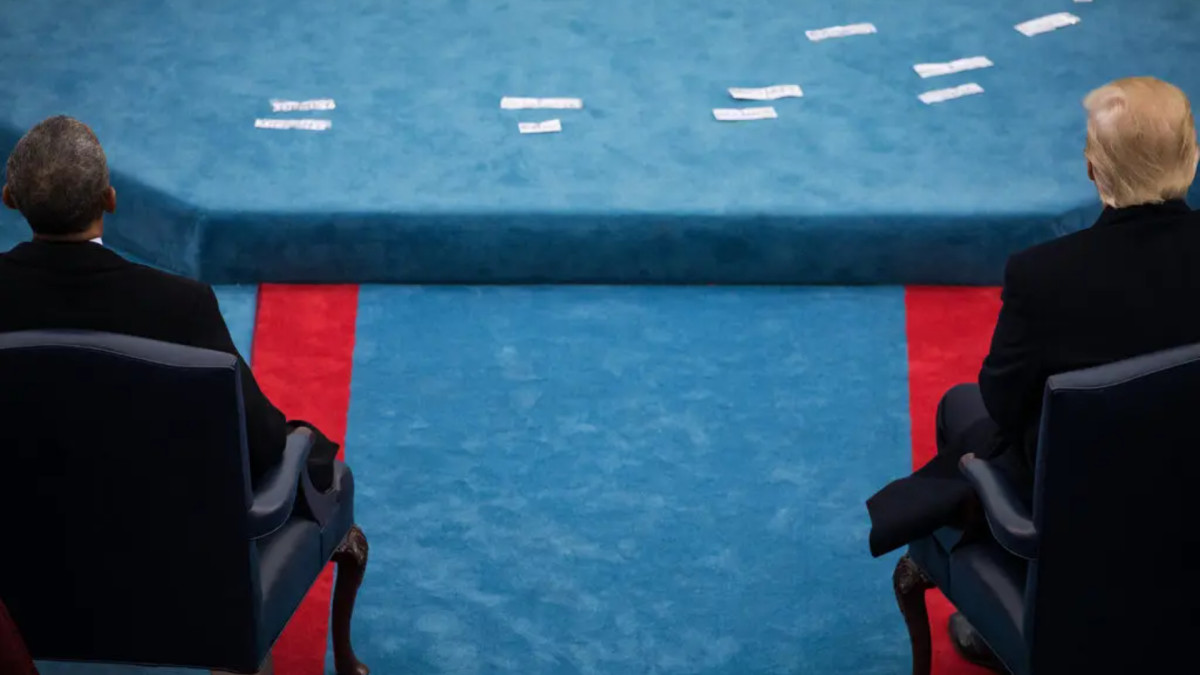
I don’t want the Twenty-Second Amendment to be repealed. But I must admit I’m frustrated that it has deprived us of the electoral campaign the United States needed: a direct showdown between Barack Obama and Donald Trump.
Obama and Trump are so radically opposed that they could seem like figures straight out of a Dickens novel. Their philosophical divide is evident not only in their beliefs but also in their temperaments, the way they speak, and even their physical bearing. Obama is lean, disciplined, deliberative, and contained. Trump is bulky, grandiose, flamboyant, and unabated. Obama is defined by superhuman self-control and by his—exaggerated—seven slightly salted almonds before bedtime; Trump, by superhuman appetites: for attention, fame, money, women, and power.
“We will not have a campaign that pits these two men and the two conceptions they embody, but in recent weeks an indirect version of that debate has unfolded”
But the deeper difference between the two—what they represent beyond themselves—resides in their opposing visions of what makes the United States great and even what it means for the United States to be the United States. We will not have a campaign that pits these two men and the two conceptions they embody, but in recent weeks an indirect version of that debate has unfolded. Those who succeed Obama and Trump politically should take note.
The June 18 ceremony at the opening of the Obama Presidential Center in Chicago featured a speech laying out his view of America. “Now that there are only a few weeks left before the 250th anniversary of the United States, it is worth recalling how radical the very idea of self-government was in 1776,” he declared. “Until then, the history of humanity had been a history of conquests, castes, and rigid hierarchies; a world in which the strong dominated the weak, power, wealth, and status were transmitted by lineage, and the majority was ruled by a few.”
Obama continued:
“When we formed our union, the founders fell woefully short of the promise of the Declaration: they kept slavery intact and allowed states to restrict voting rights for white, property-owning men. Yet, in drafting a Constitution and a Bill of Rights, they did possess the foresight and genius to give us a framework that enables each generation to perfect our union further.”
“And, for more than two centuries, through petitions and protests, marches and strikes, moral appeals from the pulpit, and conversations around the kitchen table, people of all conditions, colors, religions, and regions took up the cause of democracy and made it theirs, until We the People came to include not just some of us but all of us.”
“The United States is a process, not a place; those who believe in it are the ones who work to make its radical vision real”
The United States did not merely exist; it was made. A significant part of Obama’s political genius has been his ability to present those who tried—and continue to try—to build the United States and compel it to conform to their ideals as the true heirs of the American tradition. In an era when almost every politician wore a flag pin on their lapel, he offered an alternate vision of what it meant to believe in the country. The United States is a process, not a place; those who believe in it are those who labor to realize its radical vision.
This conception of the country is etched on one side of his presidential center. The words come from the speech he gave for the 50th anniversary of the Edmund Pettus Bridge march in Selma, Alabama.
“You are the United States,” it can be read. “Without the constraints of habit and convention. Not trapped by what is, but prepared to reach what ought to be. For in every corner of this country there are first steps to take, new territories to explore, and more bridges to cross. The United States is not the project of a single person. The most powerful word in our democracy is ‘us’. ‘We, the people’. ‘We will overcome’. ‘Yes, we can’. That word does not belong to anyone. It belongs to everyone. What a glorious task we have been entrusted with: to continually strive to improve this great nation of ours.”
As the choice of that speech implies, Obama sees himself as the heir to a long political tradition that has given the United States a meaning it did not possess at its origins. As my colleague Jamelle Bouie writes: “Reading the words of Black, free, and enslaved Americans is to see the Declaration in motion; to regard it as a living document with a meaning that extends far beyond the circumstances of American independence. And it is to see that meaning was created: built by people with a deep, essential understanding of what freedom meant and what it required.”
“It was a reverence for the ability of the strong to dominate the weak, not for the weak who unite to imagine a new form of power”
The contrast with Trump’s approach to the 250th anniversary has been pronounced. Trump placed at the center of the celebrations the UFC Freedom 250, a cage-fight set up in the White House garden. It was a celebration of the strong’s capacity to dominate the weak, not of the weak who unite to imagine a new form of strength.
The Trump speech at the Great American State Fair, held on the National Mall in Washington to inaugurate the festivities, likewise revolved around the idea of America’s recovered strength. “There has never been anything like the United States of America, and together, we are making it bigger, better, stronger, and far more exceptional than ever,” he proclaimed.
Trump argued that the United States had been on the verge of disappearing. “As you know well, not long ago we were a dead country. We were dead. Now we are the most dynamic country in the world. The whole world respects us. No one laughs at us anymore. Two years ago, they did. Now we are the most respected nation in the world.”
Two years ago, little had changed in the U.S. economy. The world admired the United States more than it does today. So what exactly has Trump achieved? He has seized the power from those who sought to change America.
“Just like those patriots of 1776, over the last seventeen months we have taken back power from that distant political class,” he said. “They are trying to take it back, but it won’t happen. We have reclaimed our sovereignty, regained our freedom, restored our prosperity, and saved our country in every sense. Once again, we are putting something called America first.”
“The world admired the United States more than it does today. So what exactly has Trump achieved?”
Then, of course, Trump released financial documents showing that his net worth had risen by $2.2 billion during his first year back in the presidency. That is what Trump really puts first: himself, his power, and his wealth. In his America, the strong dominate the weak, wealth and status are transmitted through dynastic lines, and he is the strongest of all.
But American progressive forces have known for a long time that America’s ideals can become a trap for those who betray them. And Trump has betrayed them. What Democrats have not learned to do—at least since Obama—is to trigger that trap.
The dominance of Trump over the post-Obama landscape has driven many Democrats to abandon the optimism of Obama-era progressivism. If Obama’s politics led us to Trump, what good did it really do?
But that is the wrong lesson. Since Obama, Trump has faced a slate of Democratic candidates who failed to tell the story of the United States the way he does and who, more often than not, did not even try. He has faced a left that viewed Obama’s faith in the country as naive, seeking a more direct and constant confrontation with our sins than with our hopes, and that spoke more of our villains than of our heroes.
Still, Trump’s track record of rallying ordinary Americans to his cause has been poor. He lost the popular vote in 2016. He lost both the popular vote and the election in 2020. And, although he reclaimed the White House and won the popular vote in 2024, aided by inflation, his popularity plummeted rapidly, landing among the lowest ever recorded for a modern president at this stage of a second term.
“There is room to recover not only the American story but also what it means to be a good American in opposition to Trump”
There is room to recover not just the American story but also what it means to be a good American in opposition to Trump. Obama clearly sees a political opening in Trump’s venality and crude behavior. He wove his remarks with praise for values that, he believes, still unite most Americans:
“The belief that the qualities of character—honesty, integrity, kindness, compassion, and a sense of duty and honor—matter in our public life as much as in our private life.
“These are the values and traditions I believe in, and they are not Republican or Democratic values. They are American values that we can all share, regardless of party; values that every president present here, though different from one another, has striven to defend; values in which John McCain and Mitt Romney believed as much as I do.
“This is our greatest legacy, the history of the United States at its best, because it reflect a basic faith in the decency of our fellow citizens and in the possibility that, despite all our differences, we can see one another, understand one another, and unite around a common cause.”
Is he right? When CNN asked Americans to rate all living presidents, Obama topped the list at 57% approval. Trump languished at 34%. In the next electoral contests, Democrats will still have a lot to learn from Obama, and Republicans may discover they need to unlearn many things about Trump.
This article was originally published in The New York Times and translated by Agenda Pública.
© 2026 The New York Times Company.
