
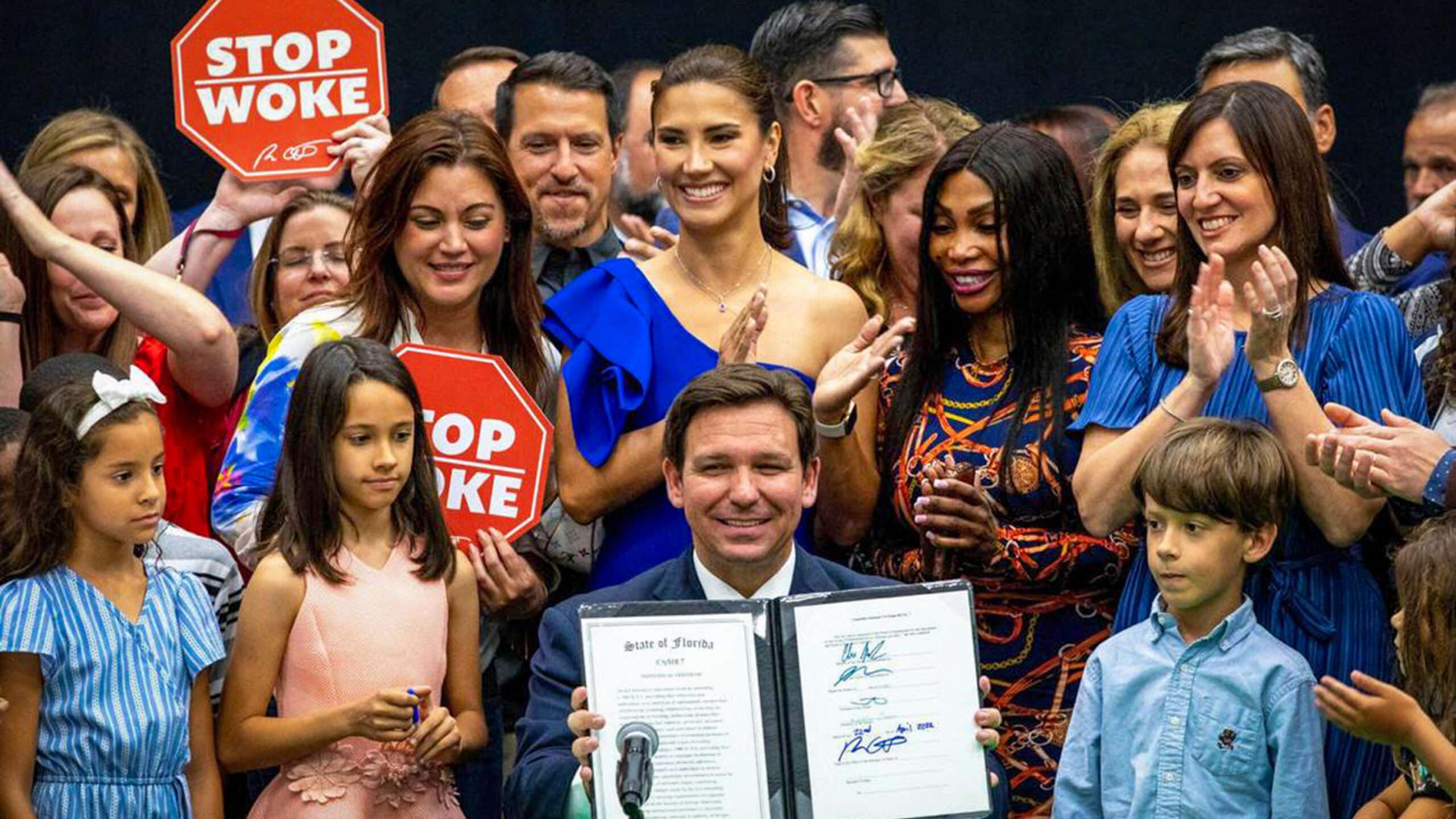
In the U.S., government officials aren’t allowed to fight ideas they don’t like with censorship.
The remedy for a regime that enforces establishment-approved ideology does not come from the government silencing conversations. That should be obvious to anyone who champions freedom, and it was forcefully underscored by a federal appeals court when it overturned Florida’s Stop WOKE Act. Declaring that the First Amendment cannot be reconciled with enforcing an official government line—in a college classroom of all places—the court reversed the state’s attempt to counter ideological dissidence by imposing its own orthodoxy.
The 2022 statute was a prominent reaction to peak social-justice activism. After the law’s passage, DeSantis told the National Conservatism conference that “in Florida, parents should be able to send their kid to elementary school without having woke gender ideology shoved down their throat.” He described the prevailing ideology in many universities and corporate HR departments as “the woke mind virus.”
Many parents share those concerns about politicized lessons. Yet the law did not empower them to pull their children out of classrooms for alternatives that align with their values (the state already has robust school-choice options). Instead, it sought to determine what could be discussed in schools, colleges, and even private workplaces. The legislation’s preface states that it aims to prohibit “subjecting any individual, as a condition of employment, membership, certification, licensing, credentialing, or passing an examination, to training, instruction, or any other required activity that espouses, promotes, advances, inculcates, or compels such individual to believe specified concepts” concerning race, relative privilege, collective guilt, and other ideas tied to social-justice ideology. Whether discussions cross the line is left up to the state to decide.
A Censorship Law That is ‘Positively Dystopian’
It’s understandable that government involvement in classroom and workplace dialogue would provoke immediate First Amendment challenges. The law hasn’t fared well.
“The State of Florida seeks to bar employers from holding mandatory meetings for their employees if those meetings endorse viewpoints the state finds offensive. But meetings on those same topics are allowed if speakers endorse viewpoints the state agrees with, or at least does not object to,” a three-judge panel for the 11th Circuit Court of Appeals wrote in a 2024 order blocking the law’s application to private businesses. “Florida may be exactly right about the nature of the ideas it targets. Or it may not. Either way, the merits of these views will be decided in the clanging marketplace of ideas rather than a codebook or a courtroom.”
That ruling followed a federal district court’s temporary injunction in a 2022 case brought in part by the Foundation for Individual Rights and Expression (FIRE) against the law’s application to colleges and universities. The judge in that case observed that “the law officially bans professors from expressing disfavored viewpoints in university classrooms while permitting unfettered expression of the opposite viewpoints… This is positively dystopian.” (Full opinion here.)
The 11th Circuit’s July 7 decision affirmed the district court’s ruling.
“Viewpoint-based restrictions designed to compel or ban a set of beliefs are dangerous in any setting, and they are especially pernicious in the classroom context,” wrote Judge Britt C. Grant for the majority. “Though the government has plenty of ways to promote its own viewpoint, puppeteering every university professor in the state is not one of them. Forcing an official government line—in a college classroom of all places—is exactly the ‘pall of orthodoxy’ that the First Amendment will not tolerate.”
“Universities and professors do not always get it right. Neither does the government,” Grant concluded. “Our Constitution is unique in its commitment to letting the people, rather than the government, find the right equilibrium.”
Fundamentally, the courts aren’t ruling on whether the woke ideas targeted by Florida’s law are good or bad—they acknowledge that lawmakers may be correct about the potential toxicity of certain ideological content. But in the United States, the government isn’t permitted to intervene in ideological battles by banning some ideas while promoting others.
“Today’s important decision means that college remains a place where professors and students are allowed to debate controversial topics — even if politicians disagree with them,” commented Greg H. Greubel, senior attorney at FIRE, in response to the appeals court ruling. “Today’s decision makes explicit something we’ve known for a long time: Governments cannot censor their way to freedom.”
The Real Cure Is Open Debate
Paradoxically, open dialogue is addressing concerns about woke social-justice ideology and its grip on institutions without government interference. In a January piece for The Washington Post, progressive political scientist Shadi Hamid conceded that “from 2014 to about 2023, peaking in 2020, Democrats fell under the sway of ‘woke’ ideas that prioritized divisive cultural issues such as transgender rights and reducing funding for police.” He added that “a growing number of Democrats and liberals have acknowledged that things may have gone too far, alienating too many Americans.”
A postmortem by the Democratic Party on its broad losses in the 2024 elections blamed part of the debacle on extreme cultural ideology. It urged candidates to “focus less on abstract issues and identity politics” if they want to attract votes.
In other words, Americans didn’t need government action to shield them from harmful ideas; they encountered those ideas, debated them, and many rejected woke ideology on their own.
Florida residents already had avenues to push back against ideas they dislike, thanks to the state’s school-choice options, the ability to choose employers, and the availability of numerous colleges and universities. Anyone feeling pressured to adopt a particular ideology and uncomfortable with debating it could vote with their feet, their labor, and their money.
What Floridians—and, indeed, all Americans—cannot do is empower the government to suppress the promotion of disfavored ideas. They can argue against bad ideology, but censorship remains off the table.
