
The judge defied established Supreme Court doctrine by ruling that a student’s privacy rights outweighed the strong constitutional assumption against prior restraints.
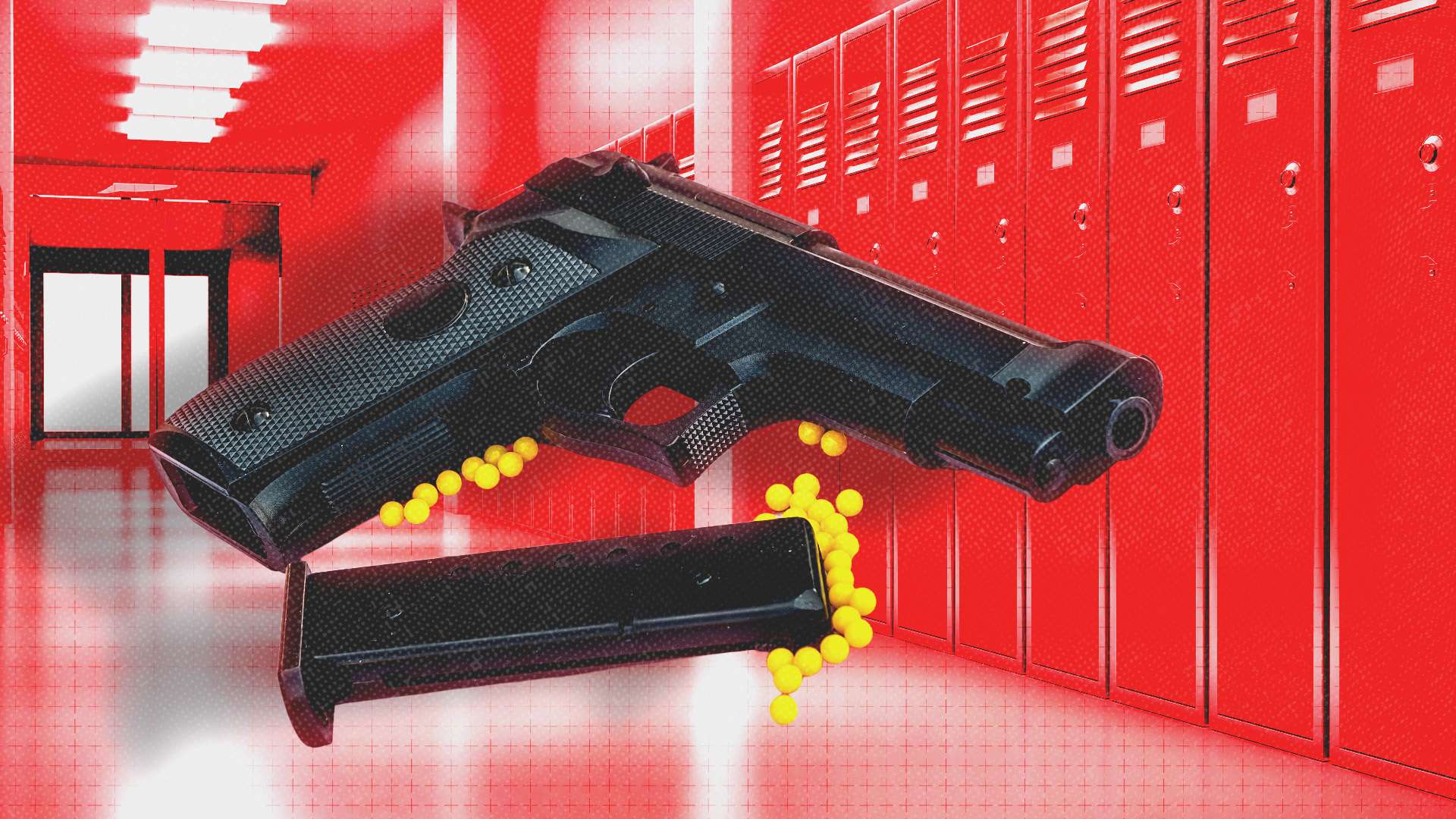
On May 8, a 16-year-old pupil carrying an airsoft pistol in his waistband set off a lockdown at New Brunswick High School in New Jersey. New Brunswick Today‘s report on the episode included uploading leaked security camera footage to its YouTube channel, which sparked an even harsher reaction: a court order demanding the video’s removal and prohibiting description of it. Last week, New Jersey Superior Court Judge Thomas D. McCloskey revised that order, permitting reporting about the lockdown that does not disclose the student’s identity. At the same time, he broadened the restraints to cover every journalist in the United States.
Such prior restraints on press freedom are considered presumptively unlawful. McCloskey’s injunction has been described by the Freedom of the Press Foundation (FPF) as “one of the worst censorship orders we’ve ever seen.” “Forcing news outlets to delete or withhold information and to submit their work for government approval before publishing is censorship, plain and simple,” remarks Caitlin Vogus, the FPF’s senior adviser for advocacy. “The First Amendment is crystal clear: Prior restraints are almost never permissible. Neither judges nor the law can censor the press.”
McCloskey’s initial edict, proposed on May 29 and issued on June 9 in response to a request from the New Brunswick Board of Education, demanded “immediate removal of confidential security/surveillance video taken at Plaintiff’s New Brunswick High School.” It also barred New Brunswick Today from “any and all future postings of confidential school security/surveillance video as captured at any of the schools in the Plaintiff’s District.” Even more strikingly, McCloskey prohibited the outlet from “writing or posting about the content of the confidential video footage of the [16-year-old] juvenile/student specifically at issue in this matter.”
New Brunswick Today pressed for the order’s rescission on constitutional grounds, and the judge’s revised order, issued July 9, loosened the prior restraints. McCloskey lifted the restriction on describing the May 8 footage, “provided that the name(s) and identity(ies) of the 16-year-old juvenile/student, and of
any and all other juvenile/students depicted in the video footage, are not revealed or identified in any way.”
McCloskey also permitted New Brunswick Today to publish the video itself but required that it first “modify the footage by redacting or blurring out the identities of all juvenile students depicted in it” and “present the modified footage to Plaintiff and its counsel for review and approval, with copy to the Court.” He pressed these conditions even as he acknowledged that “the video was already published and in the public domain,” noting that “the juvenile’s identity and image remain sensitive.”
Even as his order narrowed, McCloskey broadened who could be affected to include not only New Brunswick Today but “the press” in general. Judges “lacks authority to issue orders binding unidentified journalists across the country who aren’t in their courtroom or parties to any case before them,” Vogus observes. “Similar orders have been overturned nationwide.”
New Brunswick Today intends to challenge McCloskey’s ruling. It has ample legal precedent to argue that the judge’s directives violate the Constitution.
In the 1931 case Near v. Minnesota, the Supreme Court overturned a state statute authorizing court injunctions prohibiting publication of “malicious, scandalous and defamatory” material, treating such restraints as a form of public nuisance. “Unless the owner or publisher can furnish competent evidence to show the charges true and published with proper motives and for legitimate ends,” Chief Justice Charles Evans Hughes wrote for the majority, “his newspaper or periodical is suppressed and further publication becomes contempt. This lies at the heart of censorship.”
A statute that authorized proceedings restraining publication runs counter to “the conception of the liberty of the press as historically conceived and guaranteed,” Hughes continued. The central aim of that guarantee, he noted, is to “prevent prior restraints upon publication.”
The Supreme Court reaffirmed this stance in the 1963 decision Bantam Books v. Sullivan. “Any system of prior restraints of expression comes before this Court with a heavy presumption against its constitutional validity,” wrote Justice William Brennan for the majority, invoking Near and other precedents to this effect.
The Court applied this principle in the landmark 1971 case New York Times Co. v. United States, arising from the federal government’s attempt to block publication of the Pentagon Papers, a confidential Defense Department record on the Vietnam War. Despite the government’s national-security rationale, the Court unanimously concluded that it had not carried the “heavy burden of justification” required for such a restraint.
McCloskey argued that his order sought to “properly balance” the “privacy rights” of the student who carried the airsoft pistol with the doctrine against prior restraints. But the Supreme Court had already confronted such issues in the 1977 case Oklahoma Publishing Co. v. District Court, where a pretrial order preventing news outlets from publishing the name or photograph of an 11-year-old murder suspect was unanimously found to violate the First and Fourteenth Amendments.
Two years later, in Smith v. Daily Mail Publishing Co., the Court rejected a West Virginia statute that made it a crime to publish the names of juvenile offenders in the wake of reporting on a 14-year-old homicide suspect. And in the 1989 case Florida Star v. BJF, the Court held that the First Amendment barred civil liability for publishing a sexual assault victim’s name, even though such publication contravened state law and the newspaper’s own policy.
In seeking to suppress the May 8 security-camera footage, the New Brunswick Board of Education cited federal and New Jersey laws protecting the privacy of student and juvenile justice records, together with policies aimed at implementing the district’s obligations under those laws. Yet, as the Supreme Court’s precedents demonstrate, such laws and regulations do not trump the First Amendment’s strong presumption against prior restraints.
McCloskey conceded that the Court has “never upheld a prior restraint on pure speech, even in cases involving national security,” in issuing the July 9 order. He distinguished this case from Oklahoma Publishing and Smith, arguing that those decisions involved information that was lawfully obtained or already public. By contrast, he suggested, the footage here was confidential and allegedly acquired without authorization.
McCloskey noted that the editor of New Brunswick Today, Charlie Kratovi, “certified to the Court that the video was ‘lawfully obtained,’” but he failed to explain how or from whom. Kratovi also contended that there existed a legitimate public-interest basis for the footage, particularly since the Board of Education had allegedly misrepresented the incident to students’ parents in a text message by claiming the lockdown was a routine security drill.
That argument did not sway McCloskey. “The First Amendment does not grant the press a license to violate privacy laws,” he wrote. “Courts distinguish between reporting on matters of public concern and publishing confidential information protected by law.” Yet both Smith and Florida Star involved state privacy statutes that the Supreme Court deemed incompatible with the press freedom guaranteed by the First Amendment.
“If footage was obtained unlawfully or in breach of confidentiality statutes, First Amendment protections are substantially diminished,” McCloskey wrote. Yet he appeared to waver briefly.
“The Court would agree with the Defendant, to a degree, that even if the video was unlawfully obtained, the described First Amendment protection for publication would generally still apply,” he added. “It is recognized that the Supreme Court and other courts have consistently held that the press may publish truthful information of public concern, even if the source obtained it illegally, provided the press did not participate in the unlawful acquisition.”
Nevertheless, McCloskey argued that “the juvenile’s statutory right to confidentiality” could prevail over “the severe constitutional presumption against censorship.” He suggested that if New Brunswick Today had acquired the video through New Jersey’s Open Public Records Act, that would be permissible, but not if it had obtained it “through a leak or an independent source.”
Footage that “discloses the identities of other minor students, the locations of cameras, staffing responses, and screening procedures” can jeopardize school security and endanger students and staff, McCloskey warned, and such factors must be weighed as well. He added that publicly naming minors involved in disciplinary or criminal matters can inflict lasting reputational and emotional harm.
On that basis, he argued, the injunction was narrowly tailored and did not constitute an improper prior restraint. He noted that the revised order targeted only the confidential footage, not broader reporting or commentary.
Although the First Amendment protects speech and press freedom, McCloskey wrote, so too do the rights and privacy interests of minors. That claim is debatable, given that the First Amendment does not address such privacy rights. Nonetheless, he concluded that “the right to free speech and expression was never intended to grant an unbounded license to anyone—whether an individual, news organization, or government body—to exercise those rights in ways that could realistically or foreseeably threaten a juvenile’s safety.”
It is difficult to reconcile that reasoning with the Supreme Court’s unanimous ruling in Smith, which rejected the notion that the State’s interest in safeguarding a juvenile’s identity justified a law prohibiting publication of such information. “If a newspaper lawfully obtains truthful information about a matter of public significance,” Chief Justice Warren Burger wrote, “state officials may not constitutionally punish its publication, absent a need to further an interest of the highest order….If the information is lawfully obtained, as it was here, the state may not punish its publication except when necessary to advance an interest more substantial than is present here.”
McCloskey inverted that logic. He asserted that while the Court has recognized that minors’ privacy interests can be significant, even if not always “of the highest order,” Smith nonetheless held that such interests were insufficient to validate West Virginia’s law, whether viewed as a restraint or as a penalty for publishing lawfully obtained, truthful information, since even the latter action requires an extremely compelling public interest to sustain its validity.
In a conversation with The New York Times, Rutgers law professor Carlos A. Ball stressed how stringent that test is. “I don’t think a security video showing a high school student being detained for attempting to bring a weapon to school meets that high standard,” he said.
McCloskey remained unmoved. “The necessity and legal basis for tailored, modified restraints are self-evident,” he concluded. “There is a compelling interest in protecting juvenile privacy. The privacy of minors involved in school incidents is a recognized and substantial interest.” He invoked Smith and Florida Star, both of which rejected the idea that privacy interests alone justify prior restraints.
“Judges across the country appear increasingly disposed to grant these kinds of prior restraints,” Vogus told the Times. “And they are almost always overturned.”

Natalie Foster
I’m a political writer focused on making complex issues clear, accessible, and worth engaging with. From local dynamics to national debates, I aim to connect facts with context so readers can form their own informed views. I believe strong journalism should challenge, question, and open space for thoughtful discussion rather than amplify noise.