
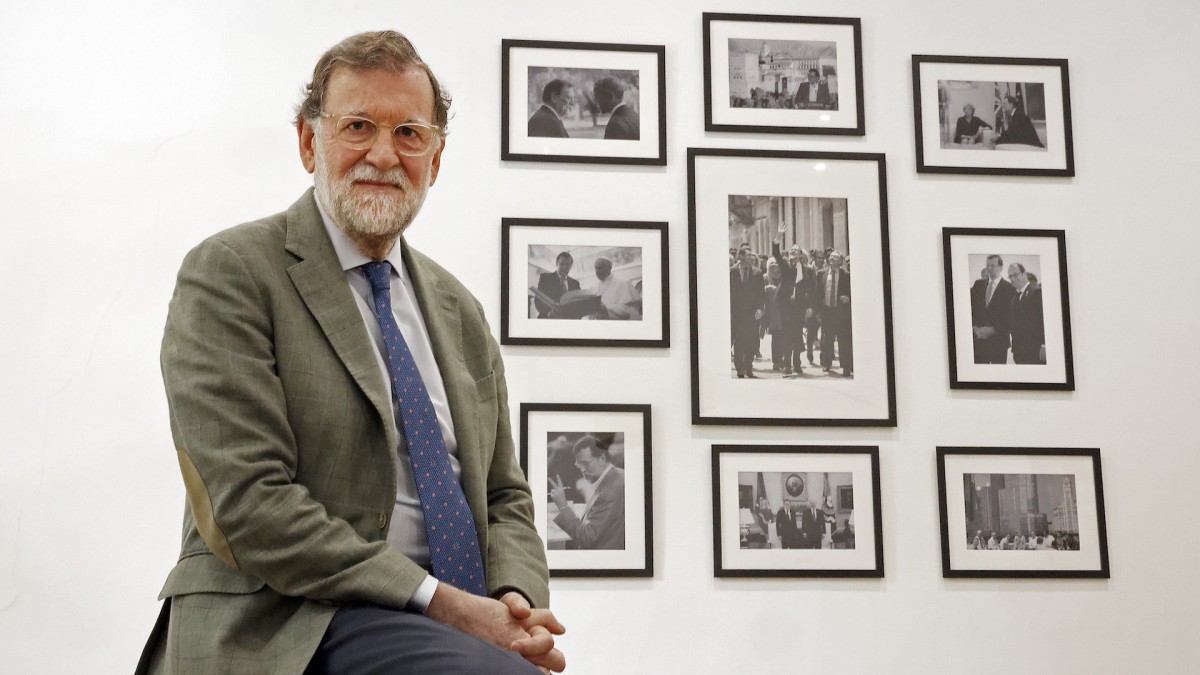
“In Spain, reaching the apex of power, which is the presidency of the Government, is easier than returning afterward—dignified and cleanly—to the ordinary people. And in that regard, Mariano Rajoy Brey has no rival. Of course, to achieve it in this way, one must have entered the Body of Property Registrars, Mercantile and Movable Property at twenty-five, climbed step by step through all levels of political responsibility, and ended public service at an age that allowed him to return to the Registry and live from his work. That is why he maintains an enviable image and popularity, although, in a dreary era of politics, when the “you” more is conjugated in the past perfect, it is invoked again and again to use it as a solvent for the everyday grime. That is why he speaks with assurance, calm, and experience,” notes Xosé Luis Barreiro.
Mientras usted ejercía la más alta política, ¿siempre le vimos como un excelente administrador de los tiempos políticos? ¿Qué opina de la reciente convocatoria del congreso nacional del PP y del ritmo que puede imponerle a la estrategia opositora de Alberto Núñez Feijóo?
Although the sprint might seem to start too soon, I believe the decision to move up the PP congress is the right one, because, although Sánchez insists there will not be elections until mid-2027, a governing party, such as the PP, must be prepared to compete successfully at all times.
“The main enemy now facing the Spanish center-right is anxiety, because decisions made when one is eager can be mistaken”
I also recognize that the main enemy facing the Spanish center-right at this moment is anxiety, because the decisions one makes when one has excessive eagerness can be wrong. Many people believe—and for ten days now with good reason—that the Sánchez era cannot be extended much further. But when a governing leader is not moved by the absence of budgets, by signs of corruption, or because minorities control his majority, the only reliable lever to dethrone him is the vote of the citizens.
Entre los ingredientes que puede usar Núñez Feijóo para cocinar un éxito electoral, ¿cuáles son los más adecuados?
It is true that moderation does not fetch a premium in these times, but it is the best path to achieve victory. An extremist cannot be fought with another extremism. And that is why Sánchez is betting so hard on polarization and populism, hoping that the PP will fall into the trap and adopt an extremist alternative.
“An extremist cannot be fought with another extremism. And that is why Sánchez is betting so hard on polarization and populism”
But if we look at what has happened in Spain since 1978, everything truly important was accomplished through consensus: the Constitution, entry into Europe, adoption of the euro, and foreign policy. That consensus was broken by Catalan separatism, and that is what Zapatero and Sánchez leaned on to generate the strong confrontation we now suffer.
¿Cómo se explica que España fuese más dialogante en la Transición y que se haya polarizado ahora, cuando los caminos parecen más llanos?
Polarization is a drama that, although it can have specific causes and dynamics, is intensified by the populisms that are fashionable in many other countries. Populism has its own characteristics, among which are the adventurism, the promise of a happy world, the critique of the establishment, and above all, the search for an enemy to blame all the ills on. This is what we are witnessing in Spain, where the basic consensuses that allowed us to manage fundamental issues are being liquidated.
En España nos quejamos mucho de que los recortes de la crisis financiera y su mala traducción hacia la realidad social fragmentaron mucho el sistema de partidos. ¿Es este un problema esencial?
This fragmentation is real, but not essential, as our electorate continues to define in each election a broad centrist space that now sums 258 seats of PP and PSOE, plus some others housed in nationalist or separatist parties, far surpassing three-fifths of Congress. In other words, we have the material to form any majority or reinforced consensus that might be needed. But we have lost the principle that worked like clockwork between 1977 and 2015, which steered investiture toward the most voted party. Political consensus gave way to the pure sum of seats, and, in seeking paths to power, we found the Frankenstein formula, which kills centralism, polarizes society, fuels populism, and reduces political dialogue to a clash between good and bad.
The former president defends the German grand coalition model as a solution for Spain, a proposal he had already suggested unsuccessfully in 2015 and 2016. Photo: Vitor Mejuto / La Voz de Galicia
¿Qué se puede hacer para recuperar una política más leal a las urnas?
The solution is already invented, it works successfully in Germany, and it is called the grand coalition. I proposed it in 2015, when the PP, having lost many votes compared to 2011, won again the elections, and the PSOE was the second political force. But it was not possible. There had to be new elections in 2016, and the PP won again with more votes than in 2015.
“The solution is invented, it works successfully in Germany and is called the grand coalition”
I proposed the grand coalition again, but the PSOE leaders, after dethroning Sánchez from the leadership, chose to abstain, and give way to the majority of 170 votes of PP and Ciudadanos that formed that investiture. But it is evident that the Frankenstein virus was already doing its work, which culminated in the 2018 motion of censure, which gave rise to an absolutely populist government, allied with extremists of every kind.
Sánchez entrilló al PP entre la Frankenstein y Vox para hacerle muy difícil una mayoría de Gobierno. ¿Qué consecuencias puede tener esa jugada?
The reconfiguration of parliamentary multipartism into three blocks —Frankenstein, PP, and Vox— meant that the PP alone could enjoy the center-right moderation, and that it would be the sole possible alternative to the total crisis of Sánchezism. That means the PP will have to govern alone—something that is now possible—or with support from Vox or other minor right-wing forces willing to back a constitutional and reformist program. But that debate cannot be conducted without having on the table the election results, which are very likely to clarify the question before the end of the next general election count.
¿Qué línea estratégica elegirá el congreso nacional del PP para llegar de nuevo a la Moncloa?
The situation of the Spanish center-right is very curious. It is the leading party in public opinion according to all surveys published, it won recently in the three elections directed by Feijóo—European, municipal, and general—and it faces attacks from both ends of the political map, Frankenstein and Vox.
“I am not in favor of debating now with whom we will pact. First we pact with the people, and then we draw conclusions”
But I am in favor of maintaining a center-right position, which is what we have been for forty years, not plotting complicated caroms, and waiting to see what the Spaniards say with their vote. I am not in favor of debating now with whom we will pact. First we pact with the people, and then we draw conclusions. Because there are already many people who believe that the greatest urgency Spain faces is to oust Sánchez from the Moncloa palace.
¿Qué utilidad tienen los cordones sanitarios contra las extremas derechas para la defensa de la democracia?
What first strikes me is that these cordons are applied only to the far right, but not to the far left and to radical or violent separatism. But what is very important is to understand that the so-called far-rights are not all the same. For example, while the German AfD rejects the current German Constitution, is anti-European, and seeks to radically modify the German political reality, the Spanish right-wing Vox accepts the Constitution, defends the democratic legality, and frames all the changes it aspires to within existing procedures and legality. And that means that, while the Germans fully use the grand coalition mechanism to defend Germany, in Spain we do not contemplate pairing with Frankenstein to curb Vox. Because here there is no risk of losing the dominance of centrist moderation, and in Germany there is.
¿Qué futuro le ve al PSOE a partir de la grave crisis que le afecta?
After what we are seeing of Ábalos and Cerdán, the PSOE cannot regenerate without entering opposition. Because to reach government it pacted with the greatest enemies of Spain, and to stay in power it is inventing a reality that is very hard to discuss, because, after the colonisation of the Constitutional Court, they have ceased to safeguard the alignment of laws with the Constitution, and they have embarked on a process of interpretations of the fundamental text that amount to a factual change of the Constitution itself. And all that will be—if it could be—very hard to reverse.
“After what we are seeing of Ábalos and Cerdán, the PSOE cannot regenerate without entering opposition”
The former prime minister tries to give some strokes of optimism to the mood of frustration that the PSOE’s inability to prioritize citizens’ interests over its own survival in power generates. “What is urgent is that Sánchez go,” he insists when asked about the rejection that some sectors of the electorate may feel at the possibility of having to pact with Vox to reach La Moncloa.
¿Qué opina usted de quienes insisten en que España tiene carencias democráticas por el abuso de las posiciones de poder que un sector del PSOE está promoviendo?
Colonisation of institutions is evident. What we just saw with the Constitutional Court, with the ERE ruling, is outrageous. And what they are about to do with the amnesty law has no pass, although we hope the European Union will stop it. But it is precisely that belonging to the EU that guarantees certain standards of democracy. And Spain is a full democracy, but that does not prevent many of us from thinking that this is the worst government since the Transition, since 1978.
The PSOE’s wildcard is to blame the PP for everything.
That is another matter. They blame me for things I don’t know about, but they have settled into an alternative truth. With a normal PSOE in power, no one would be talking now about what happened fifteen years ago. Or eighty. What Sánchez forgets is that being president does not authorize you to do whatever you want, but to work and govern for all citizens, not just a few. Rajoy has a very clear sense of the origin of Spain’s current political problems.
¿Qué siente cuando oye decir que la coalición Frankenstein normalizó la política catalana?
The origin of all these evils could lie in the constitution of the Frankenstein Government, because it has broken all bridges of consensus and dialogue, replacing a populism that has forgotten the primacy of law, the separation of powers, and the unity of the constitutional Spain. What is sold today as a normalized Catalonia is actually a Catalonia de-Spanishified, to which continuous concessions are made that crack the united and equal state. That is why one could say that an abnormality with a very worrying prognosis has been accepted.
“The origin of all evils could lie in the constitution of the Frankenstein Government, because it has broken all bridges of consensus and dialogue”
When I was in office, we applied Article 155 of the Constitution to stop Catalonia’s secession. But before that we had to present a lot of regulations in the Cortes, after prior review by consultative bodies. That regulation was challenged by the Generalitat on several occasions, and we won all the resources unanimously in the Constitutional Court. But on June 10 we heard that the European Commission has addressed the Court of Justice of the EU to state that the Amnesty Law, enacted here, violates all EU treaties, without necessarily stopping the validation of said law in the Constitutional Court that is working on it. That is why I am deeply saddened that public opinion and the literature coexist with these irrationalities without measuring their problematic scope.
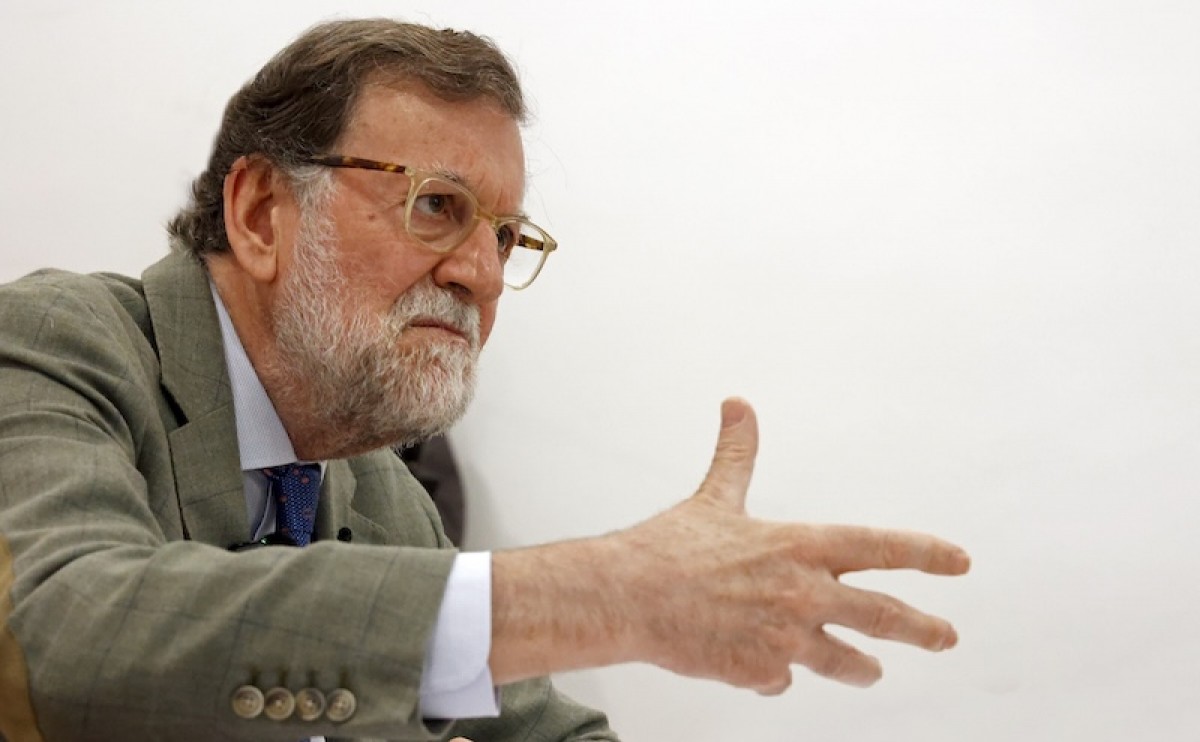
Rajoy considers that the PSOE will need to go into opposition to regenerate after the Ábalos and Cerdán corruption cases. Photo: Vitor Mejuto / La Voz de Galicia
Mariano Rajoy makes use of the office he holds as a former president to attend to a vast agenda of commitments. “I try to attend to all requests that come to me. I am a former president, and I am of those who believe that one must know how to step aside when you are no longer on the front line. And that does not mean I don’t have an opinion about the things that happen. I do. And if someone asks me, of course I will always answer,” he says, relaxed in a room where a copy of his political memoirs sits and a wall is filled with images from his past as head of the government, among them photographs with Barack Obama and Donald Trump in the White House, François Hollande, or the pope Francis, as well as other key moments in his political career. On another wall in the room, a black-and-white group photo gathers the faces of the Galician Parliament members in its first legislature, in which Mariano Rajoy played a prominent role despite his youth.
In the relaxed conversation held in mid-June, Rajoy had time to reflect on the state of journalism with the participants in the gathering. “Journalism is also at a moment of maximum danger due to the polarization that grips politics and that penetrates all layers of society. Journalism runs the very serious risk of journalists being replaced by activists. And that would be very bad for everyone because it would be one more break caused by populisms and would endanger a key element for the control of politicians,” analyzes the former Government president between 2012 and 2018.
You began your successful political career in the Parliament of Galicia. What memory do you keep of those beginnings?
The political experience we had—as most of us there—was very small, and mine was zero. But I remember the enthusiasm I had and the initial steps we were taking. I became General Director of Relations with the Parliament, appointed by the then vice president Xosé Luís Barreiro Rivas (laughter), and I recall that in the early days of Galician autonomy we were able to reach broad consensus on the fundamental issues among all parties.
“Among those members of Galicia’s first Parliament of democracy, there was far more overall level than among the current members of the Congress”
Looking back, and not wanting to argue, I could tell you with pride that among those members of Galicia’s first Parliament of democracy there was a far higher level overall than among the current members of the Congress. Today many debates are reduced to a tweet or a video in which it is impossible to address in depth the essence of the real problems that Spanish society faces. And there are many, besides.
En España se valora mucho la juventud de los políticos. ¿Qué piensa usted de eso?
I believe in the ladder of seniority, and one should not become President of the Government at twenty. My first institutional act was to be part of the age board that initiated the path of the Parliament of Galicia. I was the youngest deputy, at twenty-six, and I accompanied Iglesias Corral, who at eighty was the oldest of them all. But my first political position was in the very Mesa of the Parliament and in the general directorate I mentioned. There I took my first steps and had my first debates, and what I learned there stayed with me for the future. In short, I was in a place where there was a high level, and where there were serious disputes without outbursts.
¿Recuerda alguna anécdota personal?
During the debate on the capital status, I defended the capital status of Santiago, and I faced as an opponent, defending A Coruña, Iglesias Corral, who had already had that same debate with my grandfather in 1934. And after leaving one of the sessions he took my arm and said to me: “Hey, you Rajoys just don’t have a remedy.” He was a smart man with a sense of humor.
En una democracia poco experimentada, ¿fue usted el primero en sustituir las invocaciones a los ciudadanos y los votantes por la directa apelación a “la gente”? ¿Se trata de una deriva espontánea, o tiene algún sentido?
I believe the expression “people” is all-encompassing and more human than political terminology. We are citizens by living in a democracy, but “the people” precede democracy and are present in all regimes. We can be citizens and voters, but we are more than that: parents, or engineers, young or old. And all of that fits into the friendly category of “people.”
¿Por qué Galicia sintoniza tanto con el Partido Popular?
Galician people are—my view—moderate, sensible, and reasonable. They do not demand miracles from the politician, nor do they ask him to stand on his head. What they demand is seriousness, trust, and credibility. Presidents Albor, Fraga, Feijóo, and Rueda were predictable and focused on governing for everyone. That convergence of temperaments should explain a wavelength that has endured for forty years. Rajoy urges caution in the face of the tumultuous geopolitical moment the world is experiencing.
Volando ahora hacia Europa, ¿se acuerda mucho de Merkel?
Yes, I have a very good opinion of her. She was a very pro-European and respected woman, and she studied every dossier. In her convictions she was quite rigid, and that is why she maintained some policies—like controlling deficits and public debt—that imposed heavy sacrifices and cuts on Spain, which, analyzed in retrospect, I think benefited us.
“Merkel was the only one who advised me to do everything possible to avoid Europe’s rescue for Spain, while other colleagues advocated immediate intervention”
She listened to me carefully, and she was the only one who advised me to do everything possible to avoid Spain’s rescue, while other colleagues were advocating immediate intervention. In the end we managed to avoid it, and we relaunched Spain’s growth with excellent results. Because Merkel, without presiding the European Commission, led EU cohesion in very difficult circumstances.
Hace diez años, y dejando a un lado la monótona gestión de la OTAN, nadie creía que la guerra pudiese regresar a Europa. ¿Por qué ahora nos estamos rearmando?
The European Union was born, strictly speaking, to prevent wars. And its success was so great that not only did we witness the collapse of the Eastern bloc of the Cold War, but we also felt that we had begun a path toward the utopia of perpetual peace. But the spectacular failure of the USSR weakened Russia so much that, unable to compete in economic and political terms, it came to long for the militarism of the Cold War. Therefore, Russia is a threat that compels us to rearm, to maintain the strengthened NATO, and to bring the issue of war back onto the EU agenda.
Con la misma extrañeza le pregunto: ¿Hay amenazas reales para la democracia europea?
Europe is essentially democratic, to the point that, if we faced a democratic crisis, the EU would disappear and we would return to the statalist bellicosity of the first half of the twentieth century. Our democracies are not directly threatened by authoritarianism, but we are already noting a serious decline in our democratic quality. And that is why we should activate, as soon as possible, a methodical defense of democracy.
