
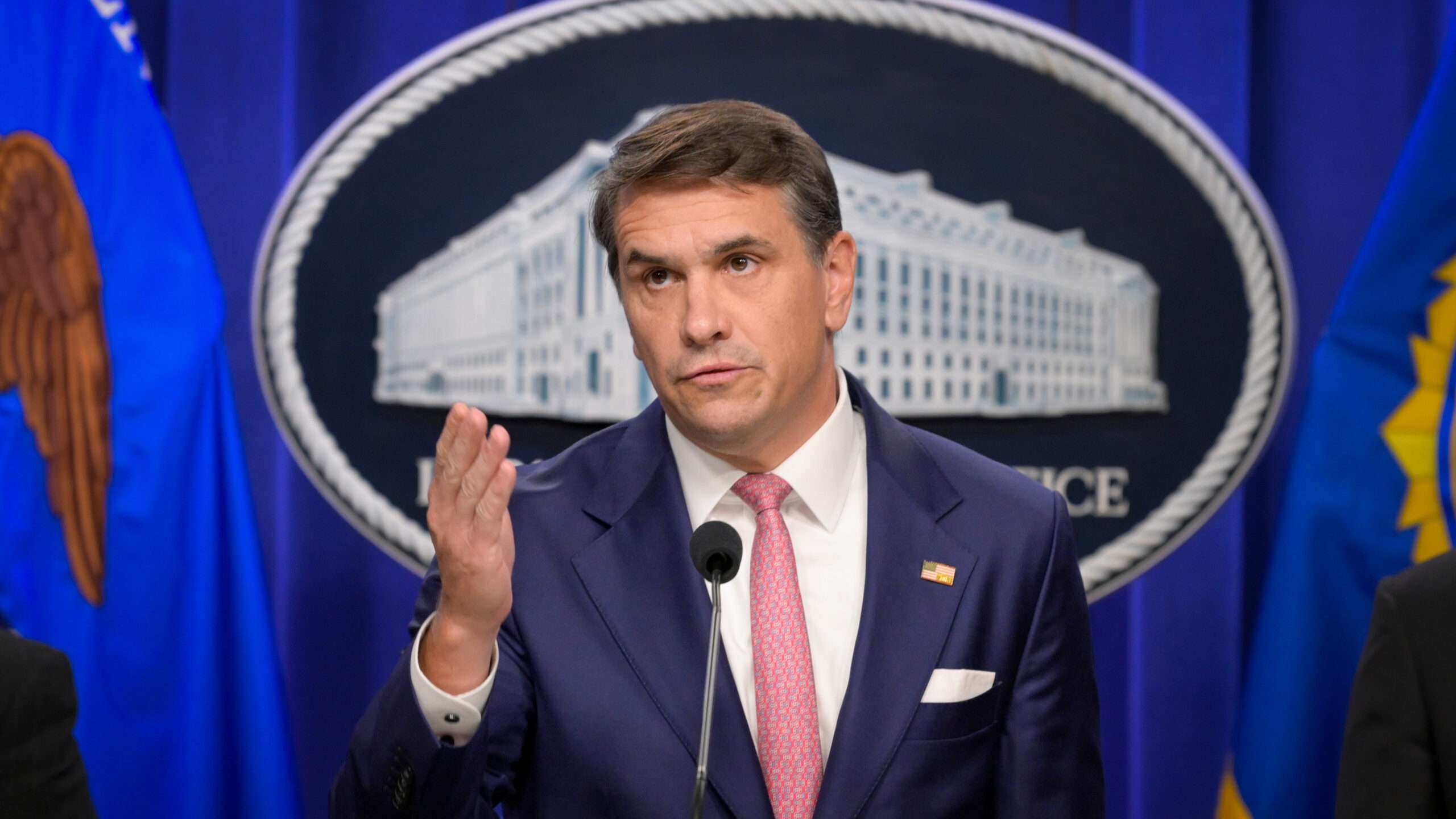
Trump’s nominee for attorney general has repeatedly subverted justice to benefit his boss.
“I’m guessing I’ll be in line,” former FBI Director James Comey quipped after Acting Attorney General Todd Blanche announced a “settlement agreement” between President Donald Trump and the IRS that included $1.8 billion in taxpayer money for targets of “lawfare and weaponization.” Comey’s joke encapsulates two grounds for opposing Blanche’s confirmation as attorney general: a flagrantly unconstitutional prosecution and a nakedly corrupt arrangement that steered substantial favors to Trump, his family, and his followers at the expense of taxpayers.
Blanche’s involvement in both of those schemes demonstrated his eagerness to appease his boss, which explains why Trump nominated him to replace Pam Bondi. Yet that same inclination should alarm anyone who believes the attorney general’s duty is to pursue justice rather than advance the president’s private agenda.
In a scathing ruling issued on Monday, a federal judge described Trump’s lawsuit against the IRS as a pretext for “a ‘settlement’ that had no viable basis in law or fact.” Kathleen Williams, who presided over the case in the Southern District of Florida, concluded that there was never a genuine dispute between opposing parties, since both sides were controlled by the president.
Trump’s suit, joined by two of his sons and the Trump Organization, absurdly claimed that an IRS contractor’s illegal disclosure of their tax returns had caused “at least” $10 billion in damages. Beyond presenting an implausible damage figure, Trump filed the lawsuit more than two years after learning of the leak, exceeding the timeframe permitted by the statute he cited.
That statute guards against unauthorized disclosures by “any officer or employee of the United States.” So even if Trump had filed on time, he would still have to argue that a contractor hired by a consulting firm fits into that category—a point the Justice Department has contested in other cases involving similar claims.
Despite those legal weaknesses, the Justice Department never bothered to challenge Trump’s claims, a sharp departure from the way it usually handles such lawsuits. That failure underscored the evident conflicts of interest created by a case pitting Trump against agencies he oversees, represented by lawyers who also answer to him.
Moreover, a February 2025 executive order bars the government’s lawyers from taking positions that conflict with the president’s. Williams viewed that order, together with the Justice Department’s passivity and Trump’s “direct, unassailable control over Defendants,” as proof that the case had been rigged from the start.
Nevertheless, Blanche approved the resulting “settlement with myself,” which triggered a fierce bipartisan backlash that led him to abandon the “Anti-Weaponization Fund” two weeks after it was announced. That move left intact another element of the cozy deal: Blanche’s order shielding Trump and his relatives from liability for tax violations and any other federal offenses they might have committed, potentially saving the president more than $100 million in back taxes, interest, and penalties.
Even as Blanche pledged compensation for victims of politically motivated government abuse, he was intensifying the problem by pursuing a farcical criminal case against Comey. Blanche claimed that Comey committed two federal felonies by posting a photograph of seashells arranged to spell the slogan “86 47,” which Blanche acknowledged is a common expression of opposition to the president.
That slogan did not remotely meet the constitutional standard for a “true threat,” and it is clearly political speech protected by the First Amendment. Yet Blanche pressed on, arguing with a straight face that Comey’s seashell image justified an 11-month investigation that culminated in an indictment carrying the possibility of up to 10 years in prison.
This case demonstrates Blanche’s willingness to subvert justice to serve the president’s vendettas, and his role in the IRS settlement indicates a readiness to bless a grossly unethical product born of self-dealing. Either circumstance would suffice to disqualify him from the office he seeks.
© Copyright 2026 by Creators Syndicate Inc.
