
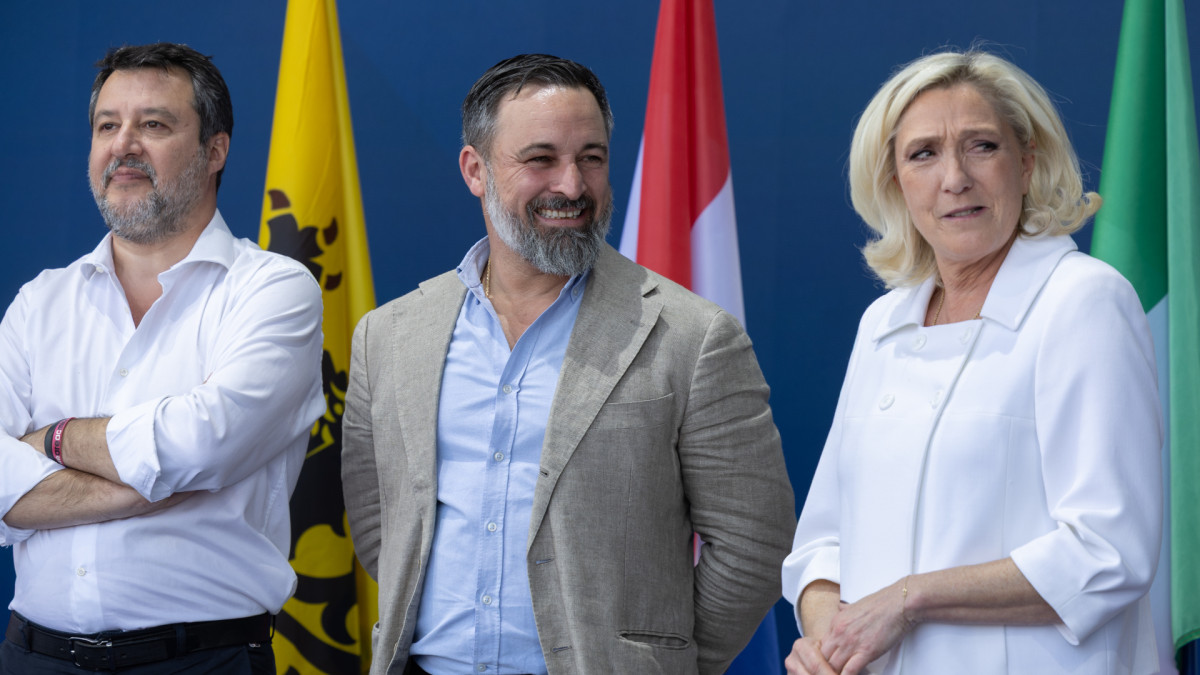
In times as fast-paced as the present, it is common to give in to the temptation of always looking to the future, to what is coming next, and setting aside what is happening in the present. Undoubtedly, it is one of the clearest biases of our era, but the coming year 2027 could be so anomalous in political terms that it warrants analysis now. 2027 could be the year of radical right in Europe, both qualitatively and quantitatively. France, Spain, and Italy will go to the polls with strong chances that, after the elections, a radical right party will be in the government, either as the main party —France, Italy—, or as a minority partner —Spain—.
In this scenario, there are not a few chances that Paris, Madrid, and Rome vote within just a few months of one another. France has defined its elections, with the second round of the presidential election scheduled on May 2. In Spain, although Pedro Sánchez could push the legislature into the summer, the political calendar increasingly points to an early election in the first months of the year, with February or March being very probable dates. Finally, in Italy there has been talk of bringing forward elections to April so they do not coincide with the budget negotiations’ deadline, although there are many odds that voting will occur after the summer.
“France, Spain and Italy will go to the polls with strong chances that, after the elections, a radical right party will be in the executive”
In any case, we are talking about a six to seven month window in which three of the four major European economies could tilt—or maintain the tilt, in the Italian case—to the right. Moreover, it would be the first time since Spain’s Transition that the governments of these three countries and Germany would sit to the right. In other words, the four major economies of the European Union could be in the hands of Christian democrats and the radical right, with the nuance of a minority presence of social democrats in the German government.
What could happen in France, Spain and Italy
As we know, the balance of power can shift in any of the three countries. In France, although Marine Le Pen currently tops the polls, various surveys identify Jordan Bardella as a more competitive candidate. His designated successor seems capable of uniting broader segments of the population and generating consensus particularly useful in a second round. Moreover, if the Court of Cassation confirms the ruling in time, Le Pen could be forced to wear an electronic bracelet during the electoral campaign. For all of that, France remains an open field: although the radical right could reach the Élysée, a moderate candidate like Édouard Philippe, from the centrist-right Horizons party, could still win. Others like Jean-Luc Mélenchon, a name to watch in the first round, would be far less competitive against Le Pen or Bardella, given that they are polarizing candidates without a broad electoral base. A person positioned on the left might vote for Philippe, but a centrist-right moderate would have many more problems voting for Mélenchon.
In the case of Spain, we are faced with an electoral and negotiation mystery. With the exception of the CIS, most polls today give a majority of seats to the sum of the PP and Vox. And, although there are arguments to believe that these two parties would be closer to a tight result rather than reaching two hundred seats, it is important to look a little further. The autonomous community cycle, which has also served as a new test ground for rapprochement between traditional right and radical right, has shown that Génova is willing to reach political agreements with Bambú even if it has to concede ground on the discursive front. The clearest example is the so-called “national priority”.
“For the first time in recent history, the four major economies of the European Union could be in the hands of Christian democrats and the radical right”
But here the most decisive thing is to think about how Alberto Núñez Feijóo and Santiago Abascal could sit at a negotiation table. In the PP they believe this will depend largely on the arithmetic of seats. That is, if the Republicans move around 150 or 160 seats —a scenario very hard to imagine today—, Vox will not be able to demand entry into the government. Yet it has already been seen that in Andalusia, despite being only two seats short of an absolute majority, Juanma Moreno Bonilla has needed to grant a vice presidency to Abascal’s people and to accept the “national priority” that he himself rejected during the campaign. Therefore, not only is it not guaranteed that Spain will swing to the right, but it will also not be easy for the two main parties of the bloc to reach a nationwide agreement.
Finally, in Italy the situation is somewhat similar to the Spanish one. Meloni exercises a much more determined leadership than Feijóo, but the Roman leader will have to reach an agreement with a new leader of the radical right if she wants to renew her mandate. Roberto Vannacci, an Italian general, has drawn a substantial portion of Matteo Salvini’s League electorate, and his party, Futuro Nazionale, has placed itself in a position that could make it indispensable for forming a new right-wing majority. Moreover, on the left, Elly Schlein, leader of the Partito Democratico, has made considerable advances in reunifying this space, and there are polls that place the left alliance ahead of the right bloc.
All in all, the battlefield will be very different if Meloni succeeds in pushing through her electoral proposal, which includes a seat bonus designed to guarantee parliamentary majority to the most voted coalition if it surpasses 42% of the votes. Of the three countries, Italy may be the one with the most uncertainties at the moment.
“Not only is it not guaranteed that Spain will swing to the right, but it will also not be easy for the two main parties of the bloc to reach a nationwide agreement”
Although we are talking about elections that are still open, this scenario does not come from nowhere. Here the question is not so much “what can happen” as “what happened for this to be possible.” At different paces and with different dynamics, the radical right has been emerging in several European Union countries to occupy significant governments, but never before has a situation like 2027 presented itself. If it manages to enter or remain in the executive branches of the major European economies, it will not be by coincidence.
The role of traditional parties in the growth of the radical right
The truth is that there is no easy recipe to implement that stops the electoral rise of these parties. One of the few paths that has managed to erode them is their time in government. However, as political science professor Elias Dinas explains, this comes with an implicit cost: the normalization and institutionalization of the radical right. Governing can expose its contradictions, but it can also definitively turn it into a legitimate option for increasingly broad segments of the population.
The role is especially difficult for traditional parties. A significant share of the responsibility for the proliferation of the radical right falls on them. Left and right share an inability to respond to certain citizen demands. In fact, it could be said that in many cases even the initial step fails: listening and understanding the political moment.
“Governing can expose the contradictions of the radical right, but it can also turn it definitively into a legitimate option for broader sectors”
A few days ago, political scientist and journalist Estefanía Molina commented in a segment of Agenda Pública that progressivism must enter the debate on the generational gap because it could not—or should not—allow Vox to own that space. I think that diagnosis should be extended and understood more broadly. The “national priority” is a measure with racist essence, but a large portion of the citizenry supports it because they see it as a response —the only response— to a matter that other parties do not want or know how to answer. If there is a concern that finds no answer from the establishment, whoever manages to name it on the table gains an advantage, even if the resulting solution is counterproductive, as is the case.
I place special emphasis on traditional parties because I think the error is twofold. Not only are they failing to understand and channel the citizens’ demands, but in many cases they marginalize those who deviate from the party’s classic discourse and confront the problems head-on. The clearest example is Zohran Mamdani. The mayor of New York faced the entire Democratic Party apparatus and demonstrated that Andrew Cuomo and other candidates favored by party elites offered only stale and distant proposals from current demands. He won, and his victory has opened space for other Democrats distant from the party’s majority current.
In Madrid we are seeing a similar example with Enma López. Her candidacy offers clearer and closer-to-current-demands answers than Reyes Maroto, the option that represents the continuity of the apparatus and is backed by Moncloa. Just like in Mamdani’s case, resistance within the party itself to those who try to alter the established discourse appears. We can surely think of other examples, also on the left of the PSOE and, of course, beyond Spain.
If 2027 isn’t the year for a rethink of traditional parties, it will be the year of the radical right. And it’s likely it will be, but it’s better to start late than never.
