
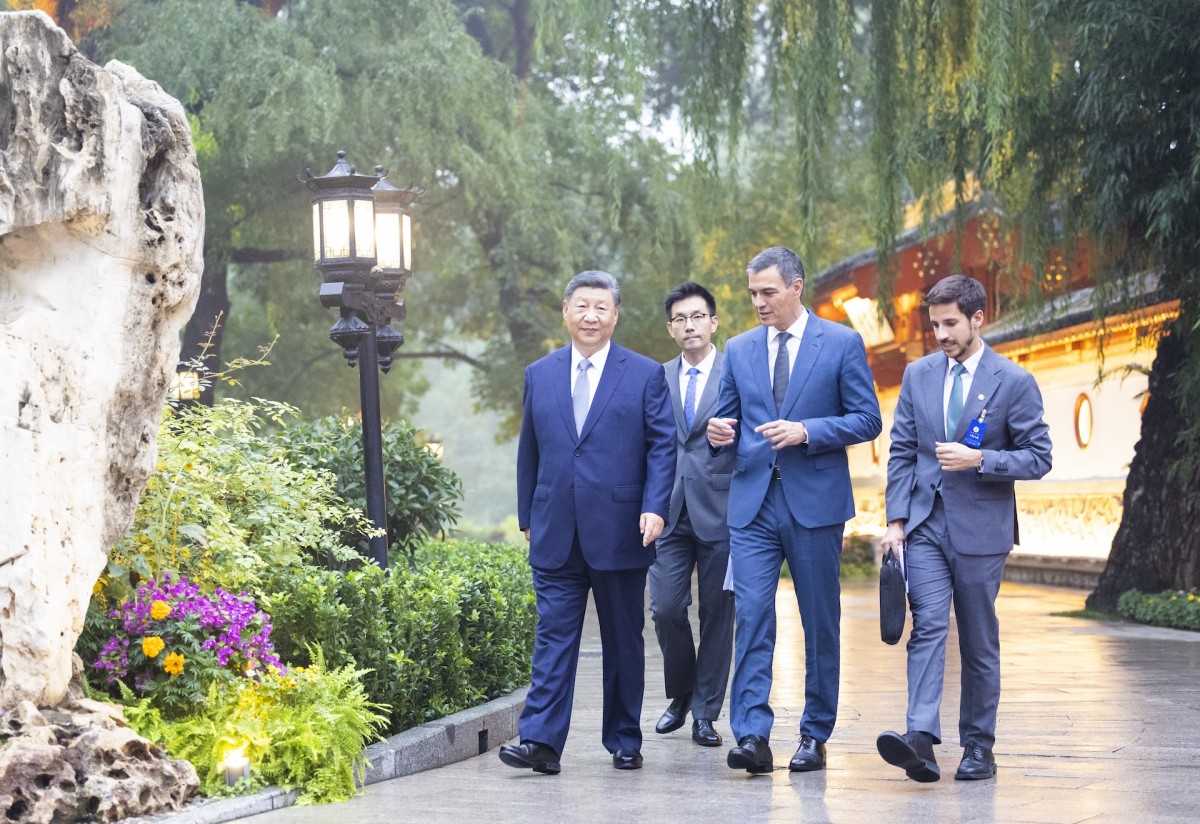
The announcement that the European Union would impose tariffs on the import of Chinese electric cars last July has sparked a frenzied round of meetings with President Xi Jinping, largely during visits to China by the continent’s top leaders. In the agenda, the top priority in all cases has been to foster European strategic autonomy with each member state contributing to its relationship with China, beyond the collective EU view. The case of Spain’s president, Pedro Sánchez, on his second visit to the Asian country in less than two years has not been different.
The export of Chinese cars to Europe marks a new chapter in the frictions Brussels and Beijing will have to face against a China that overwhelmingly dominates the supply chain, the key raw materials for the digital transformation and the energy transition, and that also leads not only the development of the most important green technologies but also the production capacity. A possible trade war looms on the horizon, although the willingness of both sides to avoid reproducing Washington’s scenario, which has waged a trade war for more than six years with no apparent results, seems to foreshadow a new approach with outcomes still uncertain.
The clock is ticking before the final decision that all member states must take by the end of September on whether to impose or not the tariffs proposed by the European Union on Chinese electric cars for the next five years. It will require 15 of the 27 member states to agree, bringing into play European strategic foresight, but also the debate over what measures the EU will adopt to level the playing field in trade with China. A sequence of retaliations imposed by the Asian giant in response to the proposed tariffs on electric cars, which, in the case of Spain, affects pork producers.
“The balance continues to tilt toward the Asian giant, with Chinese brands already reaching 11% of the European electric car market”
Meanwhile, imports of Chinese electric cars into Europe have not stopped growing, just as Beijing’s insistence that the weight of its EV industry should guide the relationship with the European Union during a period when Europe is beginning to define its strategic autonomy has remained firm. The crossroads are laid bare. To bet on European decarbonization with China as the main supplier, or to energize digital industrialization and the manufacturing capacity of green technologies, enabling Europe not to have to relinquish the podium of powers with production capabilities that will be in high demand in the coming decades.
The balance continues to tilt toward the Asian giant, with Chinese brands already reaching 11% of the European electric car market, as exports accelerate ahead of any additional tariffs being set. A distinctive feature is BYD’s Explorer No.1, the vessel owned by the leading Chinese electric car brand, capable of transporting up to 7,000 units, which docked at Santander port in late August to unload up to a thousand units destined for the Spanish market, where it will not be its last landing.
While the dispute over tariffs on electric cars will continue to shape the EU–China relationship, the European leaders’ visits to Beijing deepen the aim of balancing the trade relationship while simultaneously building strategic autonomy. Although only by reducing the deficit in green-technology manufacturing infrastructure can Europe balance the relationship and perform a globally competitive commercial role.
“European leaders’ visits to Beijing deepen the objective of balancing the trade relationship while building strategic autonomy”
In this line comes the agreement signed with Envision during Sánchez’s visit to Beijing, guaranteeing an investment of 1.0 billion dollars to build infrastructure for green hydrogen production available from June 2026, and which materializes thanks to Spain’s potential in wind and solar energy, the essential basis of the production process. A partner, Envision, with whom Spain had already signed the construction of a battery gigafactory for electric cars two years ago and with whom an irrevocable industrial transition toward green technologies that will shape Spain’s future competitive capacities is being launched.
The final decision on the tariffs will depend on whether the member states ultimately maintain the same criterion as in the advisory vote. Italy, France and Spain chose to back it, while Germany, Finland and Sweden abstained. A moment to verify whether China’s gambit of delaying the industrial capacity linked to electric cars meets its objectives, just as the Draghi report suggests a public and private investment of more than 800 billion euros annually, proposing a model of greater joint indebtedness. Regardless of the agreed formula, only greater investment will sustain the European Union’s global role.
