
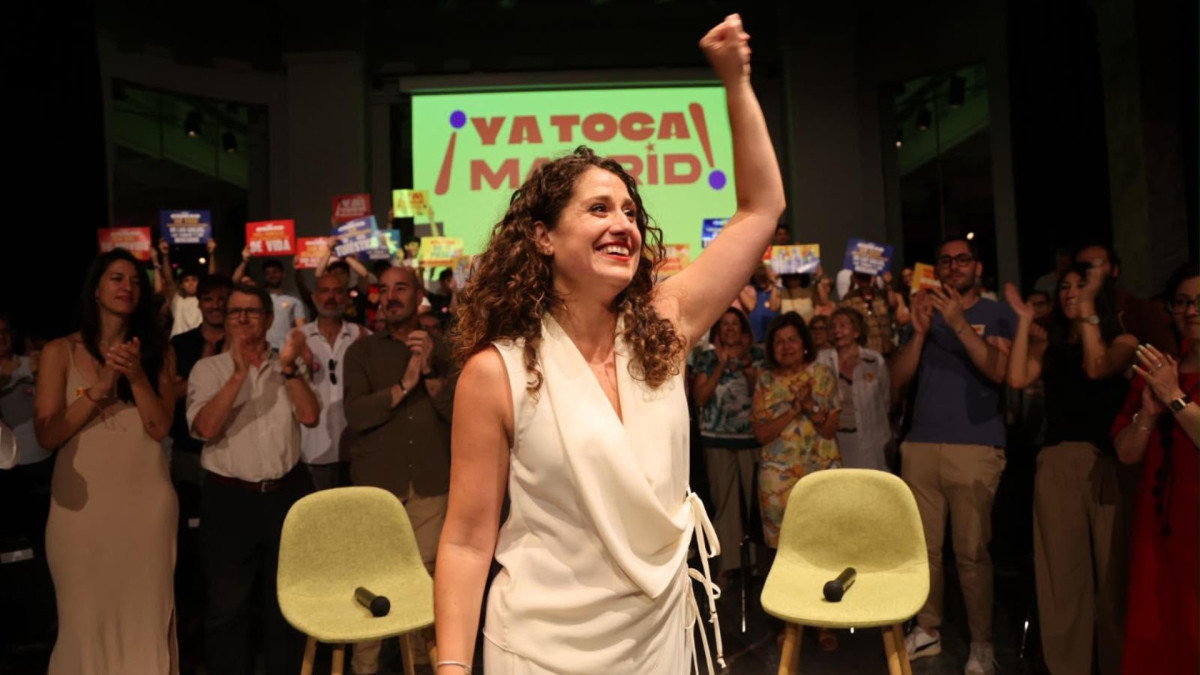
This Sunday, July 19, the PSOE primaries will decide who will lead the Socialist candidacy for the Madrid mayoralty in the 2027 municipal elections. Reyes Maroto arrives with an advantage in endorsements: she gathered 1,376 compared to Enma López’s 1,028. However, since this is a direct, secret ballot, that initial backing alone does not allow predicting the outcome.
In the hours before the vote, Agenda Pública has exclusive access to López’s decalog. The document consolidates 35 proposals organized around objectives such as “having time,” “live and not just survive,” and achieving that “culture is lived in every neighborhood.”
Beyond reproducing the text in full, Agenda Pública has asked four specialists in different aspects of cities to analyze her proposals: Miguel Álvarez Martínez, a road, canals and ports engineer and the Mobility Director of the City Council of Rivas-Vaciamadrid; Isabela León Cesín, an architect and head of decarbonization public policies at ECODES; Fernando Caballero Mendizábal, an architect, urbanist and author of Madrid DF; and Jesús San Vicente, an architect and director of NEXO COAM.
A city you can afford
- Build, renovate, and densify: promote industrialized public housing to shorten construction and delivery times; rehabilitate vacant flats and expand buildings to incorporate new public housing.
- Create affordable student residences and care-enabled housing for older people within their own neighborhoods, reducing rental pressure and preventing uprooting.
- Advance energy communities, solar panels, and thermal rehabilitation so that turning on heating or air conditioning isn’t a privilege.
- Move toward a city without tourist-use housing, reclaiming those properties for residential use.
- Ensure affordable housing so that people who lose their jobs, go through a separation, or experience a sudden change can keep access to a home without being expelled from Madrid by their new financial situation.
- Remove urban barriers that degrade and divide neighborhoods, starting with the Puente de Vallecas “scalextric.”
A city where you have time
- Rethink and update the bus network using mobility data and maps, replacing overly long routes with many stops by those that connect each neighborhood to where residents actually go, not just to the center.
- Strengthen EMT (bus system) with the drivers and buses needed, improving frequencies and connections between neighborhoods so that public transport becomes a faster and more comfortable alternative to the car.
- Create a continuous network of safe, interconnected bike lanes so cycling ceases to be a dangerous option or one reserved for the most daring.
A city to live in, not just to survive
- Advance toward a genuine decentralization of the City Hall, giving districts more budget, powers, and decision-making capacity over services that affect daily life.
- Promote cleaning contracts that are smaller, manageable, and controlled from each municipal board, with effective inspection mechanisms and fines for contractors who fail to comply.
- Green streets and squares, increase shade, and extend climate refuges by incorporating fountains, water zones, splash areas, and more municipal pools and facilities, especially in neighborhoods with fewer green spaces.
- Guarantee that heat does not force anyone to leave their own home, through subsidies for climate control and thermal renovations, solar panels, and energy communities that enable turning on air conditioning without fearing the bill.
- Reclaim municipal markets and local commerce as essential elements of neighborhood identity, economy, coexistence, and safety.
- Avoid a top-tier and a lower-tier market, ensuring municipal investment and specific recovery plans for those that face more problems or have more than half of their stalls vacant.
- Promote a model of proximity safety and emergency services, boosting coordination among Municipal Police, neighborhoods, Fire Department, SAMUR, Civil Protection, social services, and district boards.
- Promote foot patrols by police, especially in commercial and crowded areas, and incorporate bike patrols in parks and green spaces of the neighborhoods.
A city where culture can be lived in all neighborhoods
- Foster an accessible “ReMovida” cultural movement with stable programming across all districts and not limited to the center or to large events with inaccessible tickets.
- Open municipal spaces and circuits to Madrid creators, providing venues, programming, and opportunities to showcase their work in all districts.
- Balance major events with residents’ rest by establishing clear conditions and agreements among residents, promoters, and the City Hall.
A city that gives back, not only asks
- Create a sufficient network of public, free child care centers, ensuring dignified working conditions for their staff.
- Facilitate work-life balance with more public childcare centers and a municipal program guaranteeing school meals, funded with 50 to 60 million euros annually, ensuring free meals for all children from vulnerable families, expanding aid to middle-income households that currently miss out, and maintaining the service during school holidays.
- Develop neighborhoods that combat unwanted loneliness among youth and seniors by strengthening gathering spaces, community activities, and local support networks.
- Promote shared housing and intergenerational living as a social service to fight loneliness, not as a speculative real estate product.
- Encourage a sense of neighborhood belonging and strengthen community associations by providing spaces, resources, and meaningful participation in municipal decisions.
A city where equality opens the way
- Progress toward true gender equality, reducing gender gaps and fighting discrimination and violence that women still face.
- Incorporate a gender perspective into urban planning, mobility, and security, designing public spaces, routes, and services that are safe and accessible for women.
- Identify and address areas where women perceive or experience greater insecurity, creating maps and targeted actions with the participation of women neighbors.
- Keep Equality Spaces and specialized resources for gender-based violence separate, avoiding the fusion of services that address different needs and roles.
A city in which all people fit
- Avoid barriers that exclude those who live in Madrid, such as restricting certain aids or transport passes solely by residence criteria when many people work or study in the city but cannot afford to live there.
- Strengthen the centers and municipal welcome services for migrants arriving in Madrid.
- Expand public Spanish courses, guidance services, and social, educational, and employment integration programs.
- Increase municipal support for Pride and maintain a visible, permanent institutional commitment to LGBTI+ rights.
- Extend LGBTI+ services and programs to all neighborhoods, adapting them to each district’s needs and strengthening the prevention of harassment, discrimination, and hate speech.
- Enhance residential resources and temporary housing for LGBTI+ people facing vulnerability, violence, or family exclusion.
The public transport and political communication
Miguel Álvarez Martínez, a road, canals and ports engineer and Mobility Director of the City Council of Rivas-Vaciamadrid
Las medidas son esencialmente las que cualquier técnico te recomendaría. Se podrían añadir otras medidas, pero el grueso de palancas para mejorar el transporte sostenible es ese y está comprobado en multitud de ciudades que funciona. Es más, la mayoría de esas medidas particularizadas para Madrid ya están desarrolladas en planes que duermen en algún cajón.
El reto no es técnico: es político y de gestión, y tiene muchas dimensiones.
La coordinación es fundamental: por poner un ejemplo concreto, de nada sirve que el área de Movilidad planee una red de carriles bus impecable si Obras no los ejecuta en plazo, Policía no vigila que se respeten o Cultura decide cortarlos en cada evento que ocurre en la ciudad. Cualquiera que quiera lograr transformaciones reales tendrá que asegurarse de que todas las áreas entiendan que, aunque el transporte público no sea estrictamente de su competencia, sí debe ser de su incumbencia y una prioridad propia. Además, en el caso de Madrid, hay competencias que están cedidas al Consorcio de Transportes, dependiente de la Comunidad de Madrid.
The timing is key. Cada paso en la administración lleva tiempo y muchas veces las medidas no llegan a ver la luz por acumular retrasos en cada informe preceptivo, en cada fase de tramitación. There must be continuous oversight, in a four-year race against the clock.
“Technical knowledge is in the administration, but the grounded local knowledge lies in the people who live in and use each neighborhood, and both are needed to achieve good results”
Participation is also essential: changes of substance made behind the back of the citizens are likely to fail. The technical knowledge is in the administration, but the grounded local knowledge lies in the people who live and use each neighborhood and both are needed to achieve good results. We must rely on existing participation structures or create new ad hoc ones from the start, incorporating the proposals that come from them. Moreover, any change takes time before the benefits are tangible and initially requires adaptation and habit-shifts. Communication is key so that people understand why and for what purpose things are done.
A city that fights heat and supports the climate transition

El decálogo plantea un modelo de ciudad que conecta la transición climática con la vida cotidiana de Madrid: propone comunidades energéticas, placas solares y rehabilitación junto con refugios climáticos y más vegetación en calles y plazas.
Seen from urban planning, the most valuable thing is that it treats thermal comfort —in winter and summer— as a condition of livability, not a luxury. And it is right not to separate these fronts: an well-insulated building needs less energy, and a city with more shade and vegetation reduces the cooling demand of its buildings. That holistic view is especially needed in Madrid, identified by an Arup study (2022) as one of the most intense heat island hotspots in Europe, with surface temperatures in the center up to 8.5 degrees higher than the periphery.
“The most valuable thing is that it treats thermal comfort —in winter and in summer— as a condition of livability, not a luxury”
That condition is not equally distributed among neighborhoods, and here the decalog is right to link heating subsidies with the guarantee of affordable housing: each August, a part of Madrid empties because those who can afford to go to cooler places leave, while those who cannot stay in housing that is poorly prepared. The proposal to rethink the bus network to connect neighborhoods with each other rather than only to the center moves in the same direction: the same center-periphery gap intensifies the heat island and penalizes mobility.
C losing that gap requires something that the decalog does not develop: data that allow prioritizing investment where it is needed, rather than distributing it evenly. Knowing which buildings are most vulnerable and which neighborhoods concentrate the greatest risk is what is missing to move from intention to effective policy. Budgetary concretion will come later; the important thing is that the starting logic is not focused only on individual actions, but on a long-term vision.
“A city that takes care is not the one that patches every cold snap or heat wave with quick fixes, but the one that decides, using data, planning, and investment, what city it wants to be in thirty years”
Ultimately, this is the challenge: it is not enough to aggregate good, isolated measures; they must be coordinated under a single city-wide vision. A city that takes care is not the one that patches every cold snap or heat wave with quick fixes, but the one that decides, using data, planning, and investment, what city it wants to be in thirty years, and manages to implement it without leaving anyone behind.
The social-democratic recipe right, but with a revenue problem
Madrid is the heart of a metropolitan region of more than seven million people. Only the capital’s municipality has a population comparable to a country like Uruguay. Our great challenge is to make the global flows to which we are linked positively influence us to maintain and strengthen a cohesive civil society. It is not an easy challenge. Consolidating polycentrism by giving more economic power to our districts implies a structural, interesting, and risky change in our form of governance. It is not without risks, but it can help highlight the particularities and identity of each district; it is consistent with the subsidiarity principle that seeks to bring decisions closer to residents and adapt them with agility to their needs.
“Attending the small scale —markets, safety, greening, cleaning, and neighborhood cultural activities— aligns with the best practices of European social-democratic city councils”
The challenge is, obviously, the budgetary constraint it entails. The resources that go to the districts cannot be allocated to general city-wide strategies —such as housing—, or they must be delegated through the district boards. In any case, attending the small scale —markets, safety, greening, cleaning, and neighborhood cultural activities— is, to date, coherent with the best practices of European social-democratic city councils.
Nevertheless, some considerations are worth making, especially if the City Hall intends to transfer so much budget to the districts.
The administration will need to raise more. Therefore, the competition with Más Madrid’s populism should not be about more populism, as is the case with proposals to end all tourist housing instead of regulating them with pragmatic and intelligent measures. In that sense, I miss a mention of a tourist tax, which in cities like Barcelona already represents one of the largest municipal incomes.
The argument, also populist, that Madrid is expensive bothers me, so registered Madrilenians should pay for the public transport of those who do not live in Madrid or live there but are not registered, which, by the way, is a civic obligation. Certainly, it will also be difficult if so many resources are directed to the districts.
As for housing, Madrid is already the city hall building the most social housing in Spain and pushing densification the most, so there is little new to do in that regard beyond expanding public-private collaboration, precisely through densification. Constructing each unit of social housing costs around 150,000 euros. Do the math on how many are needed. How do we pay for them?
Finally, the grand public project of the legislature is expected to be the demolition of the Puente de Vallecas. If she reaches the mayoralty, that project has the potential to derail a potentially successful term.
It is important to study its budgetary and technical feasibility. Both aspects are likely to be extremely costly, given that it involves a complex operation, including crossing an underground stream and the junction with the tunnels of the M-30…
If not carried out, it will disappoint her electorate. But, if it is demolished, one must ask whether its removal might trigger a rapid wave of gentrification across the entire district. A remedy that would be worse than the disease.
Tax sticks against speculation and a carrot for those who need a home to live
Jesús San Vicente, architect and director of NEXO COAM
Creo que la propuesta de Enma es la de una ciudad pensada para habitarse con dignidad, no para convertirse en objeto de especulación. Más vivienda pública, más movilidad sostenible y más espacio público de calidad, con una mirada social, climática y de barrio.
In terms of public housing and the right to remain, the proposal places public housing at the center of urban policy, advocating for building, rehabilitating, and densifying with industrialized housing to accelerate timelines and expand the affordable housing stock. It calls for reassigning EMVS’s responsibility to create a public housing stock that acts as a counterbalance to speculative voracity. It also calls for reclaiming vacant flats, converting tourist-use housing, and preventing the displacement of neighbors. From an architectural and urban planning perspective, this means stopping treating housing as a financial asset and recognizing it as basic city infrastructure. Tax sticks against speculation and carrots for those who need a home to live.
Regarding public mobility and city connection, Madrid is a city hostile to pedestrians and cyclists. It runs counter to cities like Paris, which leveraged the pandemic to transform a mobility model. We must continue a network of safe, connected bike lanes designed not as isolated elements but as a system of urban mobility that reduces car dependence and helps decarbonize the city. This vision is coherent with a city that is more efficient, less polluting, and better integrated territorially.
“Madrid is a city hostile to pedestrians and cyclists. It runs counter to other cities like Paris, which used the pandemic to transform a mobility model”
On the matter of public space and climate comfort, Enma emphasizes re-greening streets and squares, increasing shade, and extending climate refuges with fountains, water features, splash zones, and municipal amenities. This line is especially relevant in neighborhoods with fewer green areas, where public space must function as a place to stay, rest, and shield against extreme heat. From an urban planning perspective, this means shifting from a city of transit for tourists and large events to a city of permanence, where the shared space regains value against privatization of uses and vehicle dominance.
Regarding the proposal for “a friendlier and less privatized city”, we need a city that is closer, more legible, and less hostile, where public space is no longer subordinate to private interests and returns to organizing everyday coexistence. Taken together, the proposal sketches a Madrid more livable, climate-resilient, and socially just.
Finally, in terms of high-quality public architecture, the proposal should be accompanied by high-quality, contemporary public architecture, capable of turning housing, facilities, and public space into design benchmarks, sustainability, and urban identity.
Madrid must reclaim a tradition of exemplary public works, well designed, useful, and recognizable over time. For that, the talent of architects abandoned by the current PP government must be utilized. Since Madrid Río, not a single building or park has been created that we Madrilenians can be proud of.
The slab of the M-30 will be a tombstone burying our taxes to achieve nothing.
Architecture can make Madrid a fairer, more livable, and more cultured city.
