
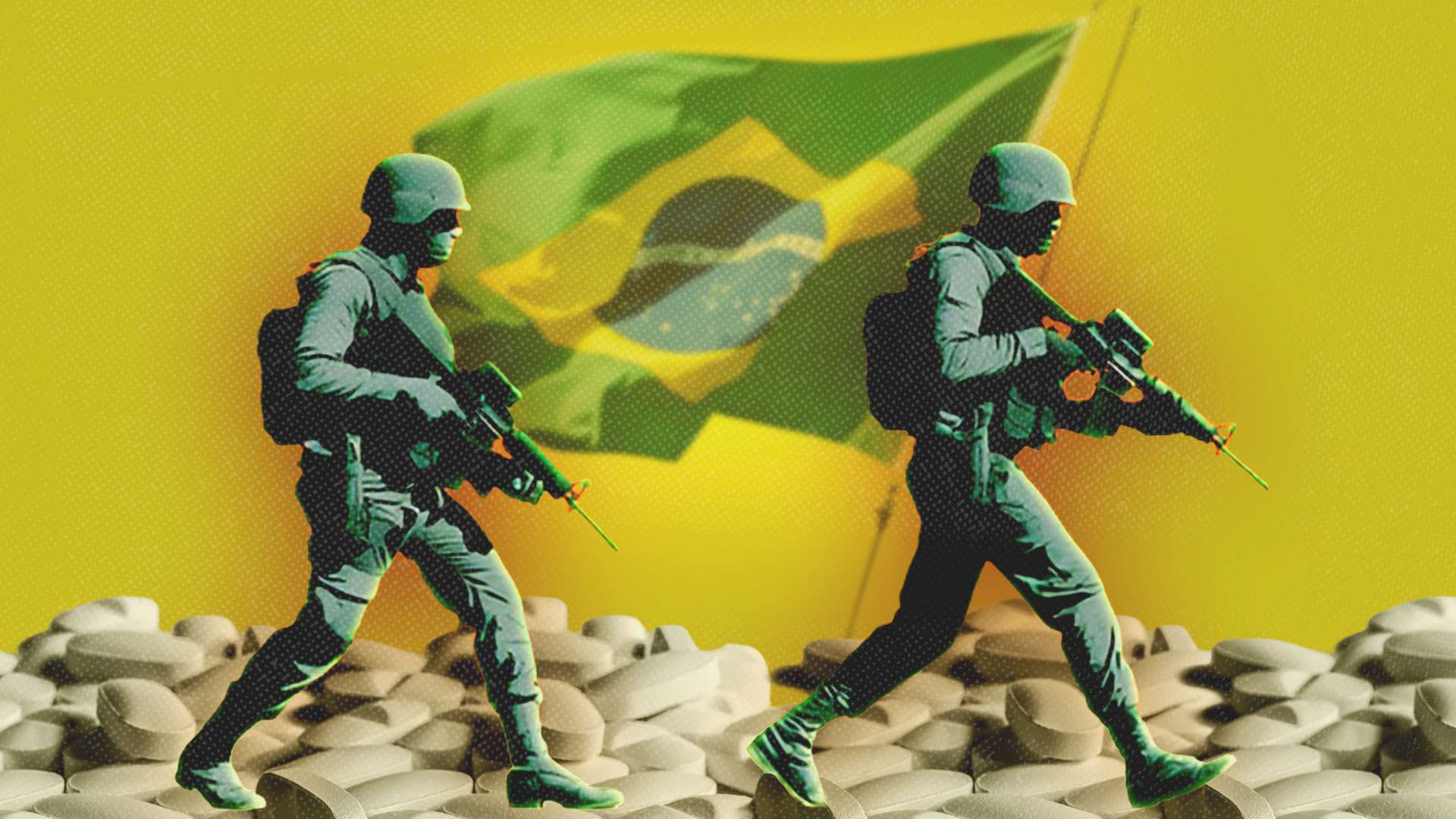
Brazil’s gangs illustrate why the term “narco-terrorist” is appealing, yet misleading, and unlikely to curb drug trafficking.
Across most nations, gang warfare tends to operate from the shadows. Law enforcement collects the bodies, prosecutors stage press conferences, and anyone who avoids the news can simply pretend nothing is happening. In Rio de Janeiro’s favelas, the violence can resemble a conventional war more than typical street conflict: territory shifts hands, armed sentries patrol the hills, and teenagers in flip-flops parade with rifles that look far beyond their age.
“In Rio, there are three principal factions [gangs],” explains Fabio Serra, who goes by the nickname Sagat B. “We own a lot of guns, but most of them are used against one another over space. If the police arrive, we’ll engage only if there’s no alternative—the shooting is mainly to cover our retreat.”
Sagat once ran a crew of drug dealers. “I was sharper than the others and pretty adept at handling numbers, so I managed both the logistics of selling drugs and the procurement of weapons and ammunition,” he recalls. At the time, he was connected with Brazil’s two most formidable criminal organizations: Rio’s Red Command and the Sao Paulo–based First Capital Command (PCC).
After serving three prison terms totaling twelve years, Sagat left criminal life behind. He has since become an author, podcaster, barbershop owner and advocate against crime. Yet his former comrades appear as targets within a much larger campaign: the Trump administration’s push to recast drug gangs as terrorist organizations and drug trafficking as war.
Since taking office again, President Donald Trump has intensified his war on what he calls “narcoterrorists,” treating drug smuggling as an “armed attack” and blurring the line between policing and warfare. His administration has described foreign drug cartels and other criminal networks as “non-state armed groups” or “unlawful combatants,” terms that were introduced during the Bush era to strip suspected terrorists of protections under the Geneva Conventions.
In August of the previous year, Trump signed a clandestine directive authorizing military strikes against narco-terrorists. By September, U.S. forces were alleged to have bombed drug-smuggling boats in the Caribbean. In December, the administration followed with an executive order declaring fentanyl a weapon of mass destruction, arguing it could be “weaponized for concentrated, large-scale terrorist attacks by organized adversaries.”
“I figure we’re just going to kill the people who are bringing drugs into our country,” Trump said.
The narco-terrorist label continues to expand. In May, the State Department added the PCC and Red Command to its terrorism blacklist, designating them as foreign terrorist organizations. But what has that accomplished for controlling drugs?
Why the Terrorist Label Changes What the U.S. Military Can Do
The label matters because it redefines the tools available to the U.S. government. A drug trafficker is typically treated as a criminal suspect. A terrorist can be pursued as a military objective. That shift—from policing to warfare—stands at the core of Trump’s new drug strategy, though the idea of treating cartels as terrorists had been gaining ground for years.
The impulse gained traction after cartel gunmen killed nine American women and children from a Mormon community in northern Mexico in 2019. The struggle with drug overdoses in the United States intensified as the 2020s unfolded, with annual deaths exceeding 100,000. The late Senator Lindsey Graham even likened Mexican cartels to terrorist organizations like ISIS and Al Qaeda.
The PCC demonstrates why the label can be appealing—yet also why it can mislead. The group arose in the aftermath of the Carandiru prison riot of 1992, which ended when the military police stormed the facility and killed 111 inmates. The PCC evolved into a crime syndicate, but it also functions as a prisoners’ rights advocate and a support network for families. Its anti-establishment rhetoric resonates with alienated young inmates, particularly Afro-Brazilian communities that are disproportionately imprisoned in the war on drugs.
“When I first arrived in prison, I feared being subjected to abuse for no reason,” Sagat remembers. Instead, he says, he was handed a rulebook. Inmates were barred from abusing each other, disputes were settled by a commission, and guards were to be treated with respect as long as they treated prisoners with dignity. “That’s why the prison environment didn’t explode into chaos,” he notes. “We stood together against the authorities.”
Yet PCC rules did not erase violence entirely, and when prison authorities resorted to torture, Sagat says, “the situation spiraled out of control, claiming lives among inmates and guards alike.”
While the PCC clings to a rough ideological frame—prisoners’ rights, mutual protection, and resistance to abusive state power—it is also capable of extreme violence. In May 2006, the group put Sao Paulo, South America’s largest city, into gridlock with coordinated assaults on police stations, buses, banks, and public buildings, while prison riots erupted across the state. In those four days, 39 police officers and prison guards, and four civilians, were killed.
“They use terror as a tool now and then,” notes Marcos Alan Ferreira, an associate professor at the Federal University of Paraíba. But he adds that they prefer other methods since violence tends to provoke a stronger state response.
In the weeks following the Sao Paulo attacks, police death squads reportedly executed more than 500 people, including many innocent bystanders from the city’s poorest neighborhoods.
Nevertheless, Ferreira argues, the PCC’s central aim isn’t political reform. “Their ideology centers on economic gain,” he says, “primarily trafficking drugs but in recent years expanding into environmental crimes in the Amazon, like illegal mining or logging.”
That profit motive has helped propel the PCC to become Brazil’s largest gang, with more than 100,000 members and affiliates, and a key player in the transatlantic cocaine trade alongside Italy’s ‘Ndrangheta mafia. “This is far from Islamic terrorism or any other group that uses fear to pursue political aims,” Ferreira states.
Their counterpart in Rio, the Red Command, emerged with more explicit ideological roots. In the late 1970s, left-wing militants were imprisoned alongside ordinary criminals on Ilha Grande, Brazil’s version of Alcatraz. The militants brought revolutionary theory; the criminals brought practical know-how in robbery, smuggling, and city violence. By the 1980s, the cocaine trade had expanded, favelas had become ready-made markets, and the Red Command shifted from stealing for revolution to working as a conventional gang.
“Terrorism isn’t the right word, because even though the factions are extremely violent, there has never been a serious intention to topple the government for a new regime,” Sagat contends.
But once Washington attaches the label, the question extends beyond fit. It becomes what the label enables the U.S. government to do.
“It doesn’t matter whether they resemble Al Qaeda or the Islamic State in every aspect,” says Guadalupe Correa-Cabrera, a professor at George Mason University and author of Carteles, Inc. “Under U.S. law they are now foreign terrorist organizations, and that shifts the entire role of the United States beyond its borders in the Western Hemisphere. You can now use the military directly against these designated terrorist organizations, marking a shift from a policing challenge to a military one.”
How the Drug War Shifted from Arrests to Airstrikes
The terrorism designation reframes the drug war as something more akin to a real war. A campaign that once progressed through arrests, extraditions, seizures, and sanctions now can move through military strikes, intelligence operations, and regional security pacts.
The clearest illustration is the U.S. government’s grainy footage of suspected drug boats being blown from the sea off Venezuela. To date, 221 people have died, including some who were reportedly “double-tapped” after surviving the first hit, or attacked while seeking to surrender. The government insists its targets are drug traffickers chosen on the basis of intelligence, but it has not publicly offered evidence of guilt. Given the track record of U.S. intelligence in past extrajudicial drone campaigns under George W. Bush and Barack Obama, skepticism is warranted. In a standard drug case, such claims could be challenged in court; here, the targets are frequently dead before any judicial process can begin.
The strikes have undermined the cooperation that the drug war relies on. Trafficking is, by its nature, a transnational enterprise: you can’t grow coca leaves in Nebraska. Meaningful efforts to combat trafficking require international partnerships. Instead, fear of being implicated in war crimes has led Britain, the Netherlands, and Canada to reportedly halt sharing certain intelligence with the United States.
The drone strikes are only the most visible facet of a broader military push. The CIA is aiding in tracking narco leaders in Mexico, while the U.S. leads joint operations with the military in Ecuador. In March, Ecuadorian President Daniel Noboa, Salvadoran President Nayib Bukele, Argentine President Javier Milei, and other center-right leaders joined the Shield of the Americas, a U.S.-led coalition against criminal networks. The pattern is clear: across the Western Hemisphere, the drug war is growing more militarized.
Brazil isn’t a target of U.S. airstrikes. Yet the episode demonstrates what that militarized logic looks like when carried to its extreme. In October, Rio’s military police conducted Operation Containment, a paramilitary sweep of the Penha and Alemão favelas aimed at capturing a Red Command boss and his lieutenants. It was the deadliest raid in Brazilian history, resulting in somewhere between 117 and 132 deaths. Suspects retreated into nearby woods, where they reportedly walked straight into a police ambush. Officers fired at everything that moved. Echoing Trump’s rhetoric, Rio’s Governor Cláudio Castro described the operation as a resounding victory against “narcoterrorism.”
Yet the boss escaped, and residents later reported seeing gang members patrolling the streets the very next day. The raid may have boosted the governor’s approval ratings, but it did little to break the gang’s hold on the favelas.
The terrorist label also grants a familiar tool a broader reach: financial sanctions. Anyone who does business with these groups—knowingly or not—can have bank accounts frozen, businesses sanctioned, and U.S. visas revoked. Given that the PCC now has stakes in everything from public transport to healthcare, those penalties could extend far beyond gang members to the daily economy of ordinary people.
“Do not trifle with the sovereignty of this nation,” Brazil’s President Luiz Inácio Lula da Silva warned in response to the U.S. labeling criminal networks as terrorists. “Do not test our democracy.”
Cocaine Prices, Seizures, and Overdose Deaths Since the Strikes Began
Despite the rhetoric of a war on terror, the anti-drug strategy has yielded little proof of success. Cocaine remains readily available and relatively affordable, priced around $60 to $100 per gram.
Meanwhile, the amount of cocaine intercepted by U.S. Customs and Border Protection actually rose, from more than 43,000 pounds in the eight months before the strikes to nearly 48,000 between September and April. That does not necessarily signal a victory by the border agencies; the Department of Homeland Security estimates that only about 3 percent of cocaine is seized at the border. Higher seizures might reflect increased trafficking or changing routes rather than an overall win for enforcement.
Fortunately, overdose deaths have fallen dramatically, and the quantity of fentanyl seized by the CBP has decreased, which likely indicates less of the potent opioid is crossing the border. But both trends began during Joe Biden’s presidency, well before Trump began targeting alleged smugglers. The causes appear to be broader factors—including supply chain disruptions in China and wider availability of naloxone, the overdose-reversal drug—rather than an aggressive war on narcos.
Even if military strikes against drug smugglers were effective, their impact seems to be misdirected. Much of the cocaine moved from Venezuela and Brazil travels across the Atlantic rather than into the United States. It is thus unsurprising that attacking these routes has had little effect on U.S. drug markets.
“As for how criminal organizations react, I doubt they’ll be overly distressed because for both the PCC and Red Command, European and West African markets carry more weight than the United States,” Ferreira notes. “They might avoid North American travel, but, in general, I doubt they’re overly concerned.”
Why Trump Pardoned One Trafficker and Targeted Maduro for the Same Crime
The underwhelming results are only one reason to question the strategy. The narco-terrorism framework also seems to bend to political expediency. In December, Trump pardoned former Honduran President Juan Orlando Hernández—a convicted drug trafficker from the same party as the candidate Trump was backing. Yet the administration pursued far more aggressive action against Venezuelan President Nicolás Maduro over similar accusations. The same drug-war framework appears to be relaxed for allies but intensified against adversaries.
The PCC and Red Command received their terrorist designation following lobbying from Flávio Bolsonaro, a presidential candidate and the son of former Brazilian President Jair Bolsonaro, an ally of Trump. The Bolsonaro family has long faced scrutiny over ties to Rio’s militias—paramilitary gangs largely made up of off-duty and former police officers. These groups have forced rivals from significant portions of Rio and engage in many of the same crimes as favela drug dealers, but with institutional protection and political connections.
Notably, milícias are not on the State Department’s blacklist.
The selective use of terrorist designations exposes a deeper flaw in the narco-terrorism framework. It treats criminal organizations as ideological enemies when in reality they are better understood as suppliers operating in an illegal market. The result is not improved drug control but a broader license for war-making. The violence stems not from terrorism itself, but from prohibition: a market rendered illegal, highly profitable, and therefore worth killing over.
