
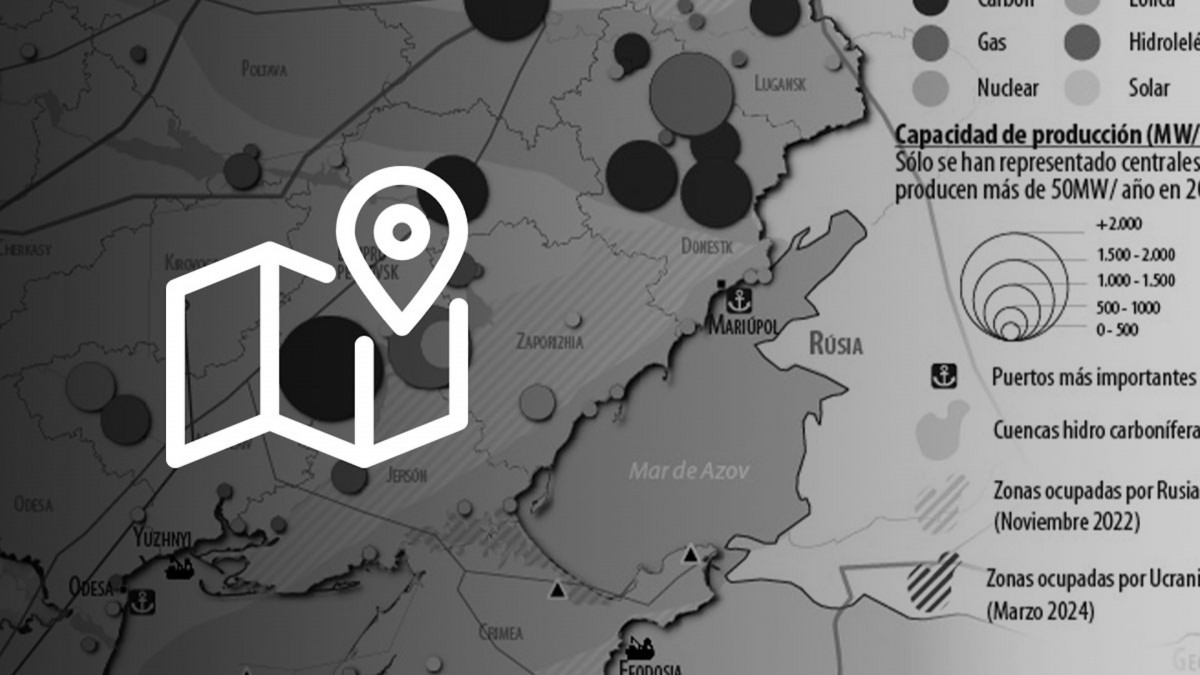
Drag over the image to zoom. | Map: Cassini Spain
Since the start of the Russian invasion in 2022, Ukraine’s energy infrastructures have become a military priority and a key arena in the geopolitical redefinition of Eastern Europe. Beyond their technical value, these infrastructures represent instruments of power whose contest is shaping new regional equilibria.
Context and evolution of Ukrainian energy dependence
Ukraine has played, since the mid-twentieth century, a fundamental role as an energy corridor to central and eastern Europe, especially through its transit of Russian gas. This strategic position as an energy transit country has been both a source of influence and vulnerability, conditioning its international relations even before the current conflict.
“The gradual energy decoupling of Ukraine from Russia, together with its accelerated integration into the European system, symbolizes a strategic shift of long reach that transcends the immediate conflict.”
In 2022, Ukraine possessed a relatively diversified energy mix, though with a strong territorial concentration in the eastern half of the country, particularly in the more industrialized regions. This pattern responds to both the location of natural resources (such as coal, gas, water or strategic minerals) and the Soviet industrial legacy.
The distribution of energy infrastructures reflected this historical heritage: coal-fired power plants were especially concentrated in the Donbas coal basin, supplying about 26.4% of the country’s energy. Gas-fired plants were distributed mainly in the central and eastern zones, with significant concentrations near Kyiv and Zaporizhzhia. Nuclear power plants, which accounted for 23.1% of national energy capacity, were strategically located across various regions, with Zaporizhzhia standing out as the largest in Europe.
Renewables — solar, wind and hydroelectric— had a more heterogeneous distribution, with greater presence in the south and west, following geographic patterns favorable to each technology.
The energy issue as a military strategy
Systematic attacks on electrical installations, thermal power plants and even nuclear facilities have formed part of a deliberate strategy to weaken the country’s resilience and to pressure the civilian population, especially during winter months. The emblematic case is the control of the Zaporizhzhia nuclear plant, turned into a top-priority diplomatic tension point.
“In any modern society, energy constitutes the functional foundation of the productive, logistical and social system. Hence the control — or selective destruction — of energy infrastructures forms part of an integral geopolitical strategy of territorial control.”
The destruction of the Nova Kakhovka dam in June 2023, attributed by various sources to the Ukrainian army as a maneuver to hinder the Russian advance, caused severe floods and the displacement of more than 16,000 people, particularly from the side occupied by the Russians. This episode illustrates how hydraulic infrastructures, besides their energy function, have a determinant impact on territorial control and on population safety.
These dynamics reflect a symbolic component: the dispute over energy control of Ukraine. Kyiv, for its part, has implemented a strategy of energy decoupling from Russia. Since the outset of the invasion, the Zelenski government ordered the disconnection from the Russian energy system, with the exception of the occupied territories (Donetsk, Luhansk, Zaporizhzhia, Kherson and Crimea). This decision, though risky in the short term, formed part of a strategic vision to redirect toward the West.
The progressive disconnection of the Russian system culminated in March 2022 with the synchronization of its grids with the European Continental System (ENTSO-E), through new 750 kV high-voltage lines. This technical integration, accelerated by wartime circumstances, has been key to ensuring supply in critical moments and represents a deeply consequential geopolitical shift. In 2023, Ukraine imported more than 2,000 GWh of electricity from Europe, thereby consolidating its growing interdependence with the bloc.
In any modern society, energy constitutes the functional foundation of the productive, logistical and social system. Hence the control — or selective destruction — of energy infrastructures forms an integral part of a geopolitical strategy of territorial control. Recent diplomatic negotiations have included discussions on the protection of certain electrical installations, which reflects the weight these infrastructures have in international agreements.
Geography of power: territorial control of resources and infrastructures
The conflict has dramatically transformed Ukraine’s energy map, territorializing power through control or destruction of critical infrastructures. The occupation of areas with strategic facilities and the selective destruction of those not of interest to preserve have shaped a new geography of power that goes beyond conventional front lines.
Coal-fired power plants, concentrated in the Donbas basin, are now largely located in occupied or contested territories. Many have been destroyed, with estimates placing damage at more than 80% of non-nuclear installed capacity. Gas plants have been largely hit hard and left without supply. In the early stages of the conflict, gas flows to Europe plummeted, dropping from 150 bcm/year to barely 15.
Nuclear power plants have been less attacked for obvious safety reasons, though most of their reactors are not operational and remain in a state of “latency.” The Zaporizhzhia plant, currently under Russian control, accounts for roughly 40% of the country’s installed nuclear capacity. Its control gives Russia not only an energy asset but also a powerful diplomatic lever.
“Renewable energies have shown greater resilience due to their territorial dispersion and technical characteristics.”
Renewables have demonstrated greater resilience due to their territorial dispersion and technical characteristics. The difficulty of rendering solar or wind installations completely unusable without precise targeted impacts has made them part of the energy resilience framework, especially in western regions less affected by direct fighting.
The main hydrocarbon basins coincide with strategically occupied regions by Russia, especially in the east and south of the country, including Crimea. This coastal and maritime space concentrates multiple strategic and energy interests, such as access to the Black Sea and its main ports; currently Sevastopol and Mariupol are under Russian control, while Ukraine retains the important port of Odesa and the oil port of Yuzhny.
The relatively sparse Ukrainian electrical grid has been a priority target in Russia’s military strategy. Substations and transmission lines, particularly those linked to the European system, have suffered recurrent attacks aimed at isolating the country and breaking its resilience, especially during the winter months.
From infrastructure to energy diplomacy
One of Ukraine’s principal strategic assets has been its role as a transit country for Russian gas to Europe. On January 1, 2025, the last transit contract with Gazprom ended, following Zelenski’s decision not to renew it, marking a gradual energy disengagement three years after the start of the conflict. This decision marks a turning point in regional energy relations.
By ceasing to be a transit corridor to Europe, Ukraine paradoxically gains greater strategic freedom, since these infrastructures ceased to be a vulnerable point in a wartime context. This shift has accelerated European efforts to diversify supply routes through projects in the Black Sea or along the Mediterranean axis, and strengthens the energy alliance with countries such as Romania or Moldova. The transformations are reflected in new regional interconnection flows, with investments in energy corridors that reduce dependence on northern routes.
“By ceasing to be a gas corridor to Europe, Ukraine paradoxically gains greater strategic freedom, since these infrastructures ceased to be a vulnerable point in a wartime context.”
The American interest in Ukraine’s nuclear infrastructures in recent years has global implications. According to international financial media, the United States has shown particular attention to this sector, given that Ukraine is the second European country in installed nuclear capacity, second only to France. Its control, integrity, and potential reconstruction are part of the new geopolitical balances taking shape. Washington has reinforced its presence in the sector through technological alliances and promises of investment in modular reactors, a strategy that links security, reconstruction and influence policy.
Meanwhile, the return of Donald Trump to the U.S. presidency has revitalized the debate about strategic minerals and rare earths present in Ukrainian territory. Although less visible than gas or uranium, these resources — especially lithium, titanium, and rare earths such as neodymium or dysprosium — are essential for future energy and technology industries. Their control, exploitation or blockage has become a new vector of geopolitical pressure, especially as the United States, China and the European Union adjust their industrial strategies. Exploration sites in Ukraine, such as Shevchenkivske or Polokhivske, could become critical enclaves within the new board of strategic raw materials.
Despite Zelenski’s refusal to concede any strategic energy infrastructures, deeming them non-negotiable for national sovereignty, energy has occupied a prominent place in diplomatic discussions and in international aid pledges for post-conflict reconstruction.
Future prospects: a new regional energy architecture
Ukraine’s energy infrastructures have moved from being a key geoeconomic asset to becoming a battlefield in themselves. Their destruction, occupation or reconversion illustrate how energy, beyond its technical value, is a tool of geopolitical power. In this conflict, Russia has not only sought to weaken Ukraine’s resilience but has ended up reconfiguring the region’s energy dependencies.
The progressive disconnection of Ukraine from Russia, together with its accelerated integration into the European system, symbolizes a strategic shift of long reach that transcends the immediate conflict. When the war ends, the regional energy map will have irreversibly changed, with new corridors, interdependencies and centers of power.
“The Ukraine case shows that energy and its infrastructures are not mere technical issues, but geopolitical pillars whose dispute is defining a new international order in the 21st century.”
The reconstruction of energy infrastructures will be one of the fundamental pillars for Ukraine’s economic recovery and political stability. Decisions about which technologies to prioritize, which international partners to involve and what energy model to develop will have deep geopolitical implications that will shape the country’s role on the European stage in the coming decades.
This case shows that energy and its infrastructures are not mere technical matters, but geopolitical pillars whose dispute is defining a new international order in the 21st century. The transformation of Ukraine’s energy landscape ultimately represents a deep redefinition of power relations in Eastern Europe, with consequences that will extend far beyond the end of the armed conflict.
