
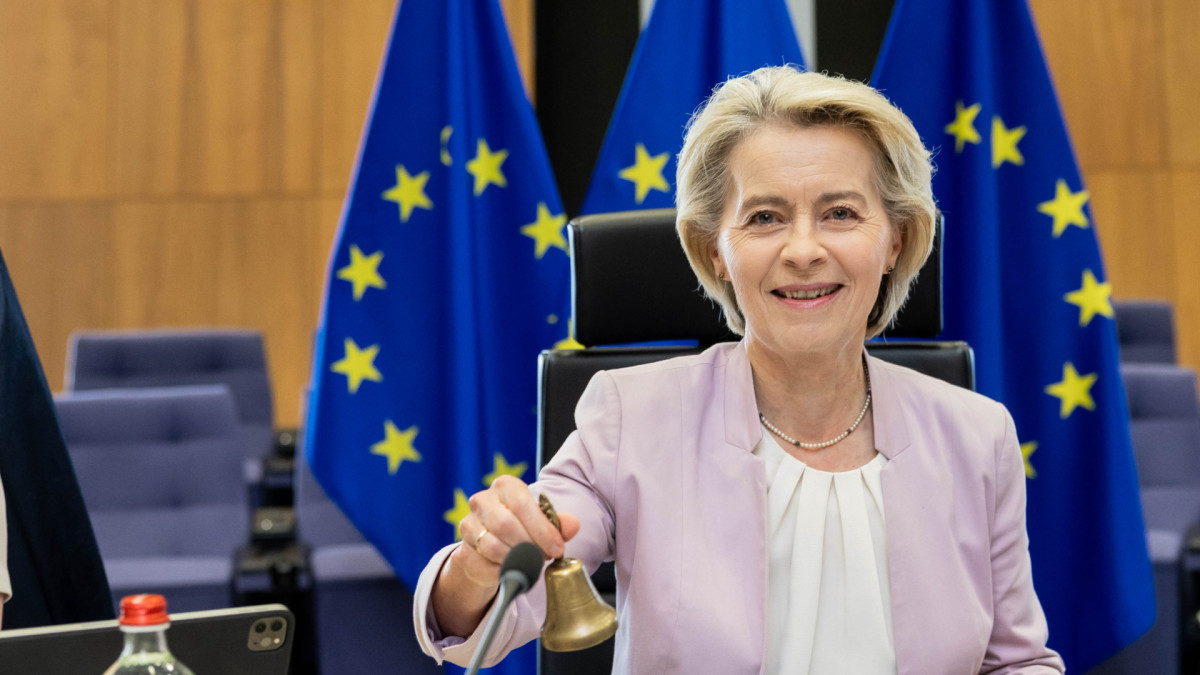
Since the dawn of the policrisis era, the European Commission has accustomed analysts, diplomats and all political actors in the Brussels bubble to a growing and increasingly public and conspicuous expansion of its powers. Brexit, renewed trade frictions, the coronavirus, or the war in Ukraine have gradually accustomed EU policy-makers to a more active role of the Commission, especially under Ursula von der Leyen at the helm of the European Executive.
That increase in its power has been accompanied by a growing centralization within the institution. In recent years, Von der Leyen has sought to give the Commission a footprint in areas where it did not have one before, or at least not clearly, such as the geopolitical arena. That, beyond generating the usual tensions within the fabric of European institutions, where competences are set out quite clearly, has had another effect, this one much less common: a gradual abandonment of the European Commission’s role as guardian of the internal market.
“Brexit, the renewed trade conflicts, the coronavirus or the war in Ukraine have gradually accustomed European policy-makers to an increasingly active role for the Commission”
As noted in 2025 by the economic think tank Bruegel in a paper on the health of the internal market, its defense “does not consist of a single initiative that can be carried out with a one-off concerted effort, but in a permanent revolution that requires constant effort.” “However, this work seems to have been relegated on the priority list during the current period of economic and political turmoil, in which crisis management has taken precedence. If the EU wants to regain economic momentum at a time when the world economic order is becoming destabilized, it should refocus on this work of consolidating the internal economy“, the think tank center noted at the time.
When the heads of state and government began the current cycle of debates around the loss of competitiveness of the European economy, a clearly non-glamorous, but highly relevant gap was identified: the Commission was not fulfilling its role as the “police” of the internal market. Mario Draghi also pointed this out in his report on the EU economy. And von der Leyen’s team admitted the error and committed to returning the Commission to its traditional business of monitoring the internal market. As part of its simplification strategy, the EU executive introduced stricter enforcement of the rules.
The data from the Commission’s own Directorate-General for Internal Market, Industry, Entrepreneurship and SMEs (DG GROW) show a very negative picture. From its peak in 2007, the year in which 1,332 infringement procedures were launched and when the EU was just entering the policrisis era, openings have fallen year after year, with only a few small exceptions, to 658 cases in 2024. The accusation from some member states is that this abdication of duties has gradually fragmented the internal market, allowing, as in a garden where weeds grow, barriers to appear in the EU in the form of uneven or deficient application of Community norms, damaging the internal dimension of the European economy.
“The accusation from some member states is that this abdication of duties has gradually fragmented the internal market”
But Brussels asserts that it is already accelerating the enforcement of the rules, following an order from the top of the institution. It has responded with an Internal Market Strategy, published in 2025, and DG GROW defends a new prioritization towards cases of greater strategic importance. Compared to 2024, the Internal Market Scoreboard, the EU’s radar for monitoring this issue, indicates that dialogues between the community technicians and national authorities to clarify possible breaches or misapplications rose by 52% in 2025. Since all of this is a pre-infringement dialogue, it would take time to translate into the historical series of infringement openings.
Many analysts, however, do not believe this is a problem of mere political will. The European Court of Auditors does not share this view either. Procedures are too slow, there is little staff to carry them out and member states have few incentives to comply with the Commission’s orders, even when there is a final ruling from the Court of Justice of the European Union (CJEU). Enrico Letta, in his report on the competitiveness of the European economy, also pointed in this direction: few instruments, few resources, late detection and sanctions that are not very deterrent.
The European Court of Auditors itself has analyzed the Commission’s 2025 strategy and is critical that it will change the current trend. The institution criticizes that the EU executive is not prioritizing correctly the cases of greatest impact, and that it is not effectively removing barriers in services. Its 2026 report describes, for example, how Hungary has been able to develop a whole set of regulations that clearly damaged the cohesion of the internal market without any effective measures being taken to prevent it.
“The procedures are too slow, there is little staff to carry them out and member states have few incentives to comply with the orders of the EU Executive”
In any case, the key question remains that, indeed, the internal market should function as the first point in the European strategy to recover the competitiveness of its economy. This is how the member states themselves view it, pressuring the Commission to enforce the rules strictly with one hand, while with the other they participate in the fragmentation of the internal market. For this to work well, it is not only necessary that the Commission reclaim its role as guardian, which it has indeed abandoned. It also requires that capitals regain the political will to make the internal market a reality, because it is in their hands to achieve it.
