
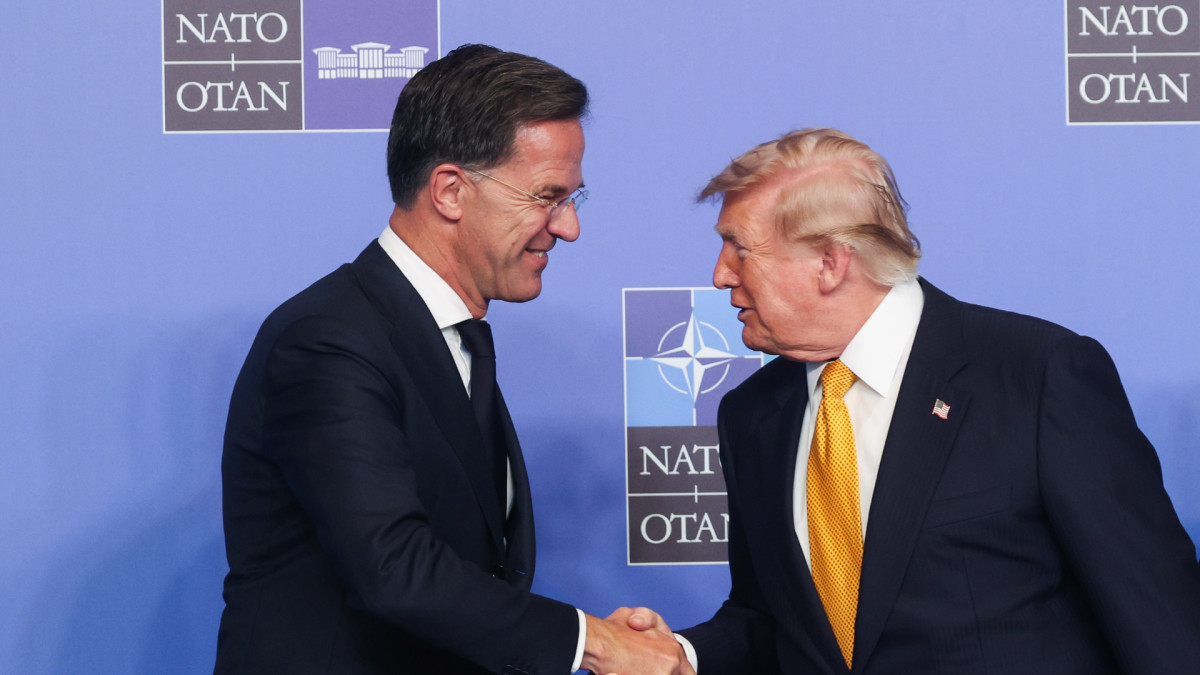
At the conclusion of the NATO summit in Ankara, Recep Tayyip Erdoğan handed to every head of state a .357-caliber Gümüşay revolver, manufactured by the Turkish state-owned company MKE, engraved with his name and presented in a wooden box alongside six rounds and a cleaning kit. Some leaders could not legally bring the gift into their countries, while others left it at their embassies, handed it to the police, or announced that it would end up in a museum. The summit devoted to returning weapons to the center of European politics ended, thus, with a weapon that almost no one knew how to take home.
“In an alliance, the more delicate the disagreement, the shorter the common vocabulary tends to be”
The gesture simplified the message Turkey wanted to convey to the Alliance: here not only are communiqués signed, power is forged. The final communiqué was less dazzling. Six paragraphs and 485 words were enough to reaffirm Article 5, point to Russia, support Ukraine, warn Iran, and celebrate the rise in investment. Brevity was presented as effectiveness, though it marked the limit of consensus. In an alliance, the more delicate the disagreement, the shorter the common vocabulary tends to be. Pese a todo, la cumbre de Ankara añadió seis palabras al diccionario atlántico.
The first is burden. Burden derives from the Vulgar Latin carricāre, itself from carrus, cart. Before becoming a budgeting abstraction, burden was what was placed on a cart, a beast, or onto shoulders. Spanish preserves an exact polysemy for the summit: to burden is to impose a weight, to load ammunition, to incur a debt, and to launch oneself at the adversary.
In earlier stages, NATO spoke of burden sharing, the distribution of the load. The expression showed the United States sustaining the structure while asking Europeans to shoulder their share. Ankara consecrated another formula, burden shifting, the displacement of burden. When a weight is shared, it remains on the same shoulders, whereas if it is moved, it changes bearer. Washington is not merely demanding that Europe pay more: it is beginning to withdraw a portion of the means with which it guaranteed its security. It has announced cuts in the capabilities allocated to the continent —half of the strategic bombers, a third of the fighter jets, fewer drones and aerial refueling, and no submarines deployed in Europe—, while the next allied planning cycle will not culminate until 2030. The burden moves faster than the European back able to bear it.
“Washington is not merely demanding that Europe pay more: it is beginning to withdraw a portion of the means with which it guaranteed its security”
That is why the 5% of GDP set for 2035 matters less as a number than as a verb. Spending does not equal bearing something. For Trump, burden is an overdue bill. By contrast, for Poland or the Baltic states, it is the price of continuing to exist, and for Western societies, the surrender of other public goods. At the same time, for Turkey it represents a major industrial opportunity. European allies and Canada increased their military investment by $139 billion in a year. The cart moves, but now we need to know whether it carries capabilities or budgets.
The second word is delivery. Delivering derives from integrāre, to restore something to its intact state, and from integer: whole, intact, untouched. Delivery and integrity are, therefore, branches of a single family that the history of language has led in different directions. In origin, delivering did not consist so much of shedding something as in reintegrating it, restoring its integrity before putting it in the hands of another. That double direction (recompose and concede) fit well with Ankara’s ambition and risk. Mark Rutte called the meeting a delivery summit and summed up its result in two words: “NATO delivers.” Delivering can mean giving, fulfilling, and sacrificing, but also yielding or surrendering. An alliance can deliver weapons to its members or surrender to the illusion that announcing a contract equates to having it. If the summit deserved its name, it should reintegrate European forces with the material coherence lost for decades of peace. If it failed, Europe could end up delivering its capacity to decide in exchange for equipment that others manufacture, upgrade, and control.
The summit answered with figures: more than $50 billion in acquisitions, $40 billion for unmanned systems, and €27 billion for deposits, distribution, and fuel pipelines. Progress was made in new surveillance systems, refueling aircraft, and strategic transport. NATO spoke of artificial intelligence and drones, but also of kerosene, hangars, and pipes. It was a material correction to an era that had forgotten everything that must work for a platform to arrive, fire, and return.
“Communiqués are narrated in the past, contracts promise in the future, and wars are fought in the present”
The problem of delivery is the tense. Communiqués are narrated in the past, contracts promise in the future, and wars are fought in the present. An aircraft ordered in Ankara may not be available until the end of the decade. A factory needs workers, components, energy, permits, and predictable orders. Europe spends far more than Russia, but fragments that money among national markets, short production runs, and incompatible requirements. The budget appears immediately, the force arrives later. Between the two, there opens the space where the promised muscle can atrophy even before it exists.
The third word is pillar. A pillar is not defined by its height, but by the load it bears. Europe’s NATO pillar has been more metaphor than structure, appearing in speeches, but it becomes blurry when asked who leads it, what capabilities it provides, and who decides in a crisis. Ankara confirmed that it will not be synonymous with the European Union army. Its political nucleus is organized around the E5 (Germany, France, Italy, Poland, and the United Kingdom); its military geometry needs Norway and Turkey; and its foundations continue to depend on the United States in nuclear deterrence, intelligence, space, and strategic transport.
“The United States has been asking for a stronger European ally for years; perhaps it will discover that every pillar that supports a building ends up shaping its form as well”
Cies cada capital dibuja una columna distinta. Washington wants it to hold up Europe while freeing resources toward Asia. France sees the framework of a sovereignty of its own. Poland accepts it so long as it strengthens the American presence. Turkey demands that Europe not raise an industrial architecture leaving it out. The result will be a hybrid construction, broader than the Union, less complete than NATO, and obliged to bear more weight. The United States has been calling for a stronger European ally for years; perhaps it will discover that every pillar that sustains a building ends up shaping its form as well. Perhaps now it will discover that strong allies have the habit of developing their own opinions.
The fourth word is autonomy. In Greek, autós and nómos denoted the ability to live under one’s own law. Autonomy began as a political question: who dictates the rule and who must obey it. The dictionary, however, preserves another, more contemporary meaning: “the distance a vehicle can travel without refueling.” Perhaps this is the best definition of European strategic autonomy. The question is not whether Europe can walk completely alone, but how far it can go without American fuel, satellites, intelligence, command, and nuclear protection.
That autonomy is decided less in steel and more in code. France is pushing Arcadia as an alternative to Palantir’s Maven Smart System. Maven, from Yiddish and Hebrew, means “the one who understands.” Arcadia refers to a mountainous region of the Peloponnese formed by communities whose political unity ended up organized into a league to preserve independence from Spartan power. Arcadia alludes to a plurality that learns to organize itself without needing the lone expert (Maven). Europe should not become an organization of atomized experts, but move toward Arcadia, an ecosystem of interdependent states.
“Being autonomous does not mean manufacturing every screw: it means distinguishing between the dependency that connects and the one that obeys”
Autonomy begins where there is the technical possibility to say no. A system can be interoperable and produce subordination if its updates, data, or critical functions depend on a foreign supplier. Europe will continue buying American weaponry for years; the contradiction is that it needs that dependency in order to reduce other, more urgent needs. Being autonomous does not mean manufacturing every screw: it means distinguishing between the dependency that connects and the one that obeys.
The fifth word is deterrence. Deterring and persuading come from the same Latin suadēre: to advise. Deterrence is the harsh sister of persuasion: both seek to alter another’s will; one invites moving forward and the other counsels backing down. Before becoming nuclear, deterrence was merely rhetorical. Its aim is not to destroy the adversary, but to change the sentence spoken before acting: “you won’t achieve it” or “the price will be higher than the gain”.
“The decisive technology ages in months; what matters is learning before the enemy”
The Ukraine experience has shifted that grammar from superiority to denial. Europe does not need to reproduce tank-for-tank the order of battle of the Russian forces; it needs to promise Moscow a war that cannot become a political victory. Cheap drones, extended sensors, electronic warfare, and precision munitions have raised the cost of conquest and lowered the cost of resistance. In Ukraine, guided projectiles that once struck nearly 70% of their targets fell to around 6% after electronic adaptation. Decisive technology ages in months; what matters is to learn before the enemy.
That is why Ukraine appears in Ankara as more than just a protected country. The declaration states that it “contributes to transatlantic security,” and the allies pledged €70 billion for 2026 and at least a corresponding figure for 2027. Kyiv receives Western systems, but returns doctrine, data, and innovation. The student teaches its protectors to survive on the battlefield they had spent decades simulating.
The sixth and final word is maturity. Maturus meant mature, but also timely: something that arrives at the right moment. A fruit ripening after a frost may have completed its development and yet remain useless. In finance too, maturity is the moment an obligation matures. Europe has accumulated strategic debt and the international context is beginning to set its expiry.
“Europe has accumulated strategic debt and the international context is beginning to set its expiry”
The maturity does not consist of proclaiming that Europe can do without the United States, but in stopping organizing its security as if American availability were a natural resource. For decades, Europe handed over to Washington the coercive part of the order that allowed it to imagine itself post-historical. It had not left history: it had externalized its legitimate violence. The Ankara summit changes that contract. Europe must become co-responsible without confusing autonomy with solitude or alliance with tutelage, and do so before the convergence of U.S. retreat, European industrial sluggishness, and Russia’s willingness to test the interval.
Erdoğan placed six cartridges beside the revolver. The summit also left six words on the table: burden, delivery, pillar, autonomy, deterrence, and maturity. All name something Europe must fund, build, or learn. Yet in Ankara, the word on which the other six depend was barely spoken: trust.
“The error began when it confused quelling its own rivalries with quelling history”
Alliances exist in arsenals, bases, and treaties, but survive in the adversary’s imagination. They require someone to believe that the burden will be shouldered, the delivery will come, the pillar will endure, and the threat will be met. Erdoğan’s revolvers will eventually be unloaded, disabled, and placed in display cabinets. Europe spent much of its recent history achieving exactly that, ensuring that weapons moved from the center of politics to museums. It was a civilizational conquest, not naivety. The error began when it confused quelling its own rivalries with quelling history. The summit leaves a question inside that wooden box, not only whether Europe is willing to shoot again, but whether it will gather enough power so that no one can compel it to do so.
