
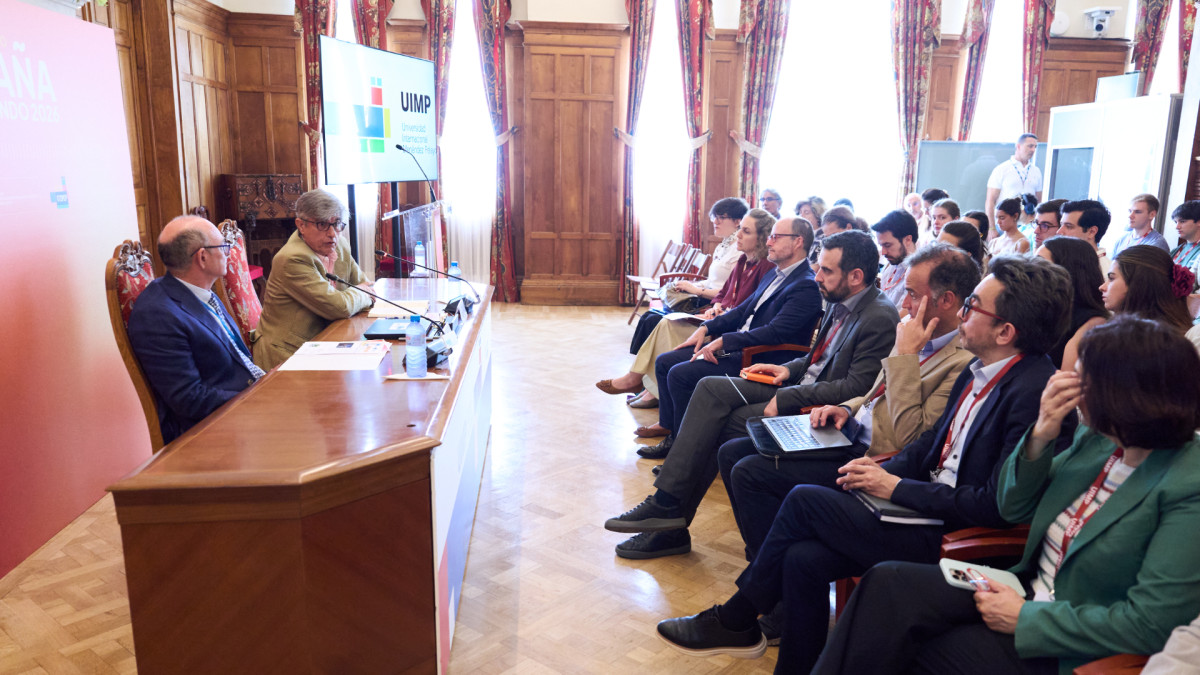
Amid the current process of changing the international order, the fourth edition of the Spain in the World 2026 course opened this Monday at the Palacio de la Magdalena in Santander with the aim of shedding light on a scenario dominated by uncertainties.
Driven by the idea that power disperses faster than the new rules are built, the course, organized by the Ministry of Foreign Affairs, the European Union and Cooperation together with the International Menéndez Pelayo University (UIMP), brought together in its first of five sessions analysts from different disciplines. Their interventions painted a world in transition: the Western order loses the capacity to organize the system, regional powers expand their autonomy and force occupies part of the space left vacant by diplomacy. In the face of the temptation to restore stability through coercion—an stability that no longer exists—the speakers defended shared rules and new frameworks for cooperation.
“When powers anticipate that their future position will be worse, they can take greater risks and fall into the temptation of laying down a marker.”
Following the institutional welcome by the rector of the UIMP, Ángel Pelayo González-Torre, and the ambassador permanent representative of Spain to NATO, Federico Torres Muro, the analysis proceeded. The Secretary of State for Foreign Affairs and Global Affairs, Diego Martínez Belio, framed the starting point as a rapid transformation of the global distribution of power. He explained that when powers anticipate that their future position will be worse, they may take greater risks and be tempted to lay down a marker. Afghanistan, Ukraine or Iran, however, illustrate the difficulties even the most powerful actors have in turning force into political authority.
Martínez Belio also advocated an external policy that does not pit interests against principles. “It is a mistake to hand the monopoly of strategic intelligence to supposed realists,” he asserted, before defining Spain’s position as “100% realistic and 100% based on values”.
The State of the World and Geopolitical Trends
Bruno Maçaes, senior adviser at Flint Global; Pol Morillas, director of the Barcelona Centre for International Affairs (CIDOB), and Ilke Toygür, director of IE University’s Global Policy Center, addressed in the first panel the deterioration of the international order from complementary dimensions. Maçaes focused on a historic redistribution of power that the West has not yet absorbed, while Toygür added the loss of legitimacy of a model that has not fully delivered its promise of shared prosperity. Linking the two diagnoses, Morillas opened the debate to the question of what rules can order a system with more actors.
Maçaes rejected the idea that the end of Western primacy necessarily leads to chaos or to a replacement of the United States by China. “We do not have only Western order or chaos,” he warned. The future, he predicted, will be formed by different poles and overlapping orders. China, India, and the United States will maintain central roles, but no power will be able to single-handedly raise a new hegemonic order equivalent to the previous one.
In this scenario, the basic principles that should survive the upheaval began to be reconsidered. “We have to decide what we want,” said Toygür, including among those minimums territorial integrity or the prohibition of changing borders by force. On the other side of the table, Maçaes argued that tolerance and other universal values do not belong exclusively to the West.
“Maçaes rejected that the end of Western primacy would necessarily lead to chaos or to a replacement of the United States by China”
In the subsequent debate, attention was especially drawn to the rise of the radical right. Maçaes linked it to a sense of impotence and cited Marine Le Pen’s party as an example: when a society believes its influence is waning, it is tempting to promise that greater toughness—toward immigrants, for instance—will allow it to recover. Expanding on this idea, Morillas stressed the contradiction that emerges from that political offer by recalling that the international system is moving toward a plurality that is difficult to reverse, so these forces propose returning to a past that cannot be reproduced.
The journalist Andrea Rizzi (left) and Comfort Ero, President and CEO of the International Crisis Group (right). Photo: Courtesy
Peacebuilding in a Fragmented World
To discuss the difficult task of international cooperation and peace processes, El País’s Global Affairs correspondent, Andrea Rizzi, spoke with Comfort Ero, president and chief executive of the International Crisis Group. The journalist opened the second panel with a diagnosis: international institutions are weakening, and, in turn, “interconnections are used as weapons, military spending rises and democracy contracts.” Ero, who has deep knowledge of the dynamics in conflict-affected countries, placed that fragmentation in the context of an accumulation of fractures spanning the 2008 crisis, the Arab Spring, Syria and the abandonment of conflicts such as Sudan or Myanmar.
The space left by traditional actors is being filled by regional powers. Turkey in Syria, China in Myanmar, and Saudi Arabia, Egypt and Pakistan in the Middle East intervene because their security and interests are at stake. Ero clarified that those countries never presented themselves as substitutes for the United States: they are “diversifying, not substituting,” in the face of guarantees they consider less reliable. Their actions can facilitate agreements, but also prolong conflicts.
Rizzi introduced the technological issue, especially relevant in the context of the Global South. In this regard, Ero highlighted its usefulness in real cases to mobilize populations, map crises or deliver health services, but warned that it also broadens surveillance, manipulation, and military advantages through drones and autonomous weapons.
“The space left by traditional actors is being filled by regional powers, but those countries never presented themselves as substitutes for the United States”
Against this backdrop, the scholar advocated a balance between deterrence and diplomacy. Europe needs to strengthen its security and take on greater autonomy, but the accumulation of armaments can fuel miscalculation and rivalries. “It is not a dichotomy,” she replied when asked whether one should choose between one tool or another. The common lesson from Ukraine, Iran, Myanmar or Sudan is that “we must return to diplomacy”. Force has its limits and no conflict ends without a political exit.
The Middle East and the New Regional Balance
The third and final panel of the day focused on the Middle East. Alberto Ucelay, Director General for Foreign Policy and Security at the Ministry of Foreign Affairs, contextualized the debate by warning that the region is experiencing its worst period of violence in decades. Ali Vaez, director of the Iran Project at the International Crisis Group, spoke to examine the results of military and economic pressure on Tehran: a costly escalation that has not achieved the proclaimed objectives and has created new problems. “Coercion does not work,” he summarized.
Maha Yahya, director of the Malcolm H. Kerr Carnegie Middle East Center, addressed the Gaza, West Bank, Lebanon and Syria hotspots within the same territorial logic and emphasized rejecting the idea that Israeli expansion can be described using the language of “buffer zones” (buffer zones). “A buffer zone is not built on another country’s territory,” she replied: these are occupied Palestinian, Lebanese and Syrian territories. In other words, analyzing each scenario separately prevents seeing a broader dynamic that fuels armed resistance and worsens regional insecurity.
Yahya also questioned whether the stabilization of Gaza can be reduced to managing food, education or healthcare. Humanitarian aid is essential, she explained, but cannot substitute Palestinian representation, sovereignty and a state perspective. “This is not a technocratic issue; it is a political one,” she added.
Several audience questions addressed the role Europe can—or should—play in the region. Vaez explained that Iran stopped seeing Europe as an “autonomous actor” after confirming that European countries could not operate independently of the United States. “Europeans are irrelevant because they lack economic sovereignty”, he summarized, reflecting Tehran’s conclusion. The subsequent deterioration makes it difficult to simply resume the role Europe played during the nuclear deal negotiations.
“Iran stopped seeing Europe as an ‘autonomous actor’ after realizing that European countries could not operate independently of the United States”
Nevertheless, Vaez distinguished between the wear of the E3 — Germany, France and the United Kingdom — and the room that still could be preserved by Spain, Italy and other countries through bilateral channels or smaller formats. His most useful contribution would not be so much mediating between Washington and Tehran as sharing Europe’s experience of gradually building common institutions.
The discussion thus pointed toward a regional architecture based on sovereignty, territorial integrity, respect for agreements and guarantees for the weaker actors. It would ultimately have to include both Iran and Israel, although Iran’s regional projection and Israel’s territorial expansion today make that horizon difficult.
Europe cannot restore the previous order or act as an omnipotent referee. It can, however, defend international law, keep diplomatic channels open and help build more inclusive regional frameworks. The challenge is complex, because it is not about forcefully recovering a primacy that is hard to regain, but about preventing the vacuum from pushing the entire region toward what Vaez called “permanent war”.
