
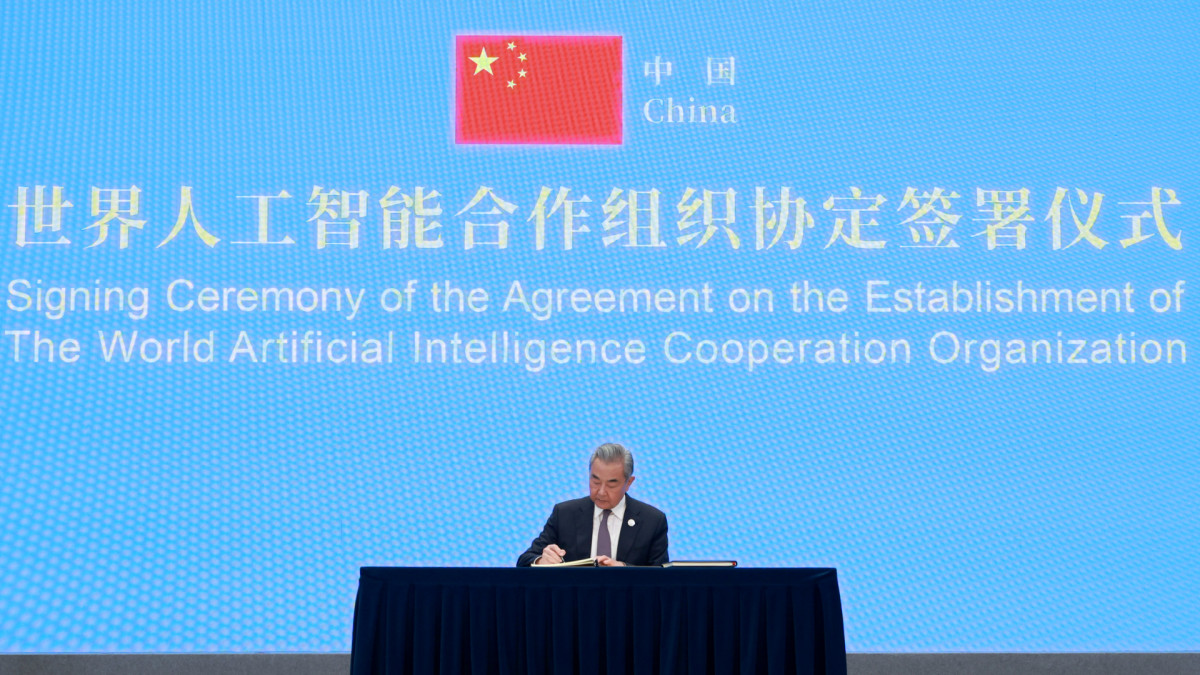
The recent signing in Shanghai of the constitutive agreement of the World Organization for Cooperation in Artificial Intelligence (WAICO), promoted by China and initially backed by twenty-nine countries, among them Russia, Indonesia, Brazil, Cuba, Venezuela and other usual suspects of the so-called Global South, marks a milestone in digital geopolitics. This initiative aims to create a new international organization dedicated to cooperation and governance of artificial intelligence, of course under Beijing’s leadership.
The accompanying discourse is hardly objectionable: international cooperation, shared development, access to artificial intelligence for developing countries, and the laying down of common rules for a technology that is set to transform the economy and society. In a context of growing and well-founded distrust of the United States and, in particular, of the current Administration, this Chinese proposal can be seductive for many governments, analysts and opinion leaders, especially for those who think that in today’s world Europe must remain equidistant between the two superpowers: Christ between the two thieves.
Precisely for that reason it is worth stopping to analyze it more closely.
“In a context of growing and well-founded distrust of the United States and, in particular, toward the current Administration, this Chinese proposal can be seductive”
There is no doubt that China has long ceased to be merely a technological competitor and has become a serious contender to lead the international order, both in geopolitics and in digital geopolitics. For years, the AI debate was dominated by the United States, while the European Union tried to consolidate its own regulatory model inspired by the world of fundamental rights born after World War II, which, for many, is already outdated.
Today things are different: China, which continues to aim to develop better AI models or to manufacture more chips, also trusts in its ability to define the global rules that will govern this technology for the coming decades. This evolution warrants serious consideration: power in the digital economy lies in developing technology, but also in setting standards, principles, rules and institutions. The one who writes the rules exerts an influence that can prove more durable than the one who first develops a given technology. China seems to have learned how useful a rule setter can be and does not appear willing to leave this role solely to the EU.
The growing receptivity to Chinese proposals reflects a dangerous confusion. The justified critique of certain US policies, exacerbated by the deterioration of transatlantic relations during the Trump Administration, is favoring a certain idealization of China as a responsible actor in global and digital governance.
The digital model of a dictatorship
That perception ignores an essential difference that no geopolitical context should let us forget: China remains a dictatorship and does not seem likely to change. It has clearly demonstrated that the old Californian paradigm, which held that technological development and innovation were intrinsically bound to free, open and eventually democratic environments, was not inevitable and China has managed to fuse political control and restrictions on analog and digital rights with a very high capacity to compete for technological leadership in AI and, more importantly, in quantum computing.
“The one who writes the rules wields an influence that may outlast the one who first develops a given technology”
Just a glance at China’s artificial intelligence legislation suffices. While in Europe the debate revolves around protecting fundamental rights and in the United States it centers on balancing innovation and regulation, the Chinese regulatory framework incorporates ideological objectives. The regulations governing generative AI services require adherence to the “fundamental values of socialism,” preservation of national security and social order, and prohibition on producing content that questions the leadership of the Communist Party. Red and white. AI thus ceases to be a technology regulated by the law and becomes an instrument at the service of the State.
This aspect is surprisingly often glossed over in many Western debates. People talk about the speed at which China develops new models, its industrial capacity, its enormous data availability, and its growing influence over the Global South. All of that is true. But it is omitted that this extraordinary technological development occurs within a political system where there is no politeness of things like pluralism, an independent judiciary, or freedom of expression. Chinese technological regulation does not pursue, as Europe’s does, to protect citizens from the risks of artificial intelligence; it seeks to ensure that this technology reinforces the stability and continuity of the regime and serves it.
Naturally, this does not mean glorifying the American model. The United States faces very serious digital problems: the enormous concentration of power among the big platforms, difficulties in adequately protecting privacy, increasing political polarization or debates about content moderation are highly relevant issues.
“In China, it is not the political power that is subject to the law, but the law that is subordinated to the needs of political power”
But precisely because it is a democracy, all those policies can be debated, amended and subjected to independent oversight mechanisms. Companies can face parliamentary investigations, lose lawsuits in courts, or publicly challenge government decisions. There is political alternation, free press, independent judges, and institutional checks. In short, technology operates within the rule of law. In China, the opposite occurs: it is not the power that is subjected to the law, but the law that is subordinated to the needs of political power.
China wants to write the AI rules
That difference is decisive when we discuss artificial intelligence. Because AI shapes what information citizens receive, which opinions circulate in public space, and what data can be collected. In a democracy, these decisions are constrained by legal and constitutional limits. Conversely, in a dictatorship they ultimately respond to the interests of the ruling elite.
Europe should avoid falling into a false dichotomy between the American model and the Chinese model. It can and should develop its own model based on protecting fundamental rights, responsible innovation, and the rule of law. But that legitimate desire for strategic autonomy cannot lead to dangerous naivety (or sometimes bad faith) about the nature of the Chinese regime.
The initiative presented by Beijing is, without a doubt, a diplomatic success and shows that China intends to play a leading role in the global governance of artificial intelligence. It will be a factor to consider in the global debate on digital governance, but we must not forget, whether out of naivety, interest, or bad faith, that digital regulatory models also reflect social models in a world where the battle for global hegemony plays out on technological supremacy. And there are many things that can be said about China’s model of society, but not that it is democratic or a state under the rule of law.
The technological competition of the 21st century will not be decided solely by who builds the best AI models or leads quantum computing, but also by who sets the rules of the global game. And this is not a technological question but a geopolitical one.
We can disagree with many decisions taken by the United States and there are good reasons for it, but these differences should not hide something obvious: a democracy offers corrective mechanisms; a technologically sophisticated dictatorship like China, precisely thanks to that technology, possesses increasingly effective instruments to perpetuate itself and it does not seem that this is a desirable model nor that our advanced democratic societies should imitate it.
