

Can a reform designed to protect mothers end up generating a new type of discrimination against fathers? That is the question posed by Spain’s equalization of paternity leave, approved with the promise to better share caregiving responsibilities between men and women and reduce the workplace discrimination that mothers face. Our research, based on a survey of nearly 4,000 mothers and fathers who recently became parents, shows a result more complex than expected: discrimination against mothers has not decreased, but a new front of discrimination against fathers has emerged.
To understand the starting point, it helps to first see how mothers and fathers across Europe perceive this issue. According to the European Social Survey of 2022, less than 5% of men in Spain say they have suffered unfair treatment at work —when applying for a job, in pay, or in a promotion— in the last five years. By contrast, almost one in four Spanish women (23.5%) say they have experienced the same treatment for being a woman. This pattern repeats across Europe, though the gap between men and women is larger in some countries than in others.
These perception data are supported by an experimental study on discrimination against mothers and fathers in Spain. Researchers sent fictitious résumés to real job openings to measure how many companies responded and called for interviews. The result: if a mother and a father have exactly the same education and work experience, she is called back only half as often as he is. And compared with a childless woman, a mother is 26% less likely to be called.
The Government approved a reform that promised to solve this problem: it equalized paternity leave with maternity leave, gradually expanding it from four to sixteen weeks. The aim was that, by spending more time caring for their children, fathers would become visible as caregivers to employers and that this would change how companies view childcare, thereby reducing discrimination against mothers. In fact, take-up of the leave grew notably after the reform, though unevenly: it was concentrated mainly among fathers with more stable jobs, while those on temporary contracts or self-employed lagged behind.
“This kind of case, unthinkable a few years ago, could point to a new form of corporate reaction to fathers who do exercise their right to leave”
First evidences after the law’s approval were unexpected. Instead of curbing discrimination against mothers, cases of discrimination against fathers began to appear in the media. In 2022 and 2024, Spanish courts ruled in favor of workers who were dismissed after notifying they would take their paternity leave. These kinds of cases, unthinkable a few years ago, could point to a new form of corporate reaction to fathers who do exercise their right to leave.
Our study: design and scope
To find out whether this discrimination against fathers was an isolated case or a broader problem, we surveyed 3,950 mothers and fathers with children born in 2018 (when the leave was four weeks) and 2022 (when it had reached sixteen weeks). We combined online responses with face-to-face interviews in playgrounds of low-income neighborhoods in the Barcelona metropolitan area. We used this second strategy because online surveys tend to attract more responses from people with higher education, and we wanted to ensure we heard from other groups as well.
The questionnaire included two central questions: whether respondents had felt discriminated against or treated badly at work before taking the leave and whether the same had happened after, due to their caregiving responsibilities. In both cases, we also asked in which specific area it occurred: when seeking work, when being fired, when asking for a promotion, in pay, when accessing training, or in treatment by colleagues.
Our study leverages a crucial detail: depending on the year in which their child was born, each surveyed father was entitled to a different length of paternity leave, ranging from four weeks before the reform to sixteen weeks after full implementation. This allowed us to compare discrimination experiences of mothers and fathers according to how many weeks of leave existed at that time, and thus to measure whether more weeks of paternity leave for fathers changed what mothers and fathers experienced at work.
Main results
As in prior studies, our survey shows that mothers suffer much more discrimination than fathers: about one in four mothers says she experienced it during pregnancy and one in three after childbirth. Among fathers, the figures are much lower — about 16-17% in both moments — but they are far from negligible.
Moreover, these figures are not the same for all fathers. When we look at how this penalty changes according to how many weeks of paternity leave each father had, a surprising pattern emerges, as shown in the following graph.
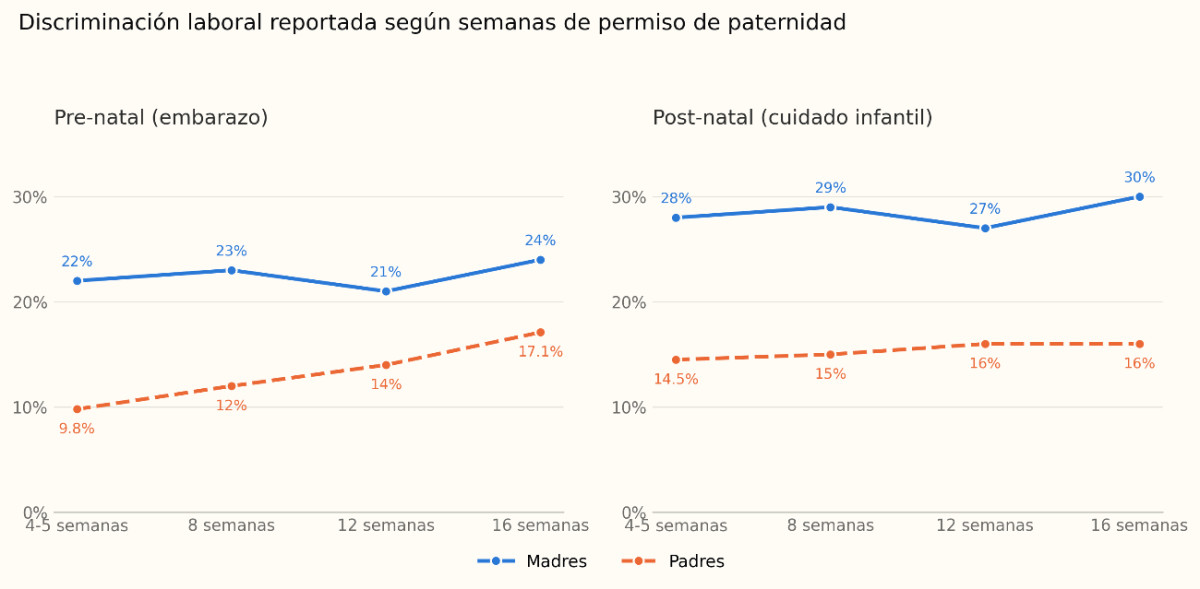
Source: FAIRLEAVE Survey. Our own elaboration.
The pattern reveals a completely asymmetric dynamic by period and gender. In the pre-birth period — measured by the treatment when seeking a job or announcing the pregnancy, when employers and workers already anticipate that leave will be taken — discrimination rises steadily and significantly as the weeks of the father’s leave increase. Fathers who had between four and five weeks report it in less than 10% of cases; those with sixteen weeks report almost a 70% higher rate. And if we look more closely, we see that this rise occurs in hiring, firing, and coworker treatment, while there are no major changes in promotions, salary, or access to training. Mothers, by contrast, maintain stable rates of around 22-24%, regardless of the year their child was born.
“Discrimination rises steadily and significantly as the weeks of paternity leave increase”
An analysis by contract type shows that this penalty concentrates mainly among those with permanent contracts, i.e., among those most likely to take the full leave and thus become visible to their company as caregiving fathers. This suggests that more precarious workers, fearing that taking the leave will hurt them, opt to shorten it or drop it altogether.
Everything changes when we look at the period after birth, that is, when analyzing discrimination linked to childcare. Here, neither mothers nor fathers show changes according to the weeks of available paternity leave. Mothers report rates of 27% to 30% consistently, while fathers stay between 14.5% and 16%. The gap of about 14 percentage points remains the same across all cohorts. In other words, the reform seems to have no effect on discrimination that occurs after birth.
A possible interpretation of this result is that taking the leave is not enough for a father to be perceived as the long-term primary caregiver: it is mothers who continue to request the vast majority of leaves and reductions in working time for child care, and it could be these prolonged absences, not the birth leave, that generate the discrimination associated with post-birth care.
These results indicate that the reform only has consequences for discrimination against men at the moment when future leave can be anticipated and not once the leave has already been taken. A possible explanation relates to the fragmentation of the paternity leave and the organizational costs of managing these absences. Many Spanish fathers split their leave into several distinct periods across the first year, which forces employers to cover their position not once but several times. This fragmentation may be more disruptive than the continuous absence of a mother, which perhaps helps explain why employers penalize fathers in hiring and firing: they react to the expectation of having to manage these repeated interruptions.
“The reform only has consequences for discrimination against men at the moment when future leave can be anticipated and not once the leave has already been taken”
Could it simply be that fathers are now more aware of discrimination, rather than suffering more? One finding rules this out: mothers, exposed to the same social and media context, show no change in their responses across the period; if it were broader awareness, they would also report more discrimination over time. Moreover, the rise is gradual and coincides with each extension of the leave —from four to eight, from eight to twelve, from twelve to sixteen weeks—, not with the moments of greatest media coverage (2019, 2021).
Final reflections
These results do not necessarily imply a failure of the reform. They are, rather, an indicator of how far corporate culture has to go to reach the equality that the law already recognizes. Our findings make clear that equalizing the length of leave for fathers and mothers is not enough to curb workplace discrimination. For now, companies are responding to the legal change by extending to fathers part of the labor penalty that previously fell on mothers. All signs point to a widening gap, not so much between fathers and mothers, but between those who have children and those who do not: both parents now bear a labor cost for being parents. Closing this gap between what the law already guarantees and what workers can exercise without fear of retaliation requires enforcing legal protections against discrimination, for both fathers and mothers, and paying particular attention to workers with the most precarious employment, who have the least room to exercise these rights.
