
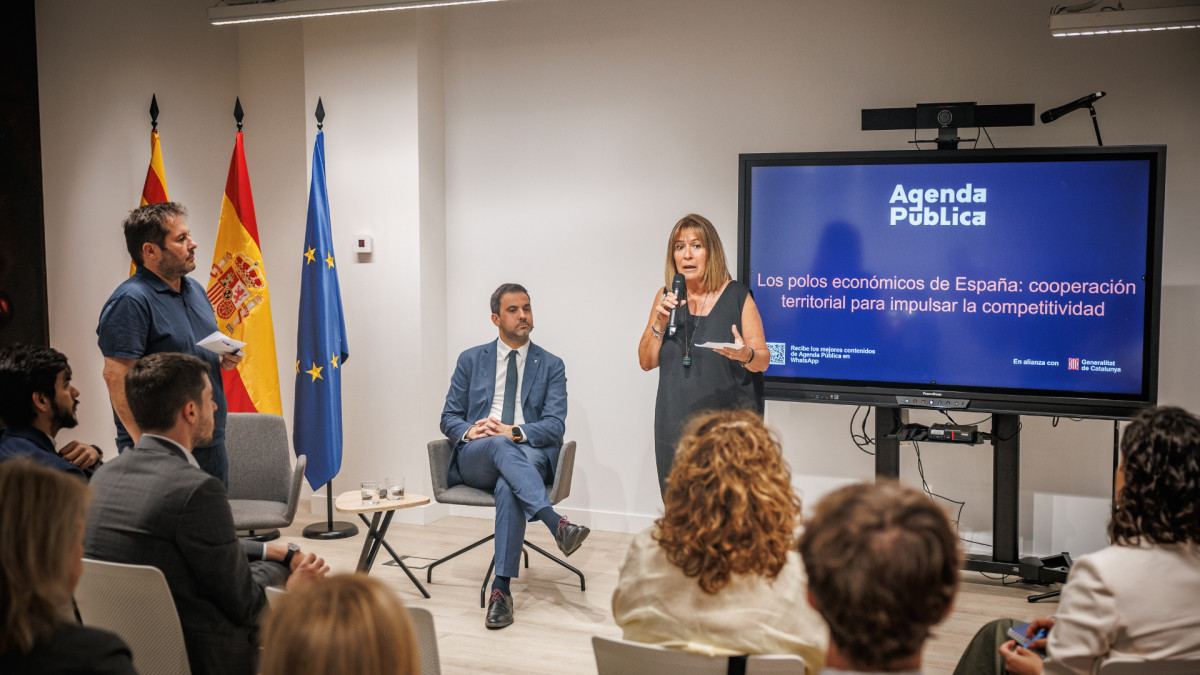
Spain is experiencing one of the best economic moments of the last decade. Employment, investment, and exports are growing. However, the debate is shifting from short-term to long-term: how to transform that dynamism into a durable competitive advantage in a context marked by international competition, technological transformation, and Europe’s push for strategic autonomy. On that premise, the micro-space Spain’s Economic Poles: Territorial Cooperation to Boost Competitiveness, organized by on July 22 at the Delegation of the Generalitat of Catalonia in Madrid.
The event, opened by the Catalan Government delegate Núria Marín, brought together the Generalitat’s Secretary for Enterprise and Work, Pol Gibert, and the economist and researcher Pep Ruiz, in a dialogue moderated by the director and editor of , Marc López Plana. The session also featured institutional and private-sector representatives, including Inés Granollers i Cunillera, president of the Congress Commission on Industry and Tourism; Ana Ojanguren, Director of Corporate Affairs at Alexion; and Laure Yvenou, Director of Public Affairs at Sanofi, together with leaders from Amazon, Hipra, Novartis and Santa Barbara Sistemas, in a space for exchange among administrations, companies, and specialists in competitiveness and innovation.
“The challenge is to leverage the country’s productive diversity and strengthen the connections between its economic poles to generate a multiplier effect across the entire economy”
From the opening, Marc López Plana framed the debate around a central idea: Spain has several economic engines capable of driving growth, and leadership doesn’t have to be concentrated in a single territory. The challenge is to take advantage of the country’s productive diversity and reinforce the links between its economic poles to generate a multiplier effect on the economy as a whole.
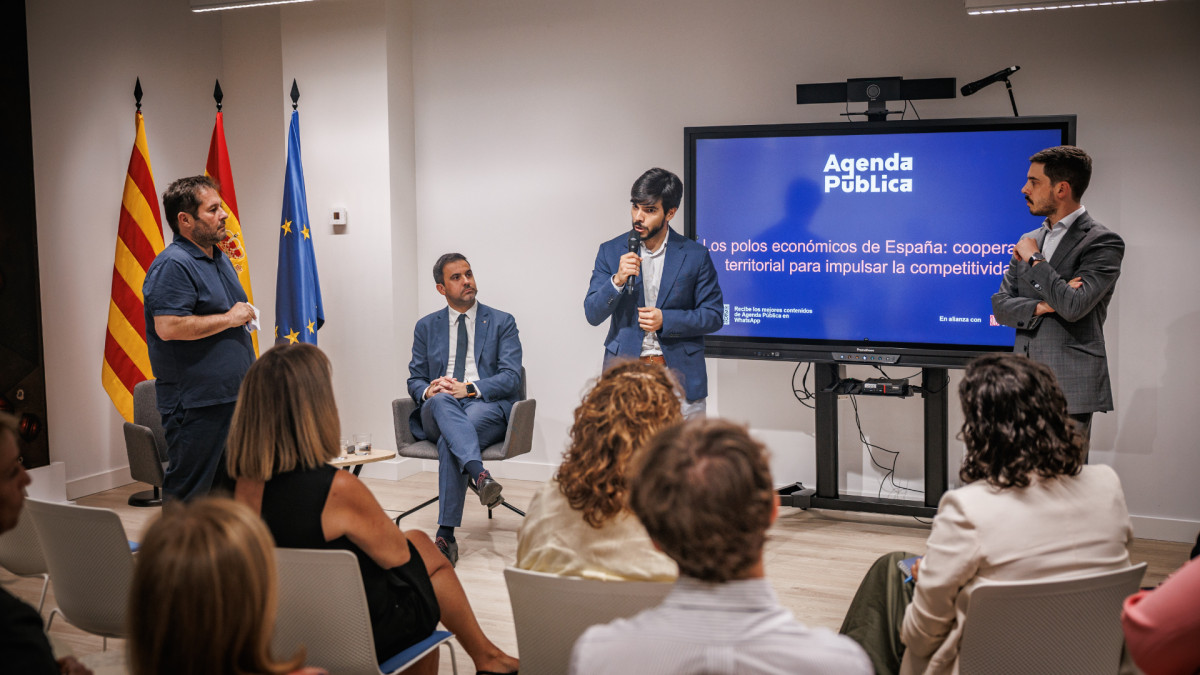
Gibert explained that the investment strategy also hinges on strong alignment with Brussels. Photo: Agenda Pública / Tania Sieira
More cooperation among territories to compete better
One of the main points of agreement was that the Spanish economic model should evolve from a logic of relatively independent poles to one in which territorial cooperation becomes a driver of competitiveness.
Pep Ruiz, after almost three decades analyzing the Spanish regional economy, argued that the productive specializations of each territory become a strength if they are coordinated. Madrid stands out in advanced services and the knowledge economy; Galicia is undergoing a growth phase; Navarra and the Basque Country maintain significant industrial potential, albeit more exposed to the international context; while other regions excel in specific sectors. In his view, challenges such as artificial intelligence, the energy transition, and industrial transformation exceed the capacity of any single region to tackle alone.
“Economic problems can no longer be solved from a single pole”, Ruiz summarized, citing the recent victory of the Spanish national football team as an example that an economy performs better when it acts as a team.
“Therefore, he argued for strengthening the relationship between both territories so that they act as locomotives of a system in which the rest of the communities contribute their competitive advantages”
Madrid and Catalonia occupy a unique position due to their economic and demographic weight. Ruiz recalled that Madrid currently outpaces Catalonia in GDP growth and population growth, though he attributed that evolution to structural factors rather than political ones. Hence, he argued for strengthening the relationship between both territories so that they act as locomotives of a system in which the rest of the communities contribute their competitive advantages.
Competitiveness, strategic autonomy, and a shared European perspective
The European dimension was present throughout the discussion. For Pol Gibert, the EU’s push for technological sovereignty and strategic autonomy represents an opportunity to strengthen Spain’s industrial capacities s o long as there is a shared vision.
“It is a mistake to think only of Madrid and Barcelona”, said the Secretary General of Enterprise i Treball, who argued that each territory should develop the sectors in which it already has competitive advantages and established ecosystems, rather than replicating external models.
“For Pol Gibert, the EU push for technological sovereignty and strategic autonomy represents an opportunity to strengthen Spain’s industrial capacities”
Gibert emphasized that the current economic moment should be used to attract investment in strategic sectors linked to innovation, advanced technologies, and industry. That strategy requires ongoing dialogue with Brussels, to the extent of defining a triangle formed by Madrid, Barcelona, and European institutions as one of the spaces where a large part of future competitiveness will be decided.
“The country’s economy is doing well and it should be said,” he stated, noting that exports, foreign investment, and employment are on a positive trajectory that should help address long-term challenges and translate into a “shared prosperity” among territories, sectors, and generations.
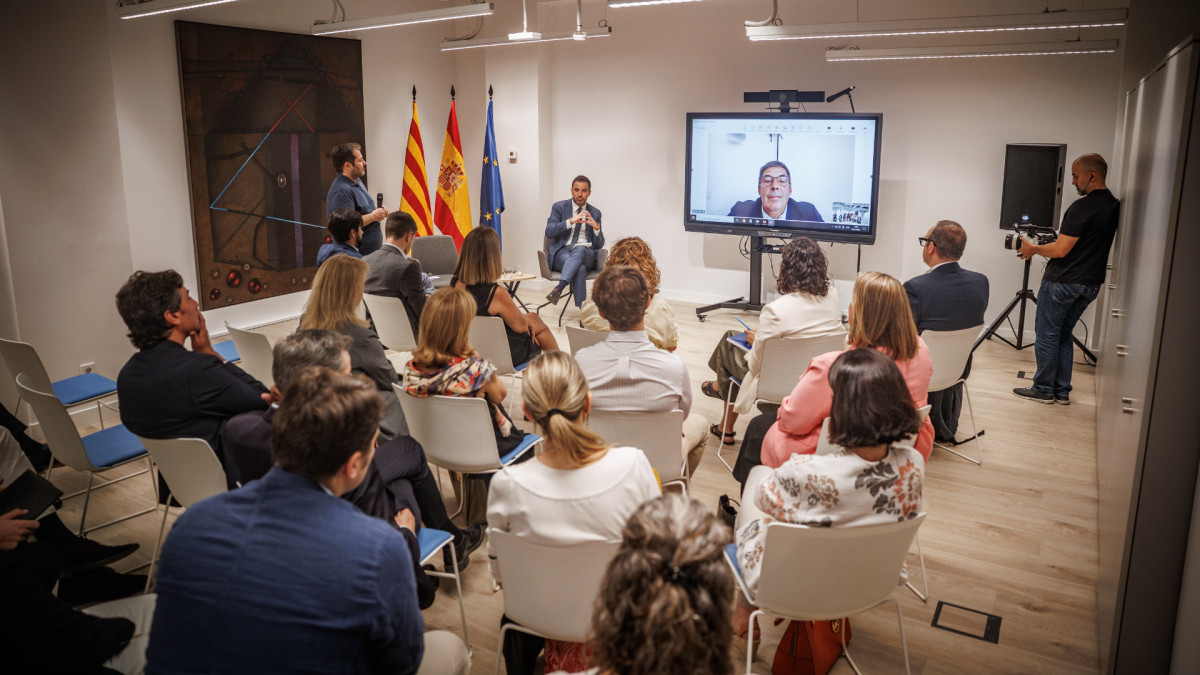
The economist Pep Ruiz participated in the meeting remotely. Photo: Agenda Pública / Tania Sieira
Public-private collaboration as a condition for growth
Cooperation between administrations and companies was another major consensus of the event.
Núria Marín highlighted the role of the Delegation of the Generalitat in Madrid to reinforce Catalonia’s institutional presence, strengthen ties with the business fabric, and project it as an attractive investment destination, contributing to the strengthening of the Spanish economy through collaboration with the rest of the communities.
Eva Pérez, Director of Institutional Relations for Operations at Amazon, underscored the Catalan administration’s collaboration to facilitate the establishment of eleven logistics centers in Catalonia and foster new investments. As an example, she noted that Girona’s future center aims to become the company’s first self-sufficient hub, thanks, among other factors, to the Generalitat’s measures in energy and administrative simplification.
From the defense sector, Víctor López Beneítez of Santa Barbara Sistemas argued for developing a dual-use ecosystem that integrates companies, administrations, and technological centers. “We have the plan and the capacity, but we don’t want to do it alone,” he said, aligning this strategy with European, national, and Catalan goals of strengthening industry and with the aspiration to consolidate Catalonia within Spain’s defense corridor.
Beyond Barcelona: territorial cohesion and specialization
Carlota Gómez, Global Director of Corporate Affairs and Sustainability at Hipra, recalled that the company develops its entire value chain in Catalonia from Girona and argued that future competitiveness depends on reinforcing other economic hubs beyond Barcelona. In her view, the concentration of investments, talent, and projects in the big cities is hardly sustainable and requires greater territorial cohesion.
The executive emphasized the importance of creating incentives for national and international companies to continue investing in Spain and called for a decided commitment to developing local talent. Hipra, she explained, is building the largest European biotech campus, a project that reflects the potential of specialized poles when they have a favorable environment and close interlocution with European institutions.
“The collaboration among administrations, companies, and healthcare centers is essential to continue attracting investment, talent, and clinical research in an increasingly competitive international environment”
Joaquín Lizondo, Public Affairs Manager at Novartis, highlighted Catalonia’s role as one of Europe’s leading regions in health. The multinational, present in the community for more than a century, concentrates much of its research activity there and argued for speeding up processes that allow turning research into treatments for patients sooner. The collaboration among administrations, companies, and healthcare centers, he said, is essential to continue attracting investment, talent, and clinical research in an increasingly competitive international arena.
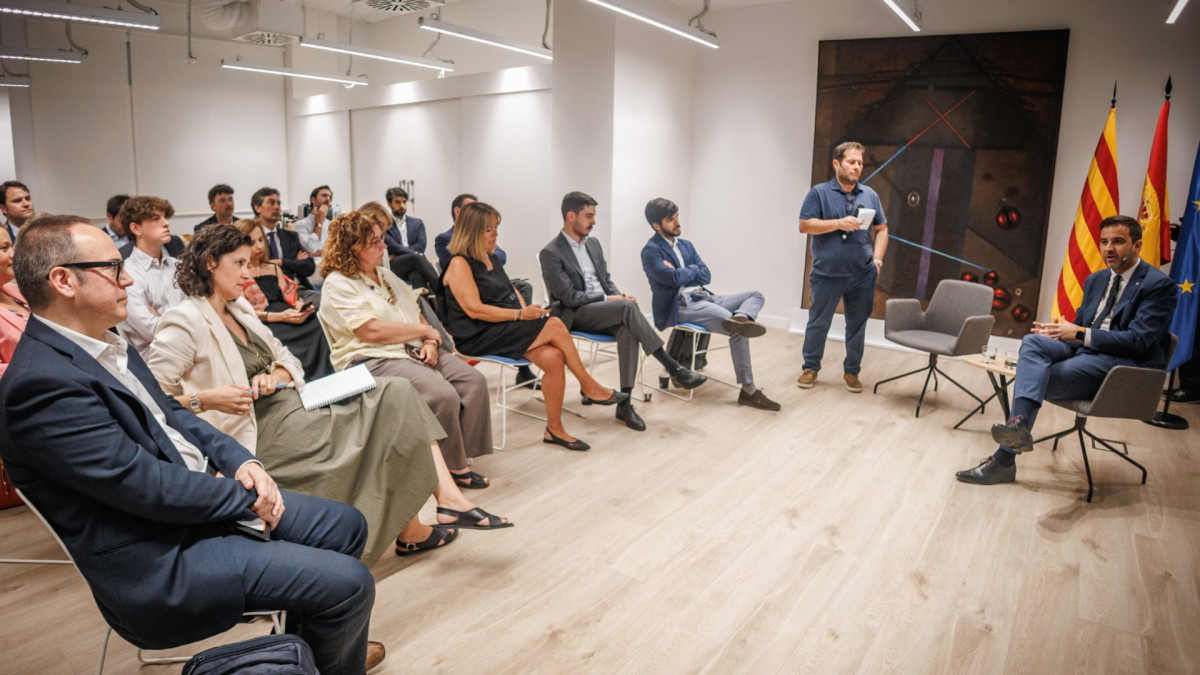
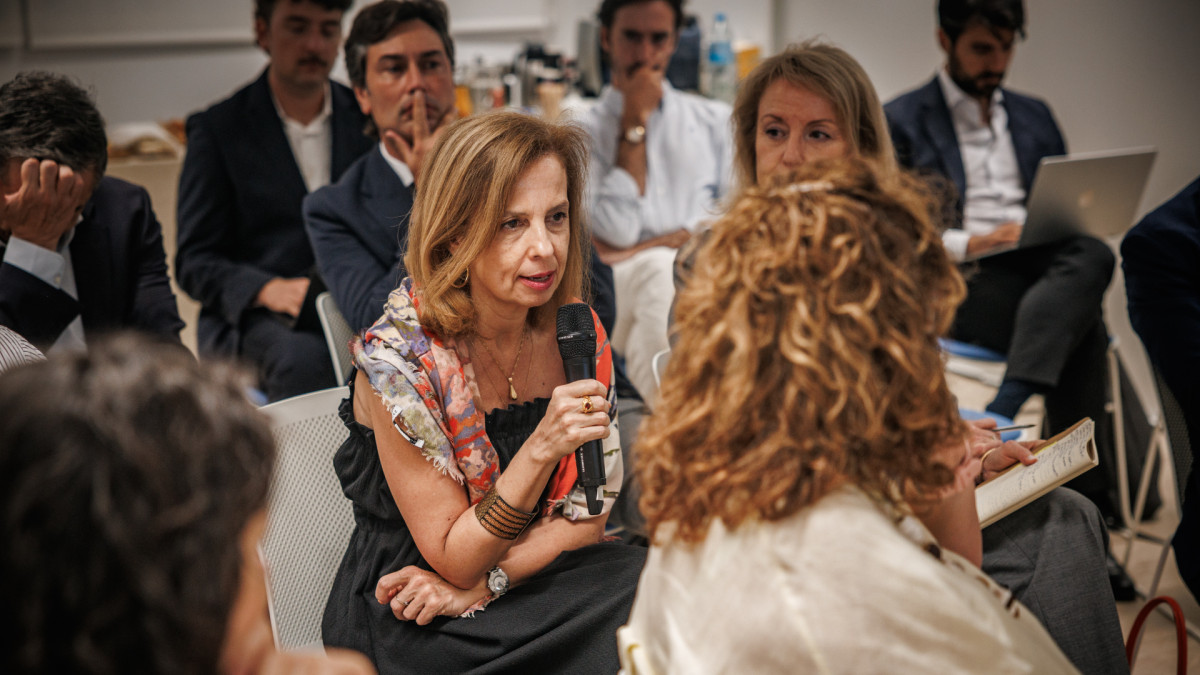
The day invited participants from different sectors to engage. Photo: Agenda Pública / Tania Sieira
Planning long-term growth
In the final stretch of the debate, participants agreed that a favorable economic moment constitutes an opportunity, but does not by itself guarantee future growth. Pep Ruiz warned that much of the recent dynamism has relied on European expansionary fiscal policy and the boost from tourism, whose ability to keep driving the economy may wane in the coming years. Hence the need to reinforce structural engines such as innovation, industry, inter-territorial connectivity, and an environment that favors attracting and retaining talent.
The economist stressed that a good current snapshot is not enough if we do not analyze how to sustain it over time. Population growth, concentration in major cities, and the need to improve connections between economic poles, universities, and research centers require greater coordination among administrations to unleash the country’s full productive potential.
“Pep Ruiz warned that much of the recent dynamism has relied on European expansionary fiscal policy and the momentum of tourism”
Pol Gibert echoed this assessment from the institutional perspective, championing the Generalitat’s “prosperity together” model and citing initiatives such as the National Pact for Industry or the Enterprise Sector Strategy to strengthen collaboration between administrations, companies, and research centers. In a context of rising international competition, he stressed that political noise should not obscure the joint work to drive common projects and facilitate investments reaching Spain.
Throughout the day, the positive economic diagnosis coexisted with a call to prepare the next growth cycle. While the priority in recent years has been to recover economic activity, the challenge now is to do so in a more territorially balanced, more innovative way, and aligned with the European Union’s strategic priorities. Participants agreed that competitiveness will depend less on the strength of each pole in isolation than on their ability to cooperate, share capabilities and develop joint projects.
“Political noise should not obscure the joint work to drive common projects and facilitate investments arriving in Spain”
In the closing, Marc López Plana revived the idea that had guided the whole conversation. The economic poles, he noted, should be understood as laboratories where new forms of collaboration among administrations, companies, and knowledge centers can be tested and later extended to the entire country. Rather than competing with one another, he concluded, the challenge is to turn territorial diversity into a shared advantage capable of driving stronger, more innovative growth ready to respond to the economic challenges of the coming decade.
Con el apoyo de




Previous Next
