
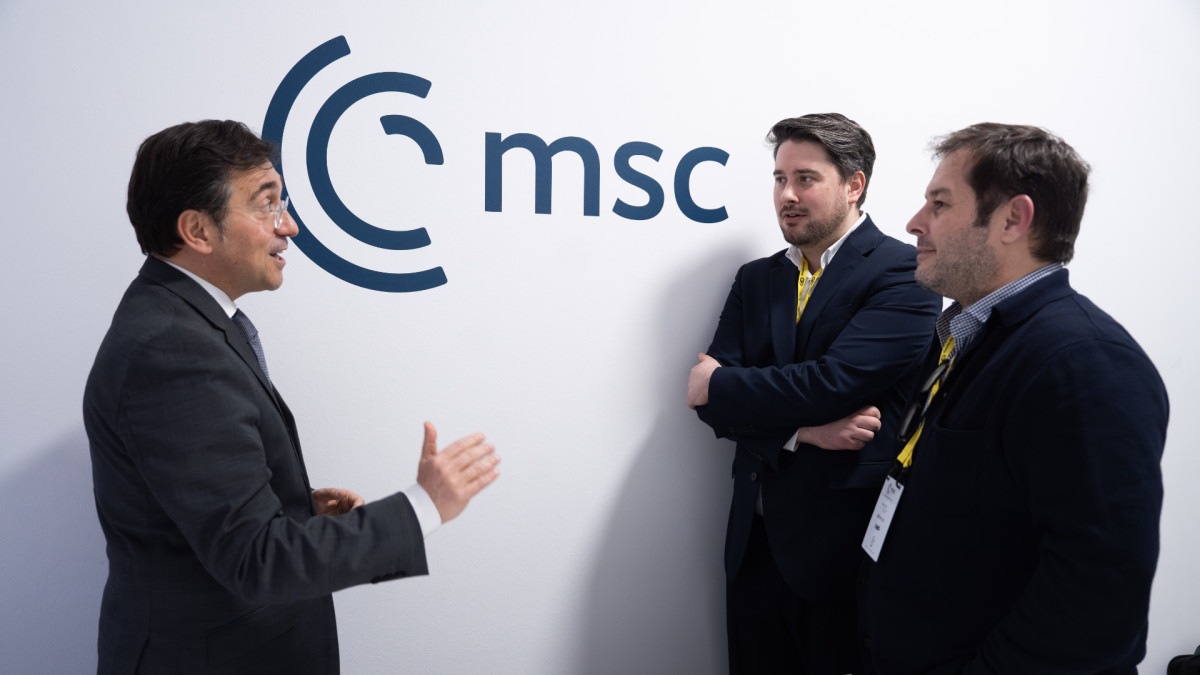
Spain has decided to elevate the digital sovereignty to the category of a state matter and international security concern. From the Munich Security Conference, Foreign Minister José Manuel Albares outlines in an in-depth conversation with our analyst Jeremy Cliffe, editor-in-chief of the European Council on Foreign Relations, how the Spanish government seeks to lead the construction of a European digital market that breaks the chains of technological dependence. “If we truly want to be free from coercion, we need a sovereign Europe“, he explains, while directly linking political freedom to the capacity to compete economically in an environment where “you cannot manage competition without cooperation; otherwise, you only reach a clash in which the strongest imposes on the weakest“.
The head of Foreign Affairs considers that Spain is at the forefront of the international agenda, drawing a parallel between its leadership in the Gaza or Ukraine crises and its role in technological regulation. As “a pivot state“, Spain advocates for an identity of its own “deeply rooted in European values” and perceives a political momentum accelerating in Brussels: “The consensus advances quite rapidly, things move very, very fast“, he asserts.
Albares defends fair competition against the law of the strongest and warns about the dangers of an external and internal policy dominated by simplified worldviews propelled by opaque algorithms. Spain’s roadmap is clear: in the face of threats to institutional demolition, the response is “the law of democracy and international law“, building an environment where “nobody wants their children exposed to hate speech” and in which technology serves humanism, not authoritarianism.
The minister Albares attends Munich to address, among other topics, the challenges of digital platforms. Photo: Ministry of Foreign Affairs / Saioa Hermosa
The Spanish Government has placed digital regulation at the forefront of its agenda, while this year’s Munich Security Report describes “a period of demolition politics” in which “an increasing number of leaders have risen to prominence promising to tear down existing institutions rather than reform them”. Is there any relationship between the two?
There are two things we must analyze. The first is disinformation and the second is dependency. For both, we need to create a European digital market.
“Citizens need to be able to reflect and ensure they make the right decision. And to choose well, real information is needed”
New technologies have enabled citizens to be better informed than ever, yet there is more disinformation than ever. For a healthy democracy, information must be verified and real. We cannot allow interference in our democracy —in our electoral processes, at the moment of voting—. Citizens need to be able to think carefully and ensure they are making the right choice. And to vote wisely, real information is required.
The second issue is dependency. We are highly dependent on companies and forces outside the European Union. If we truly want to be free from coercion —if we intend to ensure that our way of life is the one we choose and that we can say yes or no because we are sovereign—, then we need a sovereign Europe. And sovereignty means freedom from commercial coercion, from the threat of force, and also achieving digital sovereignty.
The word “coercion” is typically used with large states and foreign governments, yet here we are talking about companies, some of which are so large that their business volume exceeds the GDP of many countries.
In the technological field, it is very clear: we are facing monopolies. A lot of information passes through certain digital platforms, and we have to address these issues if we want citizens to be free.
Sometimes I tell people in Spain that we are so dependent on certain digital spheres —on certain platforms at a European level— that citizens do not even realize we are in the hands of a few companies. At times, of a single company.
Europe is about competing. Europe is about not having monopolies. Therefore, we must prevent them or we will become something different from what the European Union stands for.
Some of these platforms seem to lend themselves to a “strongman” style of politics: firm, confrontational, simplistic. It also shows up in foreign policy, where leaders with an aggressive approach, a simplified view of the world, and the idea that they can achieve things where other more democratic or plural forces cannot appear. Do you see a connection between that authoritarian style in world politics and the abuses or dangers of certain digital forces?
Undoubtedly. Without these digital platforms, there could not be such widespread dissemination of discourses that are often not just “strongman” rhetoric but hate speech. That is very toxic and divisive for our societies.
“Ultimately, it comes down to values: do you believe in humanist values or do you believe in authoritarian values?”
In the end, there are two worldviews: either you think confrontation is stronger than cooperation, or you believe the opposite. It is the law of the jungle or the law of democracy and international law. Ultimately, it is about values: do you believe in humanist values or do you believe in authoritarian values? That is what is at stake.
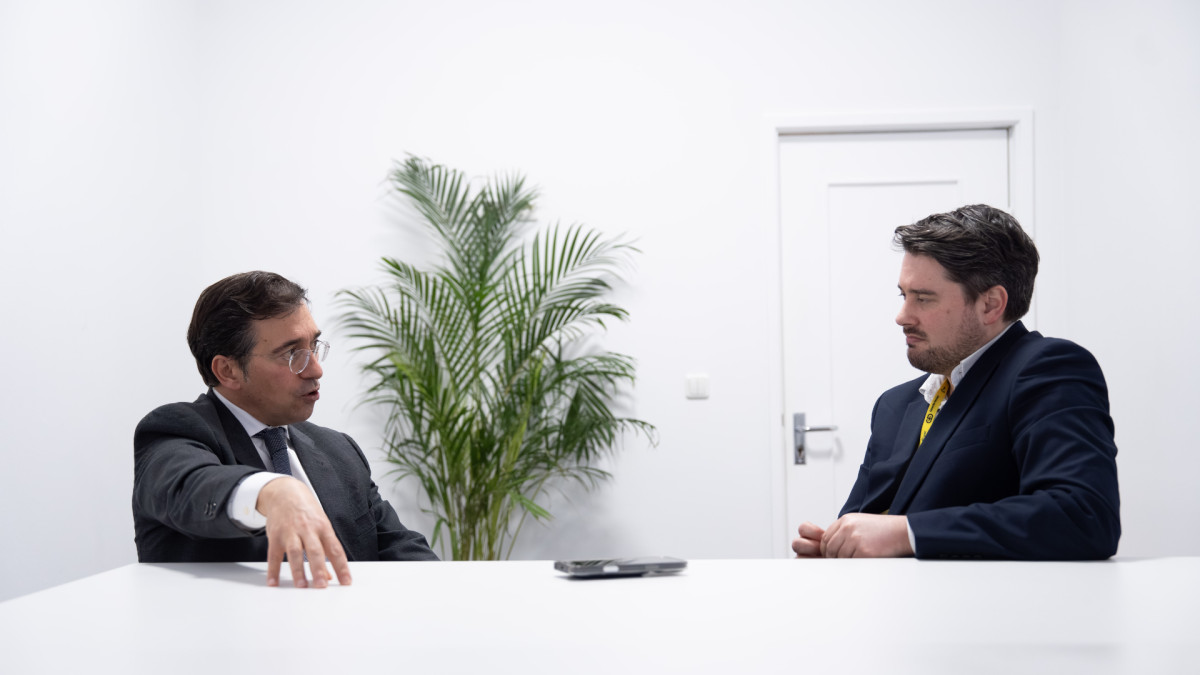
Albares and Cliffe weigh the potential political effects of social networks on democracy. Photo: Ministry of Foreign Affairs / Saioa Hermosa
Let us move to the solutions. You have spoken of more competition. What role can diplomacy play in all of this, and what role do international relations play in the search for solutions that place these technologies within a humanist framework?
Our foreign policy must have clear ideas. You cannot manage multiplicity without multilateralism, and you cannot manage competition without cooperation; otherwise, you only reach a clash in which the strongest imposes on the weakest.
There is a whole space —the digital space— where we must bring order: in competition, from a business and economic perspective; in the flow of information, to ensure it is verified and truthful; and to avoid the spread of hate speech. That is why we need rules and we have to do it multilaterally because, of course, there are no borders there. That is how our foreign policy frames it.
How does your government intend to bring this agenda to the international field? It has drawn a lot of attention, even after President Pedro Sánchez’s remarks in Davos a few weeks ago. With which partners do you see opportunities, in what formats, and with what instruments?
One of the paradoxes of today’s world is that these strong, authoritarian voices seem to be ahead, while those of us who share humanist values may appear more isolated. The truth is that those who are isolated are them. We remain a vast majority of countries and people around the world who believe in multilateralism, fair competition, free trade, regulation, and international law.
“We remain a broad majority of countries and people around the world who believe in multilateralism”
So it is not partners we lack. What we need is to find the right framework and have the political will to move forward in the face of all the noise and, at times, in the face of real coercion from very powerful actors.
The Ibero-American Charter of Principles and Rights in Digital Environments is one of our responses. Building a European digital market is another. But the partners are there. No one wants foreign interference in their national elections. No one wants their children exposed to hate speech.
Within Europe, some digital giants have intensified coercive pressure. There has even been talk of sanctioning European officials individually for their role in regulation. Do you feel there is enough consensus and energy to resist this agenda at the European level? Do you sense momentum?
Indeed. There is momentum, and the consensus is taking shape. Things are moving very, very fast. I always joke with my team: “It’s mid-February and it already feels like September,” I tell them.
It moves so fast that we think everything is slow, but we move quickly. If you think back to where we were a year ago in Munich — what the sentiment was then and what it is today — you can see the momentum. The consensus is advancing quite rapidly.
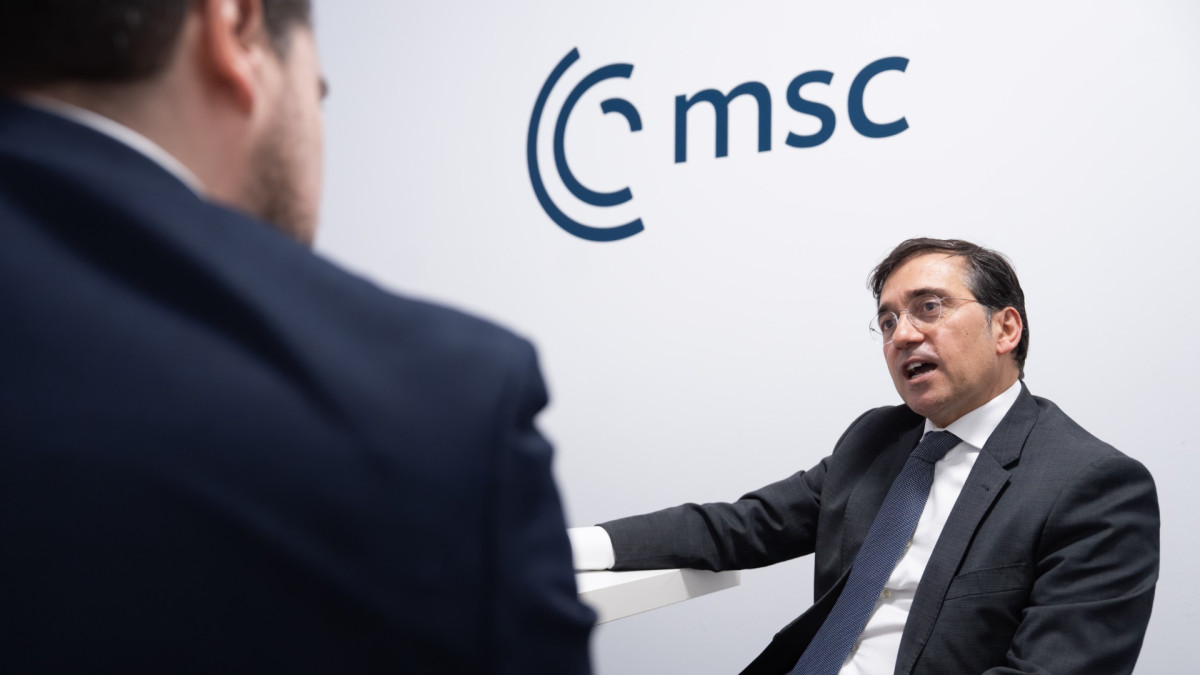
The minister Albares positively assesses EU progress in seeking consensus. Photo: Ministry of Foreign Affairs / Saioa Hermosa
The European Commission published in November its proposals for the Democracy Shield aimed at fighting disinformation. Some experts argued: “Okay, but it doesn’t go far enough. Europe should be ready to respond more firmly in cases of disinformation, manipulation, or interference.” Does Europe need to go further, to have not only a shield but also, so to speak, a democracy’s sword?
I don’t think we lack instruments. We have them. What’s sometimes missing is the awareness that we can use them and, on occasion, the willingness. The willingness to enter those spaces and confront that kind of discourse.
“Spain has a global view of the world for many reasons: the language, our history, and we truly believe in cooperation and multilateralism”
This is a huge challenge for our democracies and for the European project. If we do not address it, they will try to divide and weaken us because if they separate states, they make us more fragile. It is highly corrosive for our societies.
So it is not even a choice. We have to do it. This is the new space where we must defend democracy and social cohesion.
To conclude: this is an example of how Spain sets an international agenda. It has also happened with migration, with Gaza, with European issues. I have written about Spain as a “pivot state,” capable of engaging with many actors and bridging distances. How does that fit with being at the forefront and leading an agenda? Can you go ahead of the crowd and still be the one building all those networks?
We have done so, for example, with the recognition of the State of Palestine. We have been at the forefront from the start in supporting independence and Ukraine’s freedom. We do so by defending multilateralism and development cooperation, and also in the digital agenda.
In the end, Spain has a global view of the world for many reasons: the language we speak, our history, and because we truly believe in cooperation and multilateralism. That is why we have a global foreign policy, but at the same time, with its own identity. And that identity is deeply rooted in European values and in the principles of the United Nations Charter.
Ultimately, they are humanist values versus an authoritarian view of the world. We believe that cooperation is always stronger than confrontation.
Thank you very much.
