
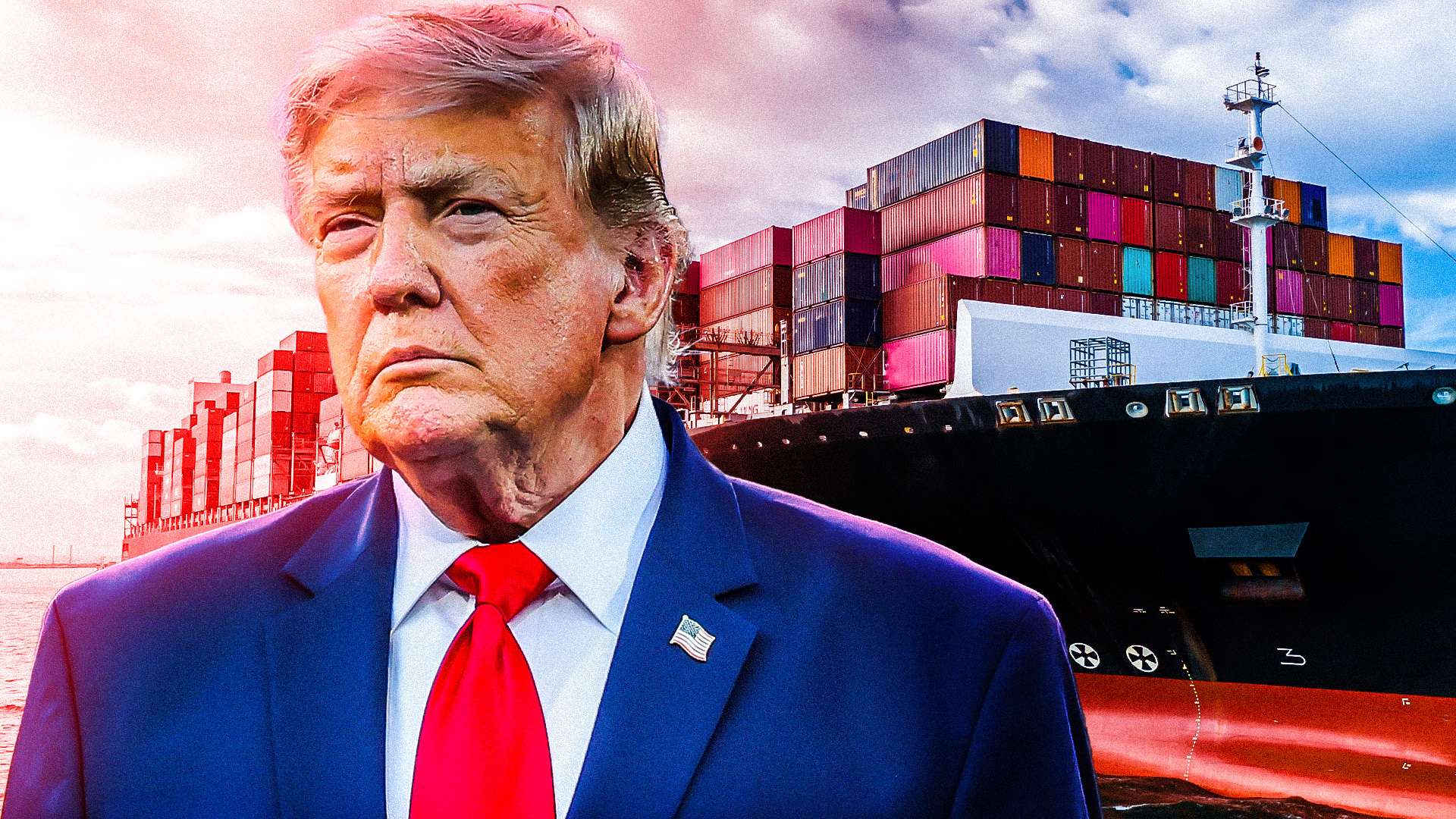
The latest phase of President Donald Trump’s trade confrontation emerged on Thursday night: new duties ranging from 10 percent to 12.5 percent aimed at most of the United States’ major trading partners.
These duties supplant the so‑called “global tariff” of 10 percent that Trump rolled out after the Supreme Court invalidated an earlier slate of tariffs in February. That global tariff had been justified under a statute granting the president authority to impose temporary duties lasting no more than 150 days; in essence, it was always a temporary fix, and the tariffs announced on Thursday are intended to function as a more enduring arrangement.
Yet, just as with the initial tranche and the subsequent temporary measures, this third batch of duties presents notable legal and constitutional shortcomings. In imposing these new tariffs, the Trump administration is once again bypassing the constraints woven into the very statute it claims to rely on. It is also flouting the constitutional principle that the Supreme Court underscored in its February ruling on the earlier tariffs.
In short: Trump’s new tariffs are likely unlawful as well. But overturning them will probably require another lengthy adjudicatory battle.
Let’s examine the two core issues one by one, beginning with the statutory defects.
Trump is invoking Section 301 of the Trade Act of 1974 to levy these new duties. Beginning today, imports from 17 U.S. trading partners—including Canada, Mexico, and the European Union—will be taxed at 10 percent. Imports from an additional 43 partners will carry a 12.5 percent tariff.
On the surface, the stated aim is to address “forced labor.” The administration contends that the tariffs stem from a review of 60 foreign economies that “fail to prohibit or to effectively enforce a prohibition on the importation of goods produced wholly or in part with forced labor.”
Right away a logical snag appears. The plan indicates that the 10 percent levy will apply even to nations that “impose a forced labor import prohibition,” so long as the administration believes that enforcement is lacking. It is unclear what exactly a country would need to do to be removed from that list. That ambiguity makes it clear that the stated goal of curbing forced labor is really a pretext for broad tariff actions.
Before Section 301 can be invoked, the U.S. Trade Representative must undertake an “investigation” into the conduct justifying the tariffs. In this instance, those investigations were described by critics as a “sham” designed to yield a predetermined result, according to Scott Lincicome, vice president of general economics at the Cato Institute, writing in The Dispatch.
“The conclusions were clearly preordained. The methodology is thin to the point of embarrassment. The remedy is both ridiculously blunt and wildly out of proportion to any measurable economic distortion,” Lincicome argues. “The action offers no mechanism for the targeted countries to secure tariff relief by remedying their purported misconduct. And the entire framework sets a precedent for an ‘automatic tariff generator’ that Trump or a future president can deploy at will.”
Earlier this year, both U.S. Trade Representative Jamieson Greer and Treasury Secretary Scott Bessent told reporters that the Section 301 tariffs were intended to replace the tariffs struck down by the Supreme Court. Greer has been explicit that the timeline for the investigations would be accelerated so the new duties could be ready when the 150‑day window for Trump’s other tariffs expired.
Thus, both in timing and in substance, the investigations backing these new duties appear engineered to arrive at a predetermined outcome.
The announced measures also seem to violate the statute’s requirement that tariffs be “appropriate” to the harm alleged. As Peter Harrell, a lawyer and scholar at Georgetown University’s Institute of International Economic Law, explained in a June post on Volokh Conspiracy, that is not the case here.
“Rather than attempting to quantify the harm caused by, for example, Italy or Japan’s alleged failure to adequately enforce a ban on imports produced with forced labor to the U.S. economy, the USTR’s investigation merely provides a few illustrative instances intended to show that a handful of individual products—such as rice exported by Myanmar—could have displaced some amount of U.S. exports in certain markets,” Harrell wrote.
Then there are the constitutional concerns. When the Supreme Court struck down Trump’s earlier tariffs, Justice Neil Gorsuch was explicit in his concurring opinion: “The Constitution places the Nation’s lawmaking authority in Congress alone, and the major questions doctrine protects that grant against executive overreach.”
What Trump is attempting with these new Section 301 duties seems to go well beyond “executive overreach.” He is again pushing the limited tariff powers granted by Congress to the brink and trying to convert Section 301 into an “automatic tariff generator,” as Lincicome put it.
That was never Congress’s intention in enacting Section 301. Even if it were, the major questions doctrine—which holds that matters with substantial economic and political significance must be decided by Congress—and the related nondelegation principle would bar the legislature from ceding such sweeping control over trade policy.
“While the Supreme Court’s nondelegation jurisprudence remains unsettled in places, last year’s ruling in FCC v. Consumers’ Research held that delegations of the power to impose taxes and other financial levies must have a clear floor and ceiling, and that more guidance is needed when an agency action could affect the entire national economy than when it addresses a narrow, technical issue,” notes Ilya Somin, a law professor at George Mason University who helped contest Trump’s earlier tariffs. “There is no meaningful floor or ceiling under the administration’s approach to Section 301. And the authority claimed is one that would profoundly influence the entire national economy.”
Of course, there is a meaningful distinction between an action that is plainly illegal or unconstitutional and one that simply keeps being blocked by the courts. In every prior instance, Trump’s tariffs have faced losses when challenged in court.
Even so, it took nearly a year for the first batch of tariffs (announced in April 2025) to be struck down by the Supreme Court (in February 2026). The second batch expired before reaching the Supreme Court—but a lower court had already ruled them unlawful.
It is likely to take a long time to push another lawsuit through the courts challenging the Section 301 duties. In the meantime, American businesses and consumers will bear the cost of these new measures—estimated at about $100 billion annually—driven by a president who seems unwilling to acknowledge the flaws in his tariff plans or the limits of his executive authority.
If there were ever a moment for Congress to enact meaningful changes to the U.S. tariff framework, that moment is now.
