
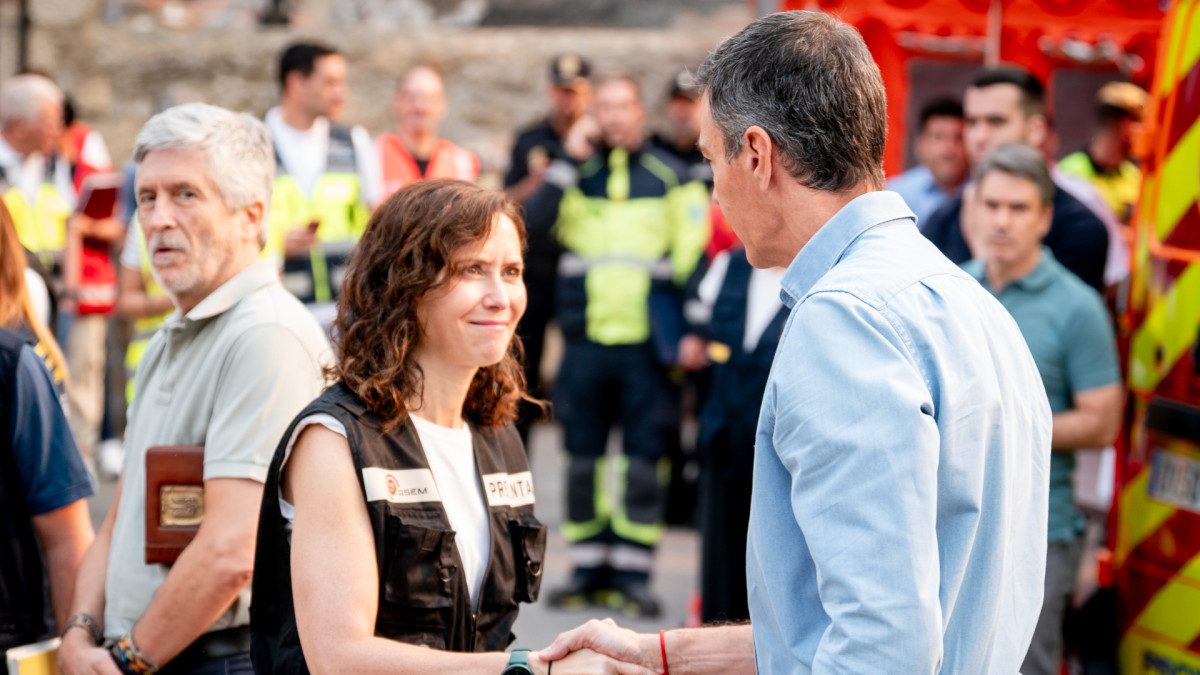
Our future is burning and our political representatives do not seem capable of reaching any agreement to unite forces in the fight against the fires that are coming. We are once again facing a matter of utmost importance for which, one more year, there does not seem to be a clear response in the form of a broad agreement (call it a State pact if you like) to prevent and tackle this kind of catastrophe. And it will not be because the population would not view it favorably, although that also varies by partisan lines. But I fear there will not be one, despite various calls. Let’s look at some evidence.
The Popular Party (PP) launched at the end of August last year an Integral Plan of Aid, Recovery and Prevention for the Rural and Forestry Environment that contains fifty reasonable measures proposed for different territorial levels (Europe, Spain, autonomous communities, and municipalities) in which the keywords are “help,” “recover,” “prevent.” The Senate (with PP majority) adopts this plan through a motion approved by 147 votes in favor and three abstentions, against 111 votes, on September 10, 2025. I do not think it is necessary to dissect who voted what. The motion’s rapporteur himself emphasizes that it is more important to have an agreement against fires than a State pact against climate change.
“Nuestros representantes políticos no parecen capaces de alcanzar ningún acuerdo para aunar fuerzas en pro del combate contra los incendios que vienen”
A few days later, the Government launches its own plan called the State Pact against the Climate Emergency, whose ten most concrete measures are found here. It is also a very reasonable proposal, open to the participation of scientists, the rest of the citizenry, and, furthermore, affected parties such as the tourism sector. It is presented by the Prime Minister on September 1 and, the following day, in the Council of Ministers. From the Government they ask the opposition of the PP to, given that some of its measures appear in the proposed State Pact, to forge a common front. Something similar has been suggested after the recent disasters of Los Gallardos (Almería) and La Mierla (Guadalajara). Silence.
That agreement was not possible then nor will it be now. And not because it is unnecessary or because the plans of either have irreconcilable differences.
That agreement was not possible then nor will it be now. And not because it is unnecessary or because the plans of either have irreconcilable differences. And not because it is unnecessary or because the plans of both have irreconcilable differences. In fact, a cursory analysis of both documents (if there are updates, we will have to see them) reveals that some (PP) observe reality to diagnose from the first floor of a building and others (Government) from the rooftop, but with similar objectives. The former tend to bring a closer, more immediate, and reactive vision and place the burden of responsibility on depopulation, the neglect of forests, and the management of fires, surely credible causes. The latter broaden the frame and link the frequency and virulence of fires to climate change, proposing prevention and transformation within a global framework of climate emergency. In both, basic concepts echo: prevent, coordinate, and respond.
That agreement was not possible then nor will it be now. And not because it is unnecessary or because the plans of either have irreconcilable differences.
Both perspectives are legitimate and useful and contain more assimilable measures than political confrontation today would make one believe. I fear the differences are more about “the floor of the building from which one looks” and, therefore, about diagnosis. The PP proposal seems more attached to forest policy and rural development, pointing to management (which, to a large extent, depends on the autonomous communities) as the main element. It avoids the concept of “climate emergency” (not cited) or “climate change” (cited only once in the context of enabling farmers to perceive income through their “contribution to the fight against climate change” by promoting carbon farming, measure 43). The Government proposal broadens the focus and links fires and other natural disasters to the climate emergency. Both plans converge on many measures, but not on the diagnosis nor the political narrative from which future public action is justified.
In electoral campaigns and similar periods, political rivals have less motivation to build agreements and more to differentiate their positions, drawing clear lines so that their respective bases stay loyal and clearly see the contours of their political proposal. The transparency with which this situation is acknowledged (page 122 and following) leaves no doubt about its existence. Practically since July 2023 we have lived something akin to the tension of an electoral campaign, with a recrudescence since late 2025 as elections were called in Extremadura, Castile and León, Aragon, and Andalusia.
In this scenario it is not only difficult to agree on measures or State pacts, but for political rivals to sit down and talk with the aim of exploring agreements.
Moreover, a State Pact would involve counting on the seventeen autonomous regional governments, some of whom already identify in this issue of fires the rejection of the label “climate change” or “climate emergency,” whether from conviction (despite the science) or from instinctive rejection of the opposite positions. Complicated. It is very difficult to reach an agreement even though positions are not that far apart, as can be seen here and, once past the initial technicisms, here.
Perhaps you may ask: why is such an agreement necessary and important? My personal answer: because it concerns a sensitive matter that affects all of us, our common good, and when a parliamentary agreement is enshrined in a law, the probability that it endures and is not repealed by a new parliamentary majority is greater. And this casts light on scenarios of stability that any democracy needs to guarantee the well-being of its citizens, which is what it is about, as the drafters of Cádiz warned us in Article 13 of the Pepa.
Besides the most immediate measures, it is in the medium and long term that we play for the future. And this future keeps burning.
Our future is burning. We all lose, regardless of the party we vote for. Even those who deny the scientific facts lose out of ignorance, myopia, or sectarianism, confirming once again Carlo Cipolla’s third fundamental law of human stupidity. Calls for agreements are made (with varying intensity, to be sure), but since both the Government and the PP launched their plans, there has not seemed to be much progress in bringing positions closer to reach any agreement that would allow implementing efficient mid- and long-term policies to reduce the frequency and extent of fires. This undermines the future of our children and grandchildren. Meanwhile, it is likely that both sides await a decisive victory at the polls to implement their plans alone or with ideologically closer allies. But that decisive victory may not come, which would generate a scenario of new uncertainties and difficulties in reaching agreements that guarantee the well-being of citizens looking to the medium and long term. And we are back at square one. Besides the most immediate measures, it is in the medium and long term that we stake the future. And this future keeps burning.
