
It seems that the Latin American “pendulum,” alternating between waves of leftist governments and waves of right-wing governments, has reached a new dimension. In several countries, the population has not felt that responses have been provided to problems that have been on the table for decades: poverty, insecurity, corruption, and states unable to guarantee basic services. Now that traditional options have lost a large part of their trust, populist leaders emerge who promise to tackle all these problems at once. And they want to do so at the expense of democratic institutions.
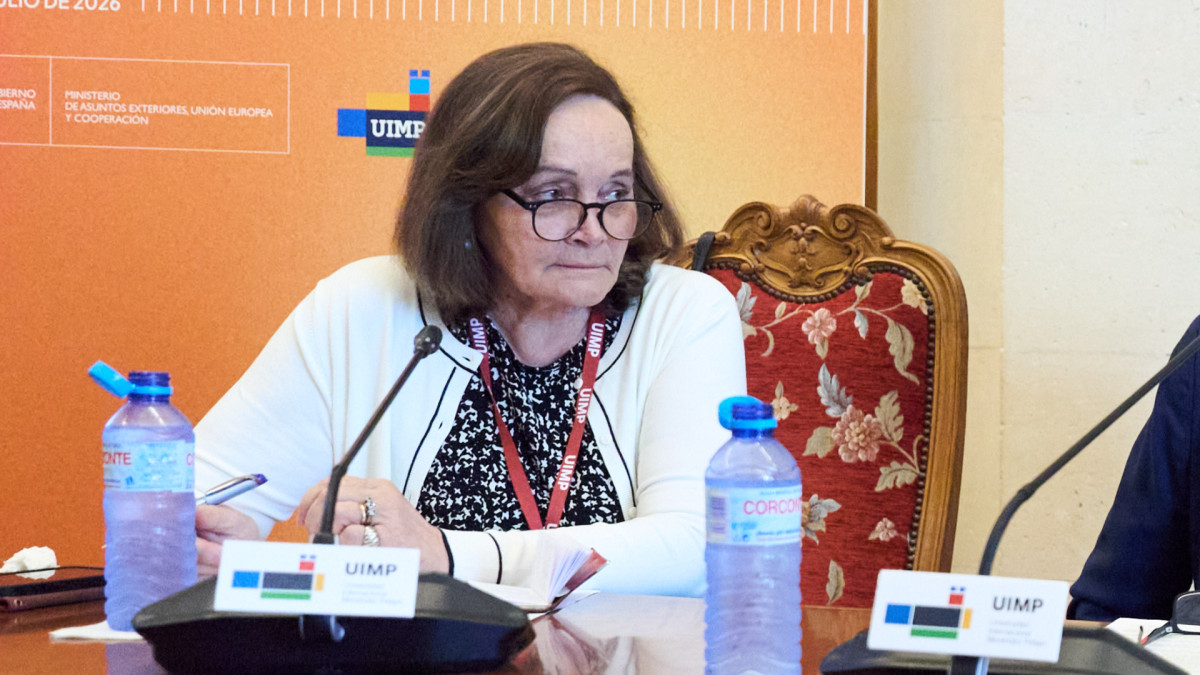
Marta Lagos has spent more than thirty years observing that relationship between citizenship, institutions, and power from Latinobarómetro, the organization where she is a founding director. During the fourth edition of the Spain in the World 2026 course, I had the opportunity to speak with her about the rise of Bukele, Milei, and other figures of the radical right; about elites who, in her view, have ruled for too long for themselves, and about the struggle between the United States and China in a region where Spain still has room to play a role of its own.
Her starting point is that “the Latin American population maintains a demand for democracy”, even if it rejects the way democracy functions in much of the region. The problem today is that “populists and dictators come to power through elections” and they find support in societies tired of governments unable to fulfill their promises. From there, Lagos posits that there is a dilemma about how much citizens are willing to sacrifice institutional norms when someone offers them security, prosperity, or tangible results.
Usted tiene años de experiencia al frente del Latinobarómetro. ¿Cómo ha evolucionado América Latina en términos de confianza y participación democrática? Parece que hoy se observan avances en algunos aspectos y retrocesos en otros.
I believe that democratic transitions occur in many countries not only due to a demand for civil and political liberties but also for prosperity. At the beginning of transitions there was extreme poverty and deprivation. The dictatorships had arrived promising improvements that ultimately were not fulfilled.
The failure of the military dictatorships opened space for democracies. But these were born in populations that, in many cases, had never lived in democracy. They had been socialized under dictatorships, with exceptions such as Colombia or Uruguay. I think academia makes a big mistake when it presumes that, as if by magic, these populations would embrace all aspects of democracy, as if it had fallen from the sky, without considering that there is a process during which certain features are accepted and these become entrenched as they are realized.
When Spain transitions to democracy after Franco’s death, nearly 80% of the Spanish population embraces democracy. Latin America, by contrast, has never had that level of support—in either the early days, during the transitions, or afterward. For a very simple reason: Spain knew democracy through Europe; Latin America did not know democracy.
Therefore, when democracy is judged and it is said that it has died because there are far-right governments and difficulties in all the countries, it is forgotten that there is an unmet demand for democracy.
“In the end, it isn’t that democracy fails: what fails is the ‘delivery’ of democratically elected governments”
Today governments of the far right or populists are elected because for thirty years others—leaders from political parties that did not fulfill the promise of the glass of milk—were chosen. In the end, it isn’t that democracy fails: what fails is the delivery of democratically elected governments.
And it should be noted that today populists and dictators reach power through elections. The possibility of seizing power by weapons has largely ended. It is the population itself that votes them in. Why? Because it embraces the democratic mechanism of the ballot. But, as the North American proverb goes, things will get a lot worse before they get better. First the military failed; now the populists and autocrats must fail, and then a new democratic era will come.
¿En qué se traduce esta degradación democrática?
The difficulties facing democracy in Latin America today stem from leaders who seize the power to override laws, as Bukele does, who is already a dictator; as Milei does, who is also on the edge; or as Keiko Fujimori could do in Peru. Since 2019, Latin American countries tend to tilt toward the opposite side. If the left governs, the right is elected; if the right governs, the left is elected. There is alternation in power.
That is the result of populations looking for solutions: “I don’t like this; I’ll go to the other side. I don’t like what this side has done; I’ll go to the opposite side.” And when the population has already tested both the right and the left, it turns to populism. If you look at the time line of some countries, they first try the right, then the left, then back to the right and the left, and on the fifth time, they elect populists.
“What they don’t want is democracy as it functions in their countries, because these are terribly flawed, imperfect, or deficient democracies”
What is that telling us? That governments have not been able to respond to the demands. The 150 million poor people who still remain in Latin America are concrete evidence. Of course, in the middle there were the pandemic and many other factors. But I value the fact that the Latin American population maintains a demand for democracy. What it does not want is democracy as it functions in their countries, because they are democracies terribly flawed, imperfect, or deficient, with weak states, incomplete structures, and governments that abuse power and rife with corruption. If you put all those elements together, you cannot blame democracy itself.
Entonces, ¿quiénes son los responsables?
The elites. The failure of the democratization process in Latin America, the lack of consolidation of democracies, and the crises that have occurred are due to the failure of elites who, as Latin American peoples say, have governed for themselves and not for the majority. The corruption of elites and of governance structures, with massive cases in Argentina, Mexico, and Brazil—the three largest countries in the region—and also in Colombia, shows a pattern: the common good and solving people’s problems do not come first.
“The failure of the democratization process in Latin America is due to the failure of elites who have governed for themselves and not for the majority”
Then the population elects populists. It elects a man named Bukele. I think Bukele is a dictator today, but in the space of a year he solved something Salvadorans considered impossible. And what did he do? He bypassed all the rules. Therein lies the dilemma: which is more important, the result or the path to reach the result? That is what is still at stake in Latin America.
En Europa estamos viendo algo parecido, no necesariamente con el populismo, sino con la derecha radical, de la que se dice que al menos ofrece o pretende ofrecer una respuesta a las demandas de la población. Sin embargo, buena parte de la derecha radical europea empieza a darse cuenta de que Estados Unidos y Donald Trump no parecen unos aliados positivos para sus proyectos, aunque estos sean nacionalistas. En cambio, esta nueva ola electoral de la oposición en América Latina viene acompañada de una élite muy favorable a Trump: Keiko Fujimori, Abelardo de la Espriella, los Bolsonaro y, por supuesto, Javier Milei. ¿Cómo interpreta esta diferencia?
I think that, indeed, Trump and the United States have no particular interest in the region’s countries nor in European countries. What they want is to use anyone who agrees with them to achieve their own ends, not to promote the well-being of other peoples. If the leaders of the global far-right do not realize that, they have a problem. Meloni has realized it; Abascal has not yet.
Trump is using the global far-right for his own benefit. He is not trying to solve the problems of Venezuela or Cuba. He wants to triumph above all. From that point of view, for example, Kast has a problem because Trump does not appeal to all the Chilean right. As he grows closer to him, he also alienates a part of his own electorate.
“Trump is using the global far-right for his own benefit. He is not trying to solve the problems of Venezuela or Cuba”
It is a complex situation because, moreover, the Southern Cone countries have a historical memory of United States intervention and many other things. Their populations do not see the United States as a positive ally. The case of Central America is different, because Central Americans do have a good opinion of the United States. Therefore, it depends on each country. Bukele can embrace Trump without it causing a big shift because Salvadorans love the United States.
¿Y qué ocurre con China?
China is an indisputable economic power that no one can do without. Each country deals with China in the best way it can. Besides, Latin American countries are weak, small, with little power and facing significant economic deficiencies. Their economic dependence is enormous. China provides trade and they will never tell it no.
China has all the possibilities to penetrate Latin America. There is the port of Chancay in Peru. The truth is that the North Americans slept. That port took ten years to build; it did not appear overnight. Now the bi-oceanic corridor is being built, which will transform the region and could represent a revolution.
“China is an indisputable economic power that no one can do without. Each country deals with China in the best way it can”
One of Latin America’s major problems is territorial mobility. Roads and railways are virtually non-existent. We have terrible physical infrastructure. The main way of communication is by air, because the sea and the land are not well used. As the Chinese change that situation, they will dominate. I think the United States has already lost that battle and will not arrive in time. It does not have the money, the people, or the plans required to compete with what China is installing in the region.
También es cierto que el modelo más reciente de Estados Unidos no pasa por las infraestructuras, sino por intervenciones políticas como la que ha llevado a cabo en Venezuela o la que planea sobre Cuba. ¿Cómo se vive eso?
I think those are initiatives by an individual, not by the U.S. state. The Chinese, by contrast, develop state-led initiatives, not personalistic ones. Whether Xi Jinping is in power or not, the bi-oceanic corridor will be built anyway. The same happens with the New Silk Road.
They took twenty years to build the route between Shanghai and Rotterdam. They have long-term visions that are unchangeable. They will bring their trains to Europe and will have some of the fastest trains in the world. They will compete with airways by land transport and will end up dominating Europe. In two generations, Europe will be deeply penetrated by Chinese land-based technology.
“The Chinese develop state-led initiatives, not personalist ones. Whether or not Xi Jinping is in power, the bi-oceanic corridor will be built anyway”
They will also dominate Latin America through their ports and I think they are seeking other strongholds. What will the United States do meanwhile? Start a war with Iran? Another war with Cuba? It has no way to compete. I think it is pursuing the wrong path.
I am not a supporter of China, but, when I observe what it is doing…
ARTÍCULOS RELACIONADOS
El profesor Torreblanca ofrece una presentación en el curso de verano España en el Mundo 2026.Agenda Pública
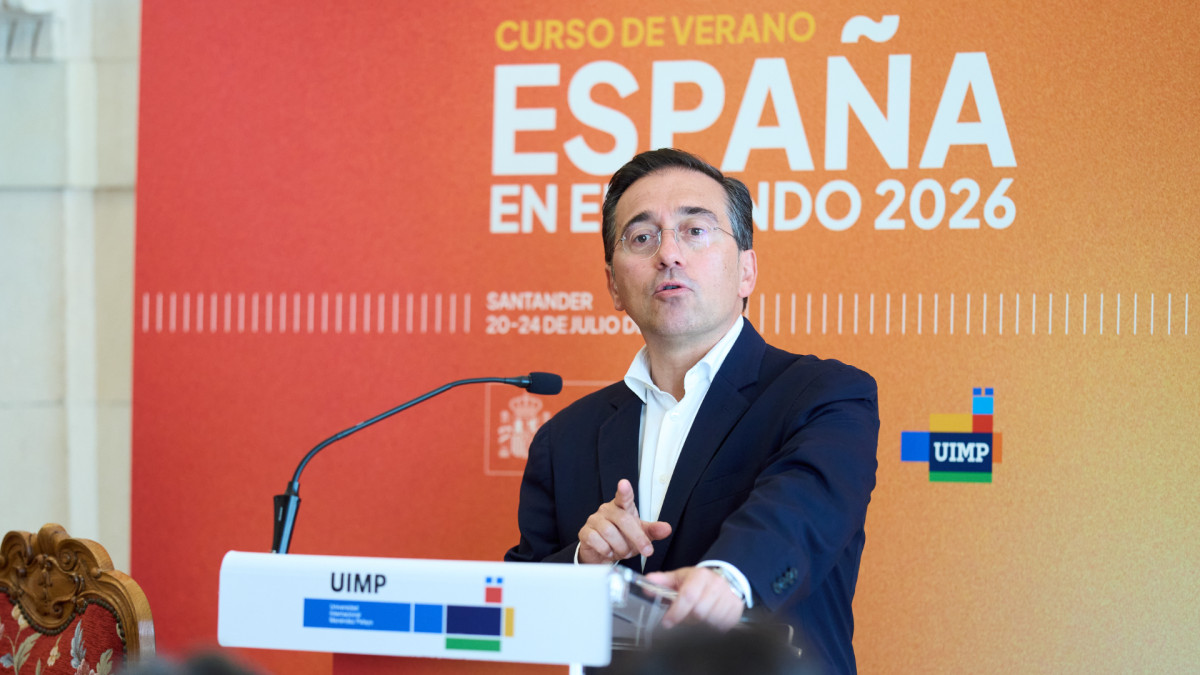
José Manuel Albares durante su intervención en España en el Mundo 2026.Imagen cedida
Estos días, en España en el Mundo, se ha hablado mucho del papel de España en la región. Creo que su visión es positiva, pero ¿qué podríamos hacer desde España que todavía no estemos haciendo para responder a esa demanda de prosperidad de la que hablaba?
Recuerdo siempre la frase de Juan Carlos I cuando le gritó a Chávez: “¿Por qué no te callas?”. Creo que se necesitan voces fuertes, capaces de decir lo que todo el mundo está pensando. Vivimos en un mundo en el que pocos se atreven a hacerlo.
Sánchez ha asumido un liderazgo muy importante últimamente porque logró interpretar algo que todo el mundo estaba pensando y que nadie decía. Pero creo que se necesita mucho más en términos culturales, económicos y políticos.
Alguien tiene que criticar a la élite latinoamericana. Es una élite que se ha dejado llevar por la corrupción. Se pueden contar con los dedos de una mano los gobernantes latinoamericanos que han dejado el poder sin estar acusados de corrupción. Nadie lo dice, pero no se puede seguir nombrando a ministros y exministros de gobiernos corruptos para altos cargos internacionales como si no hubiera sucedido nada.
“Sánchez ha asumido un liderazgo muy importante últimamente porque logró interpretar algo que todo el mundo estaba pensando y que nadie decía”
Hay mucho por hacer para poner los puntos sobre las íes respecto a lo que realmente está pasando. Los Estados son débiles y es importante fortalecer las estructuras institucionales. También hace falta regenerar las élites, formar dirigentes capaces de tomar el bastón de mando y combatir la corrupción. Con los actuales niveles de corrupción en América Latina es muy difícil avanzar.
Tengo una anécdota muy ilustrativa. Hace diez años estaba sentada en la institución creada por un presidente latinoamericano que acababa de dejar el poder. Es relativamente frecuente que algunos presidentes creen sus propios institutos después de abandonar la presidencia. Yo estaba en la cuarta fila y allí iba a hablar un invitado extranjero. Una señora se sentó a mi lado y le dije: “Qué fantástico. Qué buena tecnología. ¿Cómo consiguen tener todo esto? En Chile no tenemos nada parecido”.
La señora me miró y me dijo: “Es que aquí nosotros sabemos ordeñar la vaca hasta donde se pueda”. La persona que me dio esa respuesta era la ministra de Educación del país. Esa es la mentalidad.
El edificio era increíble y probablemente se había construido con fondos estatales, aunque no tengo ninguna constancia. Eso también es América Latina. Cuando se piensa que la situación es distinta, alguien tiene que mostrar lo que ocurre y denunciarlo como algo ilícito.
“Mientras la población siga diciendo: «Bueno, fulano hizo esto, pero mira lo que hizo el otro», los dirigentes competirán en ese terreno”
Mientras la población siga diciendo: “Bueno, fulano hizo esto, pero mira lo que hizo el otro”, los dirigentes competirán en ese terreno. Estos cuarenta años han demostrado que existe una dificultad tremenda para decir la verdad sobre lo que sucede en la política.
También faltan liderazgos. Ha habido dirigentes como Ricardo Lagos o Pepe Mujica, pero ¿cuántos son? ¿A cuántos podemos nombrar que realmente hayan sido capaces de poner los puntos sobre las íes y dar un paso adelante?
Muchas gracias.
