
Espain is burning again. It’s no novelty, even if every summer it seems so: the flames recur like a macabre ritual that reminds us the country burns not only in its forests but in its deepest social fractures.
In an article titled “Once Upon a Pyromaniac,” published nine years ago in La Voz de Asturias, it warned that fires were not merely a matter of arsonists, but a metaphor for a country crumbling in its job market, in its administrative cracks, in its increasingly fractured social fabric. Today, as headlines once again speak of hectares laid waste by the cruelty of fire, the metaphor is confirmed with painfully precise clarity.
“The fires are the mirror of a society that breaks, and in that break, it produces arsonists”
The flames that devour hills and villages are also the ones that reach precarious work, rural abandonment; they are the same that burn with institutional neglect. Each spark that ends up scorching Galicia, Asturias, Castilla and, now, Madrid seems to also ignite the memory of a State that cannot rebuild its protective mechanisms. The fires are the mirror of a society that breaks and that, in that break, produces arsonists: individuals who, by destroying, express the rage of feeling expelled from a system that does not recognize them. But they are not the problem; they are only a symptom.
It is not only about hectares of forest reduced to ashes, nor about smoke that darkens the sky and the will. It is about a country that consumes itself in its inability to manage the common good. The fires are the metaphor of that uncontrolled social anger, obstinately bent on razing everything; they are the living image of that impulse to destruction fed by social frustration. And every summer, when Spain burns —because inevitably every summer Spain burns— what we see is not merely fire; what we witness is the very representation of a collapse that repeats, that multiplies, reminding us that we still have not doused the embers underlying it. We speak of cuts, of labor discrimination, of looking the other way while waiting for the rains to come. In short, we continue believing that band-aids are the cure, and we have paid dearly for that unforgivable mistake.
Nine years ago, the same as twenty years ago, Galicia burned. And reading it now is like looking in a mirror that returns the same image — one that is heavily blackened —, only now it is in the center of the country. Spain burns because it has failed to rebuild itself. And, as the flames advance in Ávila and Madrid, the question persists: what more has to burn for us to understand that the fire does not start in the forest, but in the cracks of our society?
Administrative clumsiness and social fracture: the keys to the vicious circle of annual fires
Up to now, what is known is that, in Ávila, the flames sprang from metallic sparks: two men, a forbidden machine, a moment of carelessness (or, rather, a reckless act) turned everything into devastation. The investigations, of course, continue; doubts, too.
“What greater responsibility rests on a system that allows the same tragedy to repeat every summer?”
Today, Burgohondo, Navaluenga and El Tiemblo are names turned into ashes. The Valle de Iruelas, sanctuary of the black vulture, has become black smoke. The Civil Guard detained the perpetrators, but the question lingers in the air —one, incidentally, very dark—: what greater responsibility rests on a system that allows the same tragedy to repeat every summer?
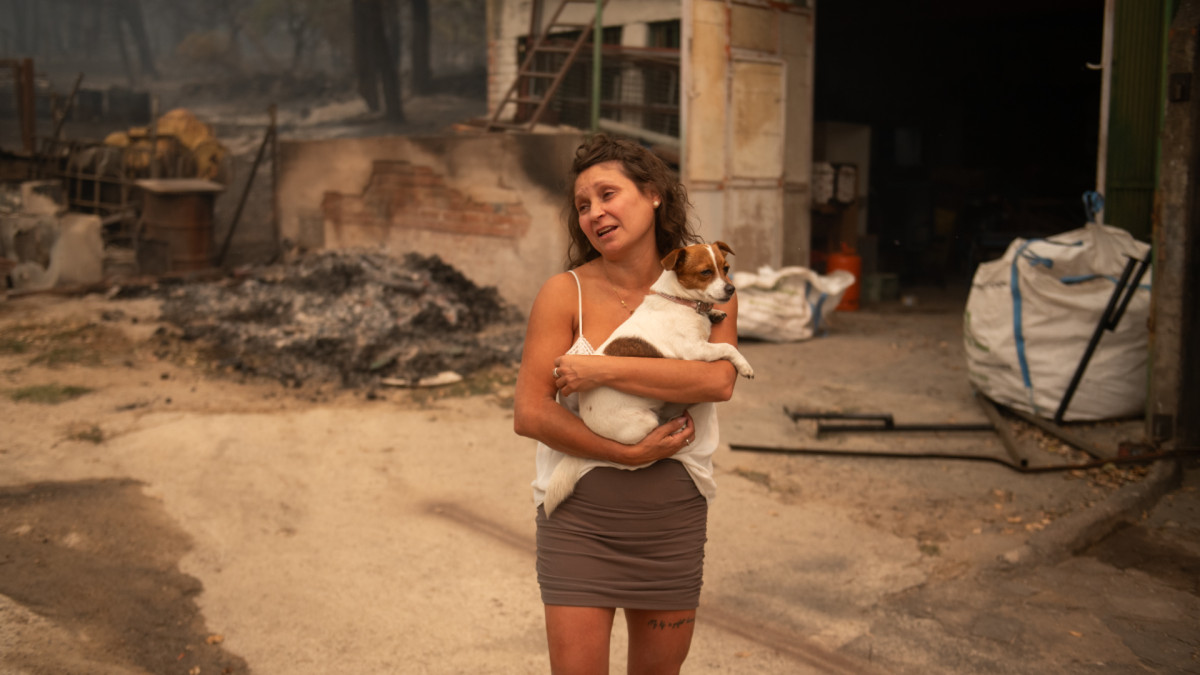
In Madrid, the fire does not respect borders. From Almorox, in Toledo, it leaped to Villa del Prado and spread like an out-of-control monster toward Aldea del Fresno, Navas del Rey and Colmenar del Arroyo. At the same time, another starting point fueled the phenomenon: a vehicle set ablaze on the M-501 devastated San Martín de Valdeiglesias and forced the confinement of entire urbanizations. The result? Thousands of people evacuated or confined to their homes as the smoke turns the Sierra Oeste into an apocalyptic landscape. Not to mention the ecological carnage that the flames have already left in their wake.
The flames of uncontrolled fire do not distinguish between towns, provinces or identity cards: they are the same ones that each year reveal the cracks of a country. Rural precarity, administrative neglect, lack of prevention and budget cuts are among the causes of a problem that, deep down, touches us all. Today, neighbors face the blaze with household hoses, and forest brigades are overwhelmed. The State declares a national emergency, but the sense is the same as ever: in the face of tragedy, help arrives late, when there is little left to save.
Today we speak of Madrid and Ávila as if they were different countries and times. But in 2022 the same happened in the Sierra de la Culebra, Zamora. In Galicia, they know it better than anyone: in 2006, between 70,000 and 92,000 hectares were reduced to ash after someone waited for the driest day and the strongest winds to unleash the devastating spark; in 2017 another 20,000 hectares; last year, the record destruction: 118,000 hectares. And in Asturias? The same: 1997, 2002, 2008, 2009, 2016, 2017 and 2023 are ecologically fateful years. The last of them, the worst.
Spain, today, is burning again: in its forests, in its towns, in its institutions. And as everything boils, the excuses, pretexts, and late explanations begin. In these days, when you open the papers, the news has jumped that, in April of this year, Madrid’s firefighters publicly denounced that there was not enough staff to cover the department’s needs. It turns out that the recruitment of 267 new personnel was halted because the process to conduct the mandatory medical examinations remained unfilled, preventing them from taking up their posts and worsening the staff shortage. It’s true: it might sound like a joke —in very bad taste, by the way—, but it isn’t.
“The State declares the national emergency, but the feeling is the same as always: in the face of tragedy, help arrives late, when there is little left to save”
Ten years ago, a candidate for the forestry post told the reporter who writes these lines that almost all fires in Spain are intentional. He spoke of the deep economic and institutional crisis that preyed on those who spent years studying to aspire to care for the woods. He was one of the underprivileged in that system. Each year he waited for the call to take the tests and open posts, but each year ended in disappointment. Eventually, he gave up and ended up as an Amazon delivery driver. “Many of the fires are started by people who, like me, were not lucky enough to get the post. They do it to prove that there is indeed a need for more foresters,” he said. He also spoke of how these senseless, devastating reactions only closed vicious circles between administrative clumsiness and social fracture. Whenever he addressed the topic, he ended with the same line: “Don’t you believe me? Wait until next year, and you’ll see we’ll be in the same place”. I repeat: that was ten years ago.
Today Spain, as every year, burns again. And, while the smoke covers the sky, the question repeats: how many more summers will we need to understand that the fire does not start in the hills, but in the cracks of administration and of society?
