
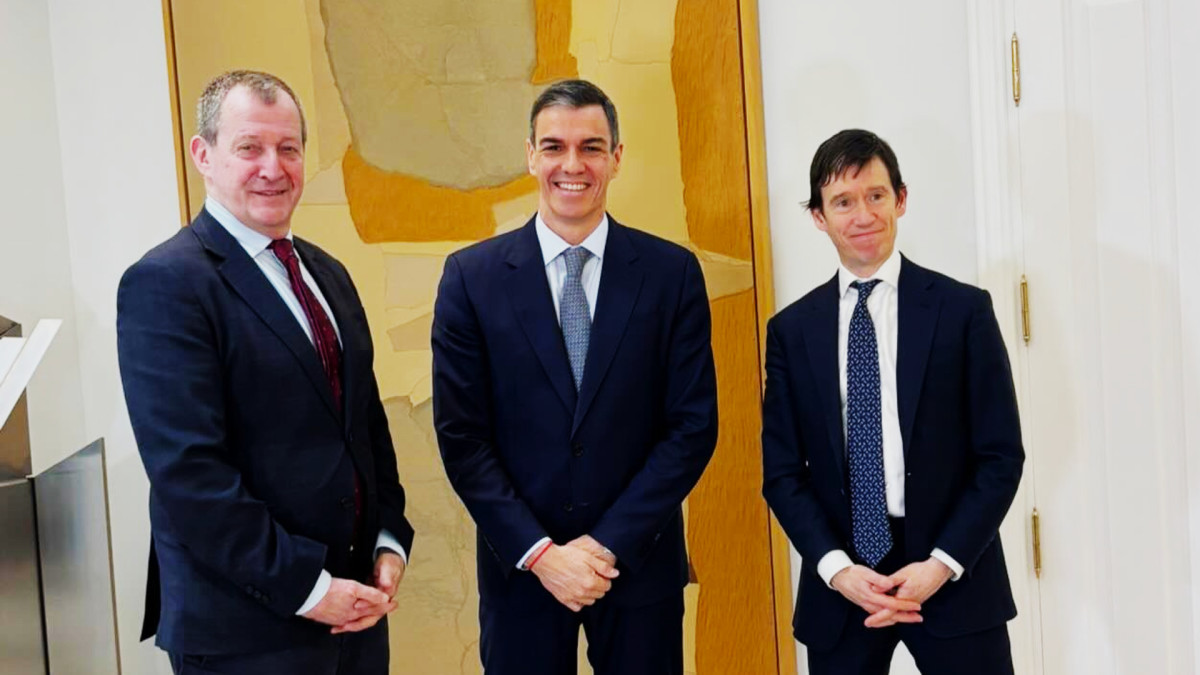
Alastair Campbell, the strategist who for a decade helped build Tony Blair’s political project, welcomed me in London several months after having chatted for an hour with Pedro Sánchez on his podcast The Rest Is Politics. Had that interview been conducted by a Spanish journalist, it would have revolved around issues like amnesty, judicial investigations, polarization, and so on.
What caught Campbell’s attention was the president’s demeanor, which he found “Very clear, very coherent, very composed.” In other words, what impressed Campbell most wasn’t any specific answer Sánchez gave, but his absolute control over the rhythm of the conversation. Even when addressing the investigations affecting members of his entourage, Campbell recalled that the president’s aspect scarcely changed. He never lost his cool or gave any impression of discomfort. That hints at a significant difference between political conversations inside and outside Spain that deserves some reflection.
Spain continues to analyze Pedro Sánchez as a domestic phenomenon – the leader who divides the country, who survives against the odds, and who governs without a clear parliamentary majority. But beyond our borders, another reading is taking hold that I find much more interesting.
In fact, an altogether different set of questions might be more interesting – not a conversation about how Sánchez has managed to stay at Moncloa, or how long he might remain, but rather how a country that for decades was scarcely mentioned among the great political capitals of Europe has come to occupy a central place in some of the main debates on the continent.
“Spain continues to analyze Pedro Sánchez as a domestic phenomenon. But beyond our borders, another reading is taking hold”
“Spain’s international position has changed,” Campbell asserted very matter-of-factly. For years, Europe was dominated by a small collection of capitals – Paris, Berlin, and London, with Rome or Warsaw sometimes joining the conversation – while Spain remained in the background. Today, Campbell argues, Madrid is expected to take a position on all the world’s major strategic issues. Perhaps the most striking feature of contemporary Spain is not the intensity of its polarization, but the growing contrast between how the country is perceived from within and how it’s starting to be regarded from the outside.
Madrid is still engaged in national politics, as must be the case. But while Brussels is interested in capacity for influence and potential for leadership, Spain remains focused on discussing parliamentary alliances. In that context, there is no “right” or “wrong” conversation. Instead there’s a recognition of current changes to the very nature of political power.
Before and throughout the rise of globalization, a relatively clear boundary was drawn between domestic and foreign policy. Prime ministers could delegate many aspects of international affairs while concentrating their political capital on the economy, taxes, or the welfare state.
Now that paradigm appears to have run its course. For that reason, Campbell insisted several times during our conversation that today, governing effectively means doing both things at the same time. Immigration, energy, artificial intelligence, the war in Ukraine, food security, trade, and technological rivalry with China are now essentially domestic politics conducted by other means.
“While Brussels is interested in capacity for influence and potential for leadership, Spain remains focused on discussing parliamentary alliances”
And in Campbells’ opinion, Sánchez seems to feel especially comfortable with that new state of affairs. From the outside, it’s striking to note the extent to which many of the positions that seemed extravagant just 18 months ago have now shifted to the center of the European debate. He mentioned two obvious examples: attitudes toward Donald Trump, and Spain’s position on Gaza. When Sánchez began to publicly challenge certain U.S. positions and was among the first leaders in Europe to take a harder stance on Israel’s offensive in Gaza, much of the conversation in Spain interpreted those moves as signs of international isolation.
The former advisor for the Labour Party sees it the other way around: “Sometimes, leadership is about arriving before everyone else.” In that contrast can be found some valuable keys to understanding why Spanish politics is at times so difficult to explain outside the country. Here, the most common practice has been to view every discussion in its own particular frame; abroad, a more linear strategy can be observed – perhaps because Spain is just one among many other topics.
This was probably the most thought-provoking part of my conversation with Campbell. He rejected the criticism most often heard against Sánchez – that he continuously changes his position – by way of a differentiation between “strategy” and “tactics” typical of British analysis. “He has changed specific positions, no doubt. But has his political project changed fundamentally? I don’t think so,” Campbell remarked. “What I see is someone who tactically adapts his positions to pursue an extraordinarily consistent strategic vision.”
One idea from Alastair Campbell operates almost as a critique of contemporary political journalism. In the United Kingdom, there’s an automatic headline that accompanies any alteration in a prime minister’s position: “the humiliating U-turn”. Campbell rejects that logic. He argues that to confuse tactical adaptations with strategic renunciations is one of the great mistakes of political coverage today. Trying to govern in a changing world requires that one’s decisions be modified. What defines a leader isn’t the absence of change, but the coherence of the direction one pursues.
Campbell’s reflection goes beyond the case of Spain. Western democracies live with political fragmentation that forces governments to sustain changing coalitions, while international crises frequently alter national priorities. Under such conditions, to govern for ten years without revising any concrete position would be incompatible with reality.
Campbell argues that a change of heart should not be judged without regarding the facts. A phrase attributed to Keynes sums it up perfectly: “When the facts change, I change my mind. What do you do?”
“What I see is someone who tactically adapts his positions to pursue an extraordinarily consistent strategic vision”
The distance between perceptions of Sánchez within Spain and internationally may have to do, in part, with this way of understanding leadership. Many foreign observers don’t follow every episode of national politics. Above all, they see a leader who has built a relatively coherent discourse on the place he wants Europe to occupy in a less stable, more competitive world. Strategic autonomy, European integration, immigration as an economic necessity, the energy transition, and artificial intelligence all appear in that discourse as facets of the same political project. Whether shared or not, this project has recognizable contours that are more visible from the outside.
Campbell took that reasoning further to wonder whether many Spaniards haven’t yet recognized the caliber of leader they have before them. Instead of trying to position Sánchez as better or worse than his European counterparts, Campbell places the president in a different generation composed of leaders who govern on the assumption that national politics can no longer be separated from geopolitics, technology, or competition among great powers.
Is there any guarantee that such an interpretation will survive the passage of time? Not really. However, at present, the contrast is perfectly visible: in Spain, the conversation loops back every week to how long Sánchez will be able to stay in power; meanwhile, in much of Europe, there’s a discussion about what his international leadership says about the new Europe that’s starting to take shape.
