
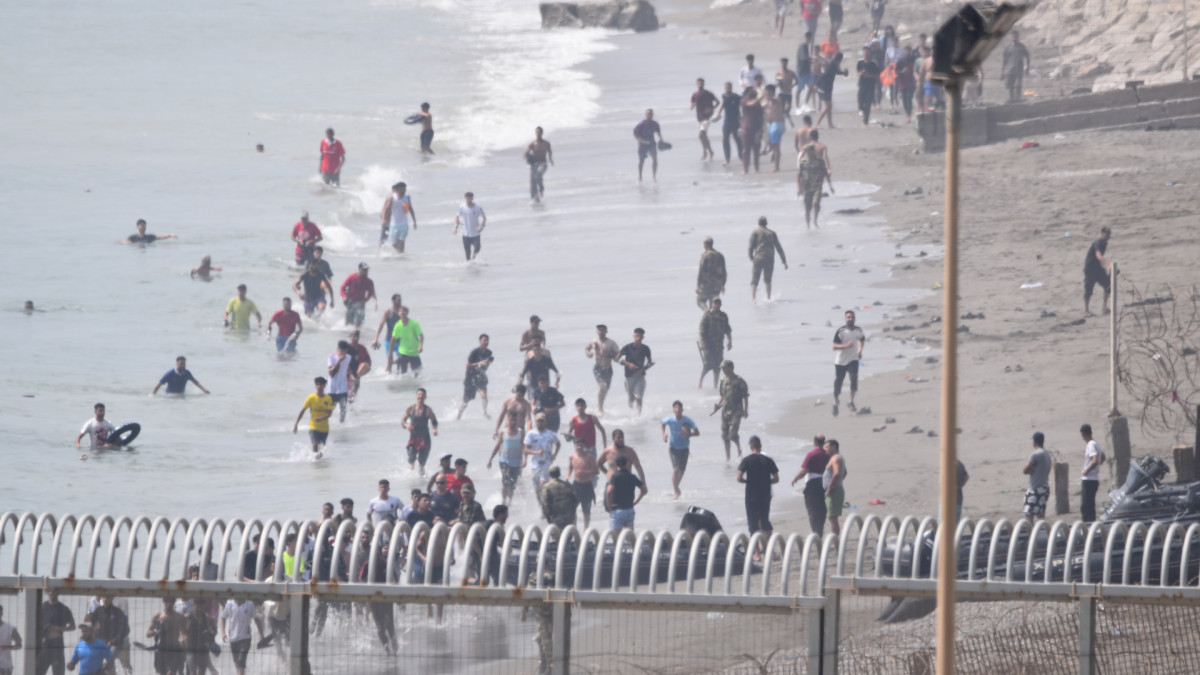
Images of thousands of people reaching Ceuta’s beaches by swimming inevitably evoke the May 2021 crisis. However, analogies can be misleading. At that time there was a diplomatic context that explained the crisis: the hospitalization in Spain of Brahim Ghali triggered a serious bilateral crisis with Morocco, and Rabat responded by loosening border controls. That episode was a political use of migratory flows widely documented and recognized even by much of the specialized literature on migratory coercion.
But what we saw on July 30 seems to have little to do with that. Although it is still early to have all the elements, so far there are no solid indications that would allow us to affirm that Morocco has decided to instrumentalize migration again as a mechanism of political pressure on Spain. In fact, both Madrid and Rabat have insisted on maintaining police cooperation and accelerating the return procedures, which is a stance very different from the 2021 crisis.
So, what explains the increase in arrivals?
“There is no solid evidence to indicate that Morocco has decided to instrumentalize migration again as a mechanism of political pressure on Spain”
Among the hypotheses considered by both authorities and various specialists is the circulation of false information and rumors on social networks about a supposed legal impossibility to return those who managed to enter Ceuta after a recent Supreme Court ruling concerning certain border returns. Although the judicial ruling introduces important nuances about procedural guarantees, one cannot deduce from it that any person who reaches Spanish territory will automatically stay there.
It would not be the first time that a distorted interpretation of a court decision triggers a sudden “call effect.” Informal information networks among potential migrants operate at enormous speed, and on occasions, a mistaken perception can lead to a significant increase in crossing attempts over a few days.
To this are added more structural factors. The majority of those arriving in Ceuta are Moroccan youths from the Castillejos and Tetouan area. This reflects internal problems within Morocco itself, such as youth unemployment, regional inequalities, a lack of prospects, and a growing frustration among generations who see it increasingly difficult to build a life project. In other words, elements that do not necessarily respond to a strategy designed from Rabat.
“It would not be the first time that a distorted interpretation of a court decision triggers a one-off call effect”
In this sense, automatically reducing any uptick in arrivals to a political operation by the Moroccan government is as simplistic as denying that Morocco has the capacity to modulate the intensity of border control when it deems appropriate. Both can be true, depending on context, and precisely for this reason, it is wise to analyze each episode carefully and not project onto all of them the 2021 precedent.
There is, however, a deeper problem that goes beyond the immediate moment. This Ceuta crisis once again exposes the contradictions of European migration policy. For almost two decades, the European Union has based its strategy on the principle of externalization of migration management, by which it shifts the effective responsibility for migratory control to third countries. Morocco is probably the most complete example of this approach. The European Union funds with its own resources the equipment, training, surveillance, and police cooperation so that Rabat stops departures before people reach European territory. What is the result of this? The paradox that, once again, a core part of European policy, in this case the security of the external border, depends on decisions taken outside the Union itself.
This legal architecture produces a deeply asymmetric interdependence. Europe needs Morocco to control its coasts, while Morocco needs European funding, investments, and political backing on issues such as, for example, Western Sahara. Then, migration, which is a humanitarian issue of first order, begins to be used as yet another element in diplomatic negotiations. The consequence is that every time migratory pressure increases, European political debate returns to the wrong question: what is Morocco doing? Perhaps a more pertinent question would be this: to what extent is a migratory policy sustainable whose effectiveness depends on the political will of external actors?
“An essential part of European policy, in this case the security of the external border, depends on decisions taken outside the Union”
But if the causes of the crisis deserve a rigorous analysis, the political response is also revealing. The president of Ceuta, Juan Jesús Vivas (PP), has requested the declaration of a national emergency to establish a single command similar to that used in major wildfires or natural disasters. The request has an evident symbolic content, but also a legal one. The National Civil Protection System Law does not expressly mention migratory flows among the emergencies of national interest. The figure is designed for situations whose gravity or scale require an extraordinary coordination of public resources, such as earthquakes, floods, industrial accidents, or large fires. Now, the attempt to incorporate migrations into this category represents a further step in a broader process: the securitization of human mobility.
For years, the European radical right has worked to replace the language of migratory management with that of national security. Immigration is framed within a discourse of existential threat in the face of which it is legitimate to activate “exceptional responses.” The troubling part is that this discursive framework has ceased to be the exclusive domain of far-right forces. Gradually, it has been taken up by broad sectors of the European center-right and is beginning to normalize itself even in institutional debates where, a decade ago, it would have seemed unthinkable.
“Immigration is framed within a discourse of existential threat in which it is legitimate to activate ‘exceptional responses’ “
It is not incidental that the national emergency request is accompanied by the demand for a single command. The vocabulary itself points to scenarios of extraordinary crises, contributing to a social perception that migration constitutes a threat comparable to a natural disaster or a major civil-protection emergency. Yet the data invite another reflection. Spain has managed tens of thousands of irregular arrivals annually for years using administrative, police, judicial, and humanitarian instruments already provided in the legal framework. It can be debated whether those instruments need more resources, reforms, or better coordination. That said, this is very different from trying to justify redefining migration legally as a permanent national emergency.
In this case, as in many others, words matter. If a public policy is built around the paradigm of exceptionalism, solutions tend to be exceptional as well. And if migration ceases to be understood through deep economic and demographic inequalities and is interpreted through the security lens, the space for integration, cooperation, or regular mobility policies gradually shrinks.
“As it externalizes the management of its borders to third countries, it becomes increasingly dependent on them to control the flows”
Ceuta reminds us once again that Europe continues to fail to solve its main migratory dilemma. As it externalizes border management to third countries, it becomes increasingly dependent on them to control the flows. While it seeks cooperation, it avoids fully assuming the political consequences of that dependence. And while human mobility continues to respond to deeply structural economic, social, and demographic factors, a growing portion of public debate insists on presenting it as an extraordinary threat that would justify equally extraordinary responses.
Perhaps the real risk does not lie merely in the temporary uptick in arrivals to Ceuta. It lies, above all, in the consolidation of a political framework that turns migration into a security problem rather than a governance challenge. Because when that cognitive shift finally takes hold, it is not only migration policies that change. It also changes the way European democracies understand their borders, their rights, and, ultimately, their own notion of security.
