
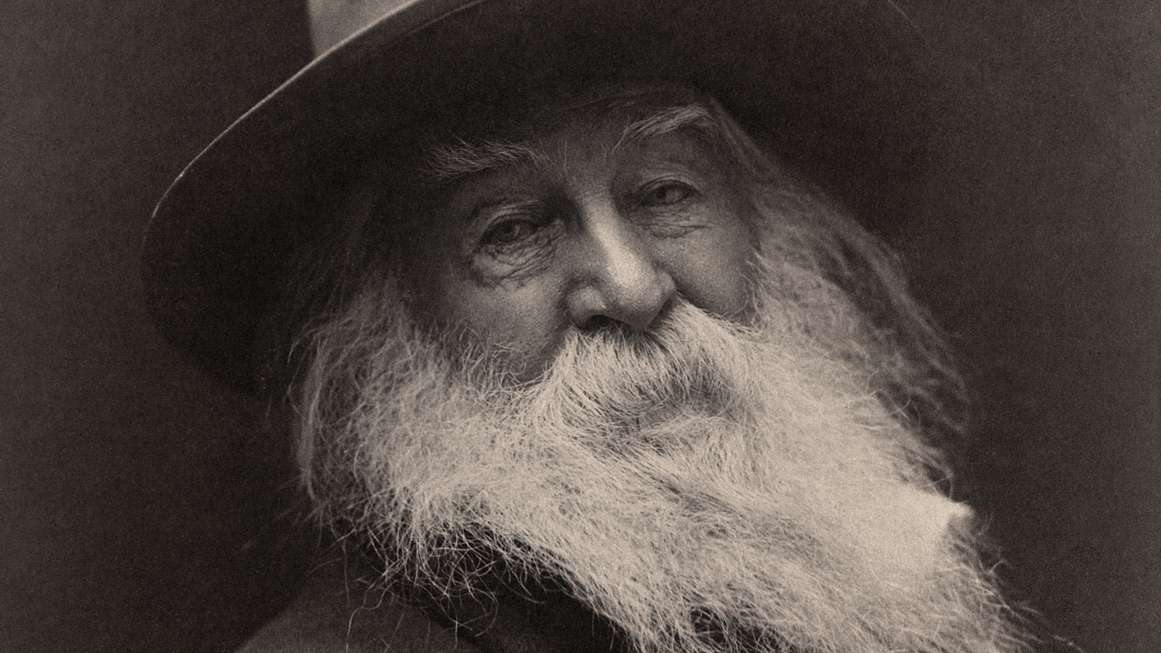
A new collection of Whitman’s writing is a fitting read for the United States’ 250th birthday.
On Democracy, by Walt Whitman, introduction by David Bromwich, Library of America, 210 pages, $12.50
Walt Whitman entered the world in 1819, a time when traveling across Long Island could take days and was probably best done on foot. Brooklyn, not yet the equal of New York City, stood as a rural enclave for Quakers, freethinkers, and teachers and writers from the countryside. Whitman began teaching as a teenager, and he even welcomed a pupil of color into his classes, a notable act for educators of that era. His home town painted a picture you might find on a colossal jigsaw today: weathered wooden fences, unpaved lanes, and a few thin trails of chimney smoke fading into the distant hills.
In the ensuing twenty to thirty years, New York City and its surrounding region experienced what is perhaps the most dynamic period in its history. First came a transportation revolution that stretched roads, canals, and railroads across the eastern seaboard. Then a market revolution wove together the economies of the coasts, inland areas, and the global marketplace. Finally, a communications revolution knit the young nation into a single network via telegraph lines. Everything altered during Whitman’s formative years. The city’s politics reflected the ceaseless flux of a new country trying to push forward in history. Now, as the United States celebrates its 250th birthday, it seems apt to reintroduce Whitman’s political writings—especially Democratic Vistas, a lengthy meditation on the meaning of America and its people. The Library of America’s new collection, On Democracy, offers a thoughtful sampler.
Amid this rapid transformation, New York established itself as the nation’s center of population and commerce. It also became the focal point of a major challenge to mainstream politics: the Locofoco movement, whose influence was felt through the Equal Rights Party in New York, then through the Free Soil Party, and ultimately within the early Republican Party. The Locofocos left a lasting legacy, and Whitman voraciously absorbed their writings in his youth. His early political sensibility was a young artist’s locofocoism, guided by the editor, poet, Navy man, and theater critic William Leggett.
Leggett hailed from the Old West but moved east as a young man. He aspired to study mathematics and write poetry, but instead joined the Navy and never forgave the experience. He was court-martialed for neglect of duties and for threatening his commanding officer during a period of suicidal emotion. The officer had subjected him to a long campaign of bullying, and Leggett kept resenting being used by those who wielded power and privilege.
Leggett found work as a theater critic for William Cullen Bryant’s New York Evening Post, and during the early 1830s he produced pieces under the condition that he would not be asked to cover political matters. He had little interest in them. Yet after a few years, Bryant embarked on an extended European trip and left the paper under Leggett’s management— entrusting him with the task of serving as the political editor. The city never looked back (and the paper nearly collapsed due to chronic financial mismanagement).
Leggett proved to be a radical among radicals, and the more he wrote, the more radical he became. He advocated a free-market extremity, abolition without compromise, and even an anarchist’s line of thought. He championed free trade, free banking, and free coinage—a libertarian stance before the term was widely used. He argued for abolition with immediacy, even suggesting dissolution of the Union earlier than William Lloyd Garrison did. He opposed special charters and the protection of intellectual property, at a time when those ideas were as radical as abolition. He stood for the rights and liberties of all people, breaking down racial barriers and aligning with Jacksonian democracy in a more consistent manner than any other public figure of his era. His early death from respiratory disease in 1839 dealt a blow to the idealism of young men like Whitman.
Leggett helped launch two sister currents: the Equal Rights Party (often nicknamed the Locofoco Party) and the Young America arts movement. The Young radicals, aligned with Leggett’s Evening Post, challenged the dominant Democratic Party in its Tammany Hall stronghold from 1835 to 1837. The radicals nudged both of the major parties toward libertarian stances by wielding influence in city elections. Leggett stood firm on every issue, but the Democrats expelled him when he crossed the color line and pushed for abolition. The Whitmans of the city cheerfully left with Leggett for more principled ground. The Locofoco Party fell victim to the usual fate—endless factional battles, poor organization, and betrayal by its own elected officials (mostly disguised Whigs). Yet where the political quest fell short, the artists’ mission began to take shape.
Young America began as a deliberate effort on behalf of New York City’s literate—a gathering of minds resembling a dinner circle. The circle broadened to include a wider group of cultural producers, such as John L. O’Sullivan’s Democratic Review, which showcased rising writers and visual artists. Their common thread was Locofoco politics and a firm belief that American art must carve out a distinct identity from its European forebears. The Young Americans believed the United States occupied a unique post in history, capable of leaping over feudalism in the Old World to reach a grand, free future.
Driven by radical abolitionist politics and a nationalist, forward-looking artistic program, Whitman embarked on a career as a journalist (and a vocal critic of the Mexican-American War)—and toward a lifelong mission to locate and nurture the great American intellect who could realize the nation’s world-historical aim of emancipation. He pursued the poet, the artist, the bard who could conjure a country the most free on earth. He cherished American democracy and strove to perfect it in the present, and in the future, yet he did not seek to export it through warfare. The Republic could welcome its sisters into the fold, but not at the cost of a war fought for slaveholders.
The driving force behind that striving toward perfection was individualism. This was Leggett’s political doctrine: the absolute, universal, equal rights of each person. If you put this principle into practice in a nation like the United States, you obtain the ideal human being: every individual akin to a nesting doll, with countless layers of the self to explore; each person harboring multitudes, as expansive as New York or America itself.
This endless exploration of the self within America’s boundless possibilities led Whitman to articulate what he called “personalism,” a concept that enhances individualism with a sense of attachment or love that binds, unites, and aggregates—making the peoples into comrades and turning strangers into brothers. For Whitman, the limits of America’s potential depended on the quality of its people, assembled again into the infinite nesting doll that is the nation. When its citizens failed to honor their promise, the country failed to fulfill its potential and capabilities in history.
Whitman’s mood darkened after he reluctantly voted for James K. Polk, a slaveholding president, in 1844. He recalled Polk’s locofoco leanings when he was speaker of the House, but as president Polk helped end the locofoco era of hopeful emancipation by seizing half of Mexico for plantation owners. Rather than allow America to become a slaveholding empire, Whitman dedicated the remainder of his life to discovering the right individual—whether in politics or literature—who could reunite the country on the grounds of personal liberation and the expansion of every self within our borders.
Although Democratic Vistas is hampered by Whitman’s own artistic temperament and the haziness with which he sometimes framed political ideas, the more journalistic writings included in this volume present the case as plainly as Leggett did in the old Evening Post. “The berths, the Presidency included, are bought, sold, electioneered for, prostituted, and filled with prostitutes,” Whitman wrote. “In the North and East, swarms of dough-faces, office-vermin, kept-editors, clerks, attaches of the ten thousand officers and their parties, aware of nothing further than the drip and spoil of politics—ignorant of principles, the true glory of a man.”
To that: “The President eats dirt and excrement for his daily meals, likes it, and tries to force it on The States. The cushions of the Presidency

Natalie Foster
I’m a political writer focused on making complex issues clear, accessible, and worth engaging with. From local dynamics to national debates, I aim to connect facts with context so readers can form their own informed views. I believe strong journalism should challenge, question, and open space for thoughtful discussion rather than amplify noise.