
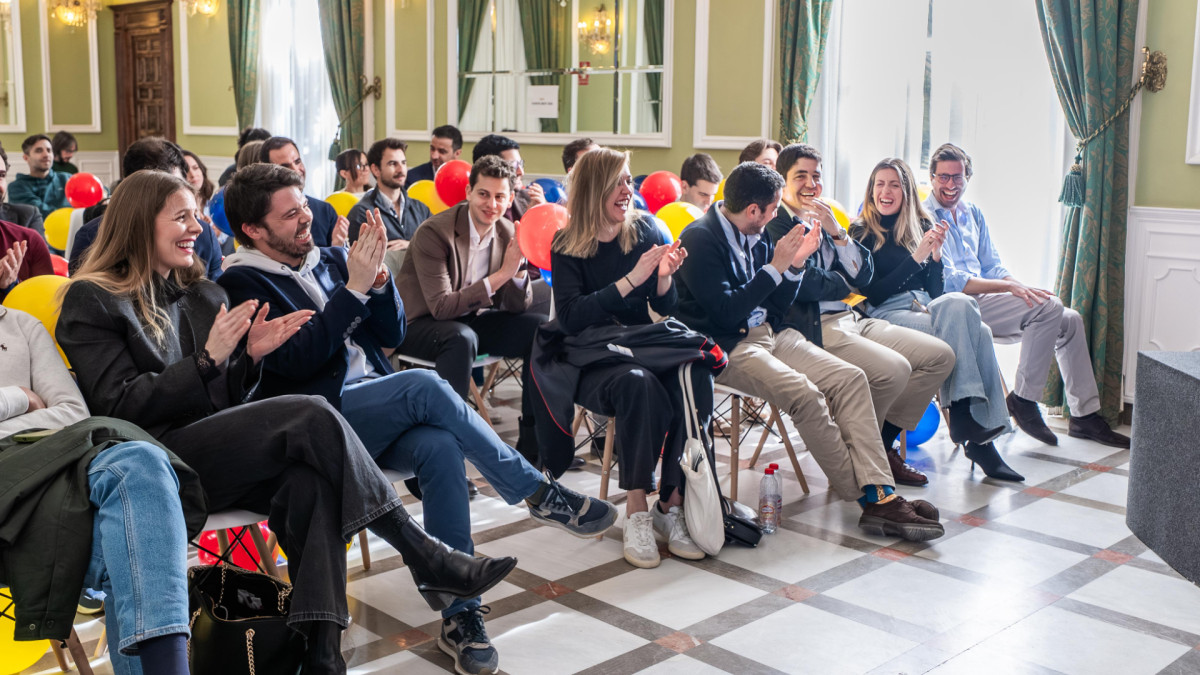
“If this weekend we learn, at least, to disagree, it will have been worth it,” said Nacho Corredor during the opening panel he shared with Ignacio Rigau, ethics and law professor at Esade Business School. Granada hosted last weekend the Next Gen Forum, the annual gathering of Agenda Pública and TALEÑTO ESPAÑA that brings together leaders born into democracy and which Corredor summarized “as a generational claim,” shaping his intervention before political and business references around “truth, gratitude and trust.”
Corredor spoke of the need to “identify a shared truth” among the leaders of the new generation. “If everything is questionable, nothing is worthwhile. If everything is the subject of dispute, there is no possible conversation. If we do not identify, at least, a shared truth, the coexistence of democratic societies will not be possible,” he said.
“The public debate not only does not revolve around what must be done, but it doesn’t even revolve around a single reality. What can we build if we don’t talk about the same thing?”
“The democratic transition was a shared truth. What truth does today’s Spanish society share? The public debate suffers a thermal inflation, but that is not its main problem. What truth can we identify for the future? Today the public debate revolves around things that, directly, are lies. What can we talk about if we do not observe the same reality? The public debate not only does not revolve around what must be done, but it does not even revolve around a shared reality. What can we build if we do not talk about the same thing?”, he asked.
Corredor also spoke about the importance “of gratitude as a way of being in the world, of relating to the previous generations and to the society around us to dispel the sterile void created by arrogance in public debate.”
Nacho Corredor and Ignacio Rigau headlined the opening session of the Next Gen Forum. Photo: Agenda Pública / Álex Cámara
“The gratitude is not a salon courtesy; it is a political act of humility. It means recognizing that what we have—this democracy or our way of life—is not solely the result of our merit, but the effort of those who preceded us and of those who, even being our adversaries, make it possible every day,” he said.
“Acknowledging is recognizing the existence of the other and validating their contribution to the common good. Without this capacity to look back and around us with gratitude, we are left with arrogance, and hatred, which is the fuel of barbarism,” he noted.
Furthermore, he concluded by acknowledging that he has been working for “almost twenty years” and that since starting “university, building formal and informal spaces aimed at developing trust among people. It is, probably, what I have dedicated more time to, and for longer, in my life.”
“Trust is the greatest economic and social asset for a society and its economy to function. No major transformation can be tackled unilaterally and without the trust of society in its institutions, without society’s trust in itself, without trust within institutions and without the trust between institutions and the private sector. Trust is the main catalyst of agreement. And to build it, thinking long-term is essential,” he said. “Without trust, societies break and the economy does not work,” he added.
“Trust is the invisible glue that allows a contract to be signed, a law to be upheld, and a citizen to live peacefully with their neighbor. It is the emotional infrastructure of any society. If we can recover truth and practice gratitude, trust will emerge not as a wish, but as an economic and social asset. Only if we also trust others can we truly sit down to design the future of the next generation,” he concluded.

Natalie Foster
I’m a political writer focused on making complex issues clear, accessible, and worth engaging with. From local dynamics to national debates, I aim to connect facts with context so readers can form their own informed views. I believe strong journalism should challenge, question, and open space for thoughtful discussion rather than amplify noise.