
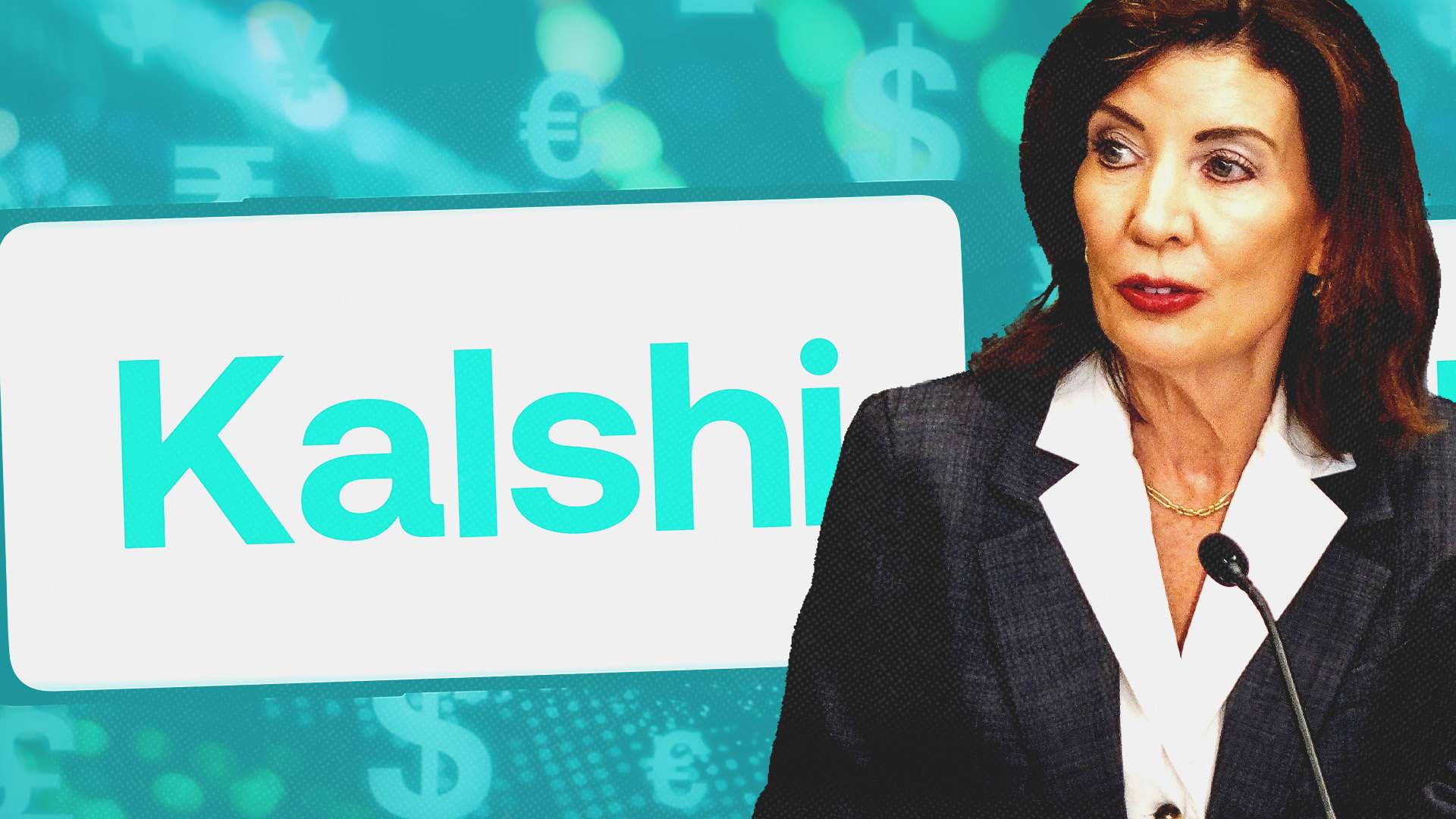
Casting Kalshi as an unrestrained gambling operation makes it simpler for the state to extract funds from both the company and its users.
New York is aiming to squeeze $36 billion out of the prediction market Kalshi for operating in the state without the involvement of state regulators.
In a move that would evoke a TV mob boss, New York Democratic Gov. Kathy Hochul and Attorney General Letitia James announced on Friday that the state was suing Kalshi for “running an illegal gambling operation” even though the company operates as a federally regulated exchange. As restitution for violating New York’s gambling laws, James wants the state Supreme Court to permanently bar Kalshi from operating within its borders until it secures “all the required licenses” from the state Gaming Commission.
James seeks for Kalshi to disclose “each of its customers,” together with a breakdown of their individual bets, the losses they’ve incurred, and the total revenue Kalshi earned during its New York activity. If the state prevails, James has requested that Kalshi provide “full restitution” to anyone in the state who used the platform, as well as a “penalty of three times the amount” of Kalshi’s New York revenue.
James is also pursuing a penalty of $100,000 for “each offering” or “attempt to offer” sports gambling in New York by Kalshi, which aggregates to a minimum of $36 billion, according to a court filing from her office.
Gambling is tightly restricted in New York. The state constitution bans all forms of gambling except for narrowly defined exceptions, including the state lottery, horse racing, casino games, bingo, and nonprofit-run lottery games. Operating as a contract market rather than a sportsbook has allowed Kalshi and its users to sidestep related New York taxes.
The state has not been receptive to that workaround. Since 2025, New York lawmakers have been pursuing a quiet effort to ban prediction markets.
Last October, the state’s Gaming Commission sent Kalshi a cease-and-desist letter accusing the company of operating an “unlicensed mobile sports wagering platform.” James has also leveraged her position as the state’s top legal official to issue consumer alerts arguing that prediction markets are “unregulated” gambling platforms that pose “significant financial risk.” In April, James sued Coinbase and Gemini Titan, alleging that, like Kalshi, their prediction platforms violated state gambling laws. A day later, Hochul signed an executive order banning state employees from engaging in insider trading on prediction markets, even though federal law and the platforms’ own rules already prohibit this practice.
There is a possibility New York could lose this battle, since federal law grants the U.S. Commodity Futures Trading Commission (CFTC) exclusive authority to regulate prediction markets.
CFTC Chairman Mike Selig says the New York suit aims to force an “unprecedented sudden shutdown of prediction markets nationwide.” The CFTC has already sued New York in April to stop the state from applying its gambling laws to prediction markets. On Thursday, the CFTC filed a motion for an emergency temporary restraining order against New York to halt the state’s pursuit of criminal or civil enforcement actions against prediction markets.
Thus far, two federal courts have sided with the CFTC’s interpretation of this law.
In April, the 3rd Circuit Court of Appeals granted Kalshi an injunction against New Jersey regulators, blocking the state from enforcing its law banning wagers on collegiate sports. This week, a federal court in Minnesota used a similar rationale when ruled in Kalshi’s favor, issuing an injunction that prevents the state from enforcing its prohibition on prediction markets.
In both instances, the courts concluded that federal law plainly preempts statewide bans on prediction markets. Yet, the Minnesota ruling left open the possibility for states to regulate event contracts outside the federal definition of a swap, such as futures contracts used to hedge investments in energy or agricultural markets.
James maintains that “no matter what they call themselves, prediction markets like Kalshi are gambling platforms, plain and simple.” Minnesota Attorney General Keith Ellison delivered similar remarks to Reason after a district court struck down the state’s ban on prediction markets.
Nevertheless, despite those recent legal wins for prediction markets in other states, James has reason for optimism, as New York has already had courtroom success on this issue. In July, Kalshi twice failed to obtain a preliminary injunction against New York’s enforcement actions. By denying Kalshi’s appeal for an emergency injunction on Monday, the New York district court found that the state was “likely to succeed on the merits” of its argument that Kalshi’s sports contracts resembled sports wagering.
Kalshi is aiming to relocate the case to a potentially more favorable Manhattan federal court, per The Wall Street Journal.
In the press release announcing the suit, Hochul framed this legal action against Kalshi as necessary to “protect consumers, prevent problematic gambling, deliver funding for critical public services, and ensure that every company plays by the same rules.” Yet the underlying motive appears clear: presenting Kalshi and other prediction markets as reckless, out-of-control gambling hotspots makes it easier for New York lawmakers to seize the tax revenue they are after.
The state is ready to permit gambling, provided that businesses and users pay a premium in corporate and income taxes.
