
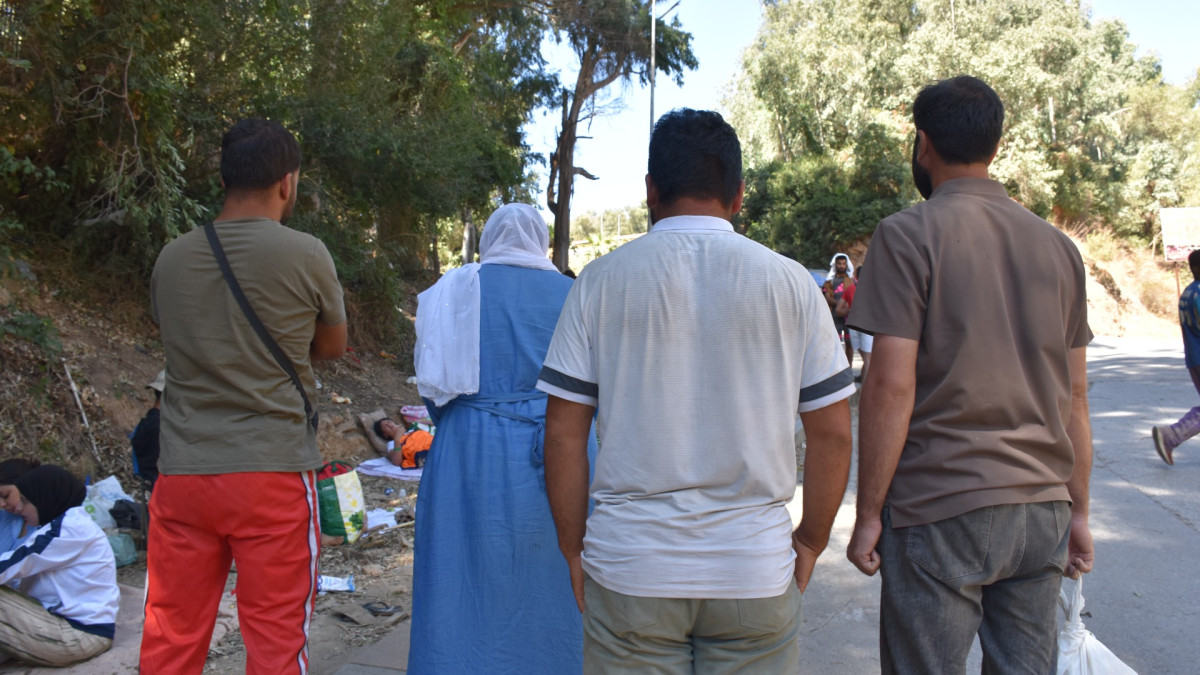
With less than ten days remaining before the date announced for a supposed second mass crossing toward Ceuta (August 15), Spain finds itself in an unprecedented situation in the midst of summer holidays, as crises during this season are becoming recurrent. The crisis of July 30 and 31 — tens of thousands crossing by swimming and on foot from Fnideq (Castillejos), dozens of deaths according to all sources and up to a hundred according to some counts, the Army on the streets of the autonomous city, and a rapid agreement on returns between Rabat and Madrid — has shifted into an information battle over what happened and, above all, what is to come. At Kartex we analyzed more than 100,000 posts on Instagram, Twitter, TikTok, Facebook and Telegram, in Spanish, Darija and Arabic, together with interaction graphs of thousands of accounts and channels, to map out this battle, which has clear hybrid consequences — that is, on the ground — and we try to answer the main questions about the conflict.
The two info-spheres of the Strait: from invasion to humanitarian crisis
The coverage of the July 2026 crisis cannot be analyzed as a single public debate, and we must introduce the dialogue produced on both sides of the border, which here does coincide with the split in cyberspace (languages are vectors of border-making in cyberspace). One frame centers on humanitarian emergency, the other on territorial threat. Analyzing conversations recorded on five platforms in the weeks after July 30 allows this fracture to be reconstructed.
On the southern shore, the conversation in Darija is organized around a humanitarian and emotional framework that concentrates between 48% and 71% of attention depending on the platform. It is a space of mourning more than mobilization. The most-shared post in the Facebook segment takes the form of a religious invocation (“may God make this bring some good”), and the mediation of the event does not come from media or institutions, but from hyperlocal intermediaries. The page zoom.fnideq, with 213,000 followers, illustrates this attention economy; a single audiovisual piece, showing a father crossing with his wife and young daughter, accounted for a third of the interactions recorded during the analyzed week.
In the Spanish-language sphere, this humanitarian discourse has largely been sidelined. On TikTok and Instagram, the dominant narrative comes from the established media (El Confidencial, RTVE, Antena 3, El País), which deploy a visual chronicle with an alarmed yet factual tone, with videos reaching up to twenty million views each. Telegram, by contrast, operates as the space where the nativeist frame of the “invasion” dominates, accounting for 45.6% of Spanish-language views in the corpus, though on Twitter this representation also takes up roughly 50% of messages. The agitation ecosystem on Telegram is led mainly by a single actor, Alvise Pérez, who, with more than 660,000 views accumulated, strings together a complete escalation sequence that moves from the assertion (“the city is TAKEN”) to legal action against the prime minister and a street demonstration in Ceuta, answered in turn by a neighborhood counter-protest under the motto “Ceuta united, not divided”.
“While there is, on the one hand, a humanitarian concern, on the other, the debate has exploded under the lens of invasion and territorial threat.”
In short, the conclusion we draw is that the debate on social networks and in the media in the first days is highly polarized. On the one hand, there is concern from a humanitarian viewpoint, while on the other, the debate has erupted under the lens of invasion and territorial threat. This conclusion leads us to pose a series of questions that we will try to develop further below. Could this crisis have been foreseen and anticipated? Who was responsible? Is there a hybrid warfare? Let’s begin.
A migratory crisis with early warning signs?
The migratory flow data from the DSN and from Interior for 2026 already painted a trend change in mobility that anticipated Ceuta’s events. While the national migratory aggregate was declining, with 14,479 irregular entries between January 1 and July 15, 24.7% less than in 2025, with drops of 52% on maritime routes and 72% in the Canaries by mid-May, the pressure concentrated on a single point in the system — the Ceuta perimeter — with land entries rising more than 240%, something the DSN reports of July 11 and July 17 had already indicated.
The 2026 crisis — thousands crossing by swimming from Fnideq (Castillejos) and Belyounech to El Tarajal, with a contested death toll and military deployment — likely responded, at first instance, to a legal-informational detonator (the Supreme Court ruling preventing returns without procedures for those intercepted at sea, “instrumentalized,” Interior claims, by trafficking networks) against a structural backdrop of 37.2% Moroccan youth unemployment and a youth response like GENZ212, and thus stands apart from coercive crises such as Perejil in July 2002, during a full diplomatic crisis.
The summer factor of migratory phenomena — warmer seas and milder weather, as well as fog on July 30 — are meteorological and climatic references that annually facilitate recurring migratory flows. Here a first-order informational factor should be considered for future crises: the informational vacuum of the summer holidays, which only fuels far-right debate, always very active and well organized against these events, as we observed last year in Torre Pacheco.
The border’s international dimension and the rise of political violence
The ultra-Spanish community does not operate alone: it coexists and exchanges content with the German-speaking conspiracy cluster (the largest node of the graph), with the U.S. QAnon/MAGA ecosystem — whose central node, SGT News Network, is the most shared channel across the network analyzed — and with the pro-Russian Spanish-language geopolitical sphere (increasingly aligned with far-right discourse, unlike earlier stages when it focused on the far left). The same Tarajal videos circulated with German, English and Russian subtitles within hours, and the echo reached the White House spokesperson, who on Fox News blamed “European policies” for fueling the invasion narrative also in the United States, as well as the rise of ultra voices in Europe, such as Meloni, calling for the Schengen treaty with Spain to be annulled.
What is most salient from a Spanish perspective is the mobilization of the far right and the emergence of “brigades” to confront migrants in Ceuta. This brigadismo has been cultivated for some time in far-right circles, as in the case of Deport Them Now in Torre Pacheco, but also in other cities where these initiatives are becoming more established, such as in Catalonia. In Ceuta, some mobilized neighbors fortified different neighborhoods, such as Benítez, Los Rosales and El Príncipe. It is not accidental that in these neighborhoods Vox is one of the main forces: despite a pronounced drop in the 2023 general elections, these neighborhoods easily surpass the 20-30% vote threshold, and in the 2019 general elections, more than 45% of the votes cast were for those districts.
This escalation on the Spanish side does not happen in a vacuum, and it is useful to understand who else benefits from it. On the other side of the border, Morocco has its own informational influence machinery, which analysts — such as Javier Valencia — have described for years, operating on three levels. The first is the most visible, formed by the state official media and large private outlets such as Hespress or Le360, capable of presenting their narratives to foreign audiences. The second is more subtle and rests on small digital portals that first push ideas so that social networks later pick them up and amplify them. The third is the most discreet: the increasingly outspoken voices aligned with Rabat in the major analysis hubs of Washington and Brussels, where the idea has taken hold that Morocco is an indispensable partner for Mediterranean and Sahel security.
“Each video of a mass crossing becomes the north in the ‘proof’ of invasion, and each fortified neighborhood becomes the south in the proof of Spanish hostility.”
The key point is that this machinery participates, whether it wants to or not, in the radicalization on the other side. The constant flow of frontier imagery produced and amplified by Moroccan outlets and pages — real-time reporting on the state of the fence, the framing of Sebta occupied, the display that the migratory faucet is opened or closed — is precisely the raw material with which brigadismo and the ultra-international feed. Every video of a mass crossing becomes the north in the proof of invasion, and every fortified neighborhood becomes the south in the proof of Spanish hostility. This circle yields benefits to Rabat on three distinct levels. First, it deflects the conflict, since the crisis stops being a bilateral standoff and becomes an internal Spanish fracture, with parties, brigades and governments pitted against one another. Then, it undermines the adversary, since a tense Spain that responds with neighborhood militias and calls to suspend Schengen projects to Brussels precisely as an unstable partner, elevating Morocco as a reliable guarantor of the southern flank. And finally, it validates its narrative, because ultra-reaction reinforces for Moroccan and international opinion the framework of an occupied and hostile Ceuta.
Three attribution narratives and a 51-kilometer video
From August 3 onward, the question dominating the Spanish debate is who organized the crossing, and at least three answers compete. The first describes a horizontal branding campaign, woven from Facebook groups using coded language and with no leadership to depose (according to Golden Owl). The second points higher and maintains that there was an operation involving or tolerating Moroccan state structures, activated through the informational manipulation of the Supreme Court ruling on returns. The third describes something more elemental: a massive rumor with a time stamp that pushed thousands of people toward the water and which was then exploited by all the others.
The role of Morocco deserves careful scrutiny, and the most instructive episode is a video circulated as proof that the Moroccan police escorted trucks of youths to the border, geolocated by Maldita.es and Open.online at 51 kilometers from Ceuta, with the vehicle moving away from the border and a witness stating that the agents intercepted the youths. But debunking the video does not close the question. What it does verify is that trucks loaded with youths openly crossed the north of the country, that Moroccan forces were aware of the movement, and acted selectively, and that, despite that control, tens of thousands of people arriving from cities hundreds of kilometers away reached Fnideq in hours. In a state with such interior surveillance, the pertinent question is how the permeability of those two days can be explained in light of the containment demonstrated in earlier episodes.
The ambiguity of attribution explains the fragmentation of the Spanish response. The Government holds the most moderate position, attributing the episode to mafias and disinformation and preserving Rabat as a partner; the PP escalates the frame to a hybrid war and asks what the CNI knew (discussions between the ministries of Marlaska and Robles intensify this point); and on the extremes there is an unprecedented convergence, as Sumar and Podemos proposed excluding Morocco from the 2030 World Cup for being a “dictatorship” that “threatens sovereignty,” and Vox registered days later a similar initiative for a Spain-hosted World Cup in the middle of FIFA’s bid to award it to Casablanca. The fact that both the left‑of‑center and the far right converge on punishing sport shows that attribution has already become a tool of domestic policy, and the World Cup — conceived as a symbol of the Spain-Morocco partnership — has become its first cart that can be used as punishment.
“Recent gestures of rebalancing with Algeria lend plausibility to the hypothesis of a disciplinary signal, the warning that deviating from the 2022 doctrine has a border cost.”
The narrative is completed by the Maghreb triangle. The episode sits within a sequence that began in 2021 when welcoming the leader of the Polisario Front preceded border opening and the Pegasus spyware scandal on the president and several ministers’ phones, attributed then to Morocco and never clarified, and which apparently closed in 2022 with Madrid’s shift toward the autonomy plan for Western Sahara. The recent gestures of rebalancing with Algeria lend plausibility to the hypothesis of a disciplinary signal, the warning that deviating from the 2022 doctrine has a border cost, although the same sequence allows the reverse reading: that expectations of punishment push toward overinterpreting what might have been overflow. And the Moroccan legislative elections in September add another layer, since an episode with dozens of deaths is explosive material in Rabat as well. Attribution, in short, is not resolved between a culprit and an alibi, but within a system of at least four actors — Rabat, Madrid, Algiers and Moroccan social dynamics — where the Pegasus precedent shows that covert aggression is part of the plausible repertoire, but where no single hypothesis currently has conclusive evidence. Holding that uncertainty with precision, rather than resolving it by acclaim, is the difference between informed foreign policy and impulsive and biased policy.
Arriving at August 15 knowing where we stand on the map is the task that remains.
Three main ideas emerge from all of the above
The first is that there is not a single digital conversation about Ceuta, but two, separated by language and framework: a mourning space managed by hyperlocal intermediaries on the southern shore and a layered northern shore where the hegemonic media chronicle of Spanish outlets coexists with a notable dominance of alarmist discourses crystallized in the notion of “the invasion.”
The second idea is that the crisis was less unpredictable than the subsequent confusion suggests. Signals were available, from the DSN reports on border pressure concentration at the Ceuta perimeter to the juridical-informational detonator of the Supreme Court ruling, plus the seasonal factors that recur every summer and an agitation ecosystem, transnational and well connected, waiting to exploit the event. The neighborhood brigadismo, the ultra-international that subtitles the same videos in three languages, and the Moroccan information machinery supplying the images form a circuit that feeds itself, where northern radicalization objectively serves southern status interests without any need to attribute a formal order.
The third idea is that attribution has become the true battlefield of Spain’s domestic and international politics. Three narratives compete to explain the crossing, none currently backed by conclusive evidence, and the most cited piece of evidence, the truck video, targets the Moroccan government. Yet the summer passivity of the Spanish government is notable, evidenced by the crossing of responsibilities between ministries at the start of the crisis. This seasonal factor is not less important, and it leaves open a window every summer for the far right to occupy the information space. Meanwhile, Spain’s response fragments to the point that the left and the far right converge on punishing sport, and the triangle with Rabat and Algiers, with Pegasus in the background, reminds us that in this relationship covert aggression belongs to what is plausible, without granting license to prove it. On the night of August 15, whether a second crossing occurs or not, the date will have already fulfilled its purpose: to mobilize deployments, agendas and fears in two countries before the event even exists.
