
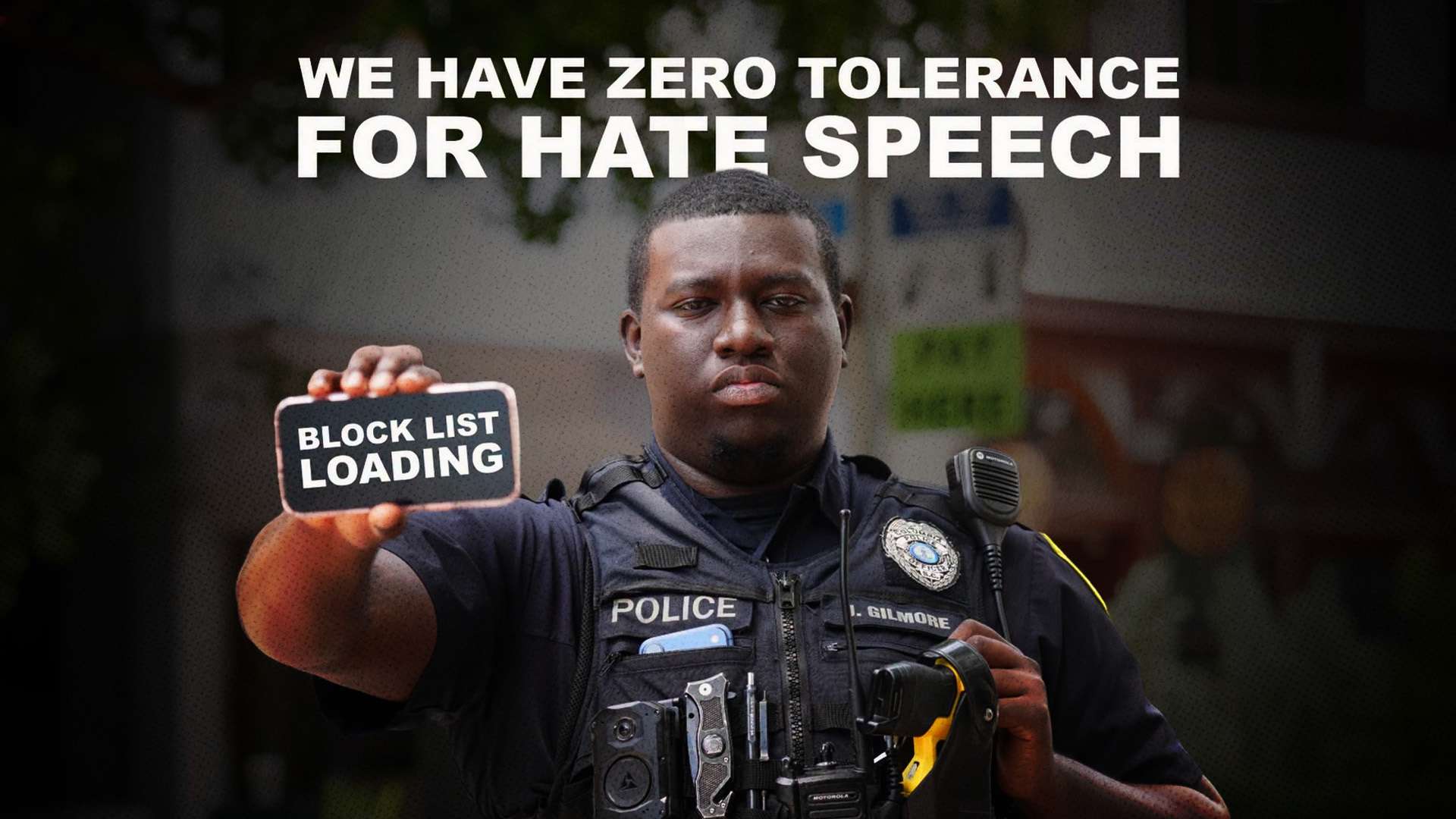
Columbia’s police department has publicly stated that South Carolinians should expect a strict stance against “hate speech,” a stance that is drawing scrutiny from free-speech advocates.
Last week, FIRE—the Foundation for Individual Rights and Expression, a group focused on First Amendment rights—sent a formal letter to Columbia’s police chief after the CPD published a post on Facebook featuring the declaration, “WE HAVE ZERO TOLERANCE FOR HATE SPEECH.”
The image, uploaded on June 25, includes a photo of an officer holding a device that displays “BLOCK LIST LOADING.” The accompanying caption stated that there has been a rise in vulgar, racist, threatening, bullying, and disrespectful comments beneath reels and other posts.
“This kind of language and conduct will not be tolerated on our social media outlets,” the CPD message continued. “Comments that breach these standards may be hidden, removed, or addressed accordingly.”
The post also contains a link to Ariana Grande’s track “thank u, next.”
While the CPD may have viewed the post as a lighthearted public-service announcement, FIRE argued that its anti–hate speech stance raises substantial free-speech concerns. The organization emphasized that the CPD’s Facebook page functions as a designated public forum used for official government business, which brings it under First Amendment protections.
FIRE also urged the CPD to revise its Facebook policy, which states that “CPD reserves the right to remove and/or block anyone who posts inappropriate material as determined by CPD.” The policy further notes that “CPD reserves the right to remove any comments that are inappropriate, threatening or offensive, include personal information about another person or that violate a person’s privacy interests, or include copyrighted material belonging to another person.”
According to FIRE, the CPD’s prohibition on “hate speech” and on comments deemed “inappropriate,” “offensive,” “racist,” or “disrespectful” constitutes viewpoint discrimination, since such restrictions hinge on the speaker’s perspective.
FIRE also observed that bans on “vulgar” remarks, on copyrighted material, and on sharing “personal information about another person or that violate a person’s privacy interests” amount to unconstitutional content-based restrictions.
As of Monday, the CPD’s June 25 post and the department’s moderation policy remained visible on the page. The letter, authored by FIRE’s director of public advocacy, Aaron Terr, requests a response by August 20 at the latest.
This is not the first instance in which public officials have needed reminders to honor free expression. In 2019, after the Loudoun County Board of Supervisors chair blocked a Virginia resident from the official’s Facebook page, the resident sued, asserting a violation of the First Amendment. A federal appeals court unanimously held that since the page’s comments section was treated as a public forum, the chair could not ban commenters based on their viewpoints.
In 2021, a federal court found that the Arkansas State Police violated the First Amendment when the department’s moderation filter was set to “strong” and the terms pig, copper, and jerk were blocked from its Facebook page. The court ruled that using the strong filter was overly broad and that barring those particular words amounted to viewpoint discrimination. While pig and copper can carry an anti-police slant, the court noted that the First Amendment protects otherwise disrespectful language. The word jerk, the court added, has no place on a prohibited-words list, given the page’s context, the agency’s stated purpose for a filter, and the word’s harmlessness.
FIRE’s attorneys are not alone in worrying about the CPD’s post. More than 1,000 individuals weighed in with comments on the anti–”hate speech” post. A number of contributors argued that the measure was unconstitutional, correctly noting that hate speech is safeguarded expression. Although policing a social-media page might not be the most urgent issue for many Americans, it is encouraging to see citizens engage with the principle of free speech and urge government officials to uphold it.
