
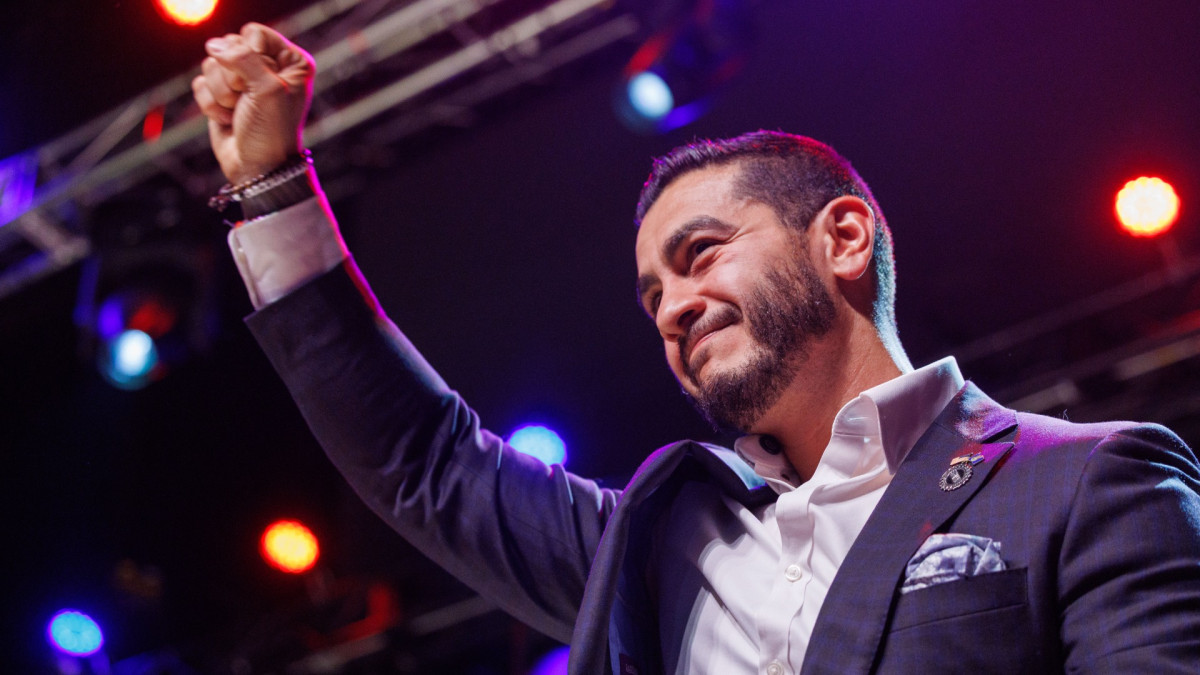
In this era of political polarization, the table remains set. In Michigan, the Democratic Party has just endured a shake-up that seems written to underscore the tensions of its time. Abdul El-Sayed, a physician, son of Egyptian immigrants, Muslim and advocate of universal public health care, defeated Haley Stevens —who represented the more moderate wing within the blue party— in the Senate primaries. What is the great significance of this fact? That Michigan is a key state heading into the midterms, as it is swing state, meaning that in recent elections it has swung toward both Democrats and Republicans. From Trump to Biden, and from Biden to Trump, so simple.
As we discussed last week in this outlet, the Democratic Party is undergoing an internal transformation that, broadly speaking, has left two clear political currents: the moderates, who respond to the party’s traditional praxis; and, on the other hand, the more radical ones, that is, a generation betting on structural changes, not only within the party but in American society. And in this case, the polarity has intensified thanks to El-Sayed’s victory — it is worth noting that it was by a narrow margin.
” Michigan is a laboratory where, in recent times, the different ways in which Americans want to see themselves have been expressed”
It turns out that he didn’t just defeat the establishment candidate, but did so in a particular territory. Michigan is, in some sense, a laboratory where, in recent times, the various forms in which Americans want to see themselves have been expressed. In 2016, the vote went to Donald Trump; then, in 2020, the bet was for Biden; in 2024 the Republican past returned and gave its support to the current president. It is, put differently, a kind of mirror in which all the apparent contradictions of the United States are reflected, but which is nothing other than a full-fledged expression of the democratic exercise.
Now then, what does his victory mean? It is something more than a personal victory: it is the eruption of a progressive discourse (very powerful) within a party that still hesitates between embracing the radicalism of part of its base and sheltering in the moderation that promises governability. It is also another demonstration that, regardless of the party, times are not favorable for conciliatory rhetoric or for traditional moderation: people in the United States want firm, decisive stances, “whatever it costs”.
Just under three months remain until the midterms, the moment in which the political future of the United States will be decided for the next two years. It is difficult to trace in the annals of history a moment of such internal political tension — at least, one so widespread — in that country, and that same polarization is having such international impact. Two years ago Trump returned to power and changed, perhaps like no other president in the history of the United States, the rules, the alliances, and the dimensions of the geopolitical board in such a short time and in ways that very few could have foreseen.
What, then, does the advance of radicalism within the Democratic Party mean? Will that ideological fringe become a strengthening force for a party facing legislative scrutiny that will define the policy roadmap for the remainder of the Trump era? It is perhaps premature to make predictions, since, as is well known — and as elections such as 2008, 2016 and 2024 have shown us — at the tail end of campaigns in the United States anything can happen. Nevertheless, it may be already too late to be so ambiguous and ignore that this internal split within the Democratic Party could be decisive in reversing the polls that, for now, suggest a slight edge for the blue party.
Who is Abdul El-Sayed and what his Michigan victory represents
In the United States, illness, beyond the obvious, also represents many other things: social exclusion, economic ruin, and a highly profitable private health care business. In other words, health care is a privilege more than a right. Therefore, El-Sayed’s victory, who has insisted that the current health system is neither viable nor healthy (socially and politically speaking) nor representative of the social policy discourse of his country, places the Democratic Party before a dilemma: to continue being the party of cautious reforms or to dare to consolidate a structural health reform without precedent.
“Michigan has become an example that times change and that progressive as well as conservative formations have many adherents who want to bet boldly on urgent and radical changes”
It should be noted that Stevens, the defeated candidate, was no minor figure. She represented continuity, pragmatism, calculation — those who believe that to win you must appear secure and present consolidated projects. For her followers, the main political weapon for the November elections was to be predictable, politically correct. Yet Michigan has become another example — as New York did before — that times change and that progressives, just as conservatives, have many adherents who want to bet strongly on urgent and radical changes.
Moreover, since the end of last year, already in the “Trump 2.0 era”, and at the start of this year, the figure of Israel has also unsettled the geopolitical board. The Epstein papers and the war against Iran have polarized the image of both the Israeli government and its leader, Benjamin Netanyahu. Michigan has not been immune to this global phenomenon. Aside from the primaries becoming one of the most expensive Democratic Senate contests in recent memory, the issue of Israel’s influence in U.S. policy was also decisive for the outcome. As the International Business Times reports, Stevens spent tens of millions on advertising, with parts of that funding received as support from groups affiliated with the American Israel Public Affairs Committee (AIPAC). In contrast, El-Sayed built a campaign narrative centered on public health as one of his banners, in addition to underscoring that he is against economic inequality and in favor of reducing the impact of external money in politics. Seen from that angle, it is hard to believe that El-Sayed’s positions and Stevens’ were meant to represent the same party in the same state.
The generational shift dividing the Democratic Party
One of the major criticisms Joe Biden faced during the first part of the 2024 presidential campaign — before he withdrew, leaving Kamala Harris as the candidate — is that the Democratic Party, which, in theory, embodies progressivism, appeared to be represented by a candidate who had little to do with the demands and needs of the new generations of Americans (the criticisms that followed the June 2024 debate with Donald Trump expressed the general discontent of Democratic voters).
“His Arab origin, his youth, and his insistence that health should not be a privilege make him a symbol of generational and cultural renewal that unsettles those who prefer politics to be an exercise of restraint”
Just like Zohran Kwame Mamdani, El-Sayed embodies the possibility that the Democratic Party — and American politics — could dare to be something else: a party that not only manages the present but also has its sights set on competing for the future. In very clear terms, his Arab origin, his youth, and his insistence that health care should not be a privilege make him a symbol of generational and cultural renewal, one that undoubtedly unsettles those who prefer politics to be an exercise in restraint. Unfortunately for him, just like the New York City mayor, the shared anxieties of a country that today still struggles to decide whether it wants to be more just or more secure intersect in him as a leader.
In short, what has happened in Michigan, the state that has swung between Republicans and Democrats, has become a laboratory of the progressive contest: as if what happened in the recently held primaries was a detailed snapshot of what is happening inside the blue party at the national level. Should the Democrats dare to change everything without losing their identity? Or should they opt for the safe line as a containment policy, as a consolidation of a single discourse, against the incendiary Republican narrative? In the tension arising from these open questions, the Democrats are not merely fighting an election, but the identity of a party that is debating whether to be the shelter of what is possible or the engine of what is necessary.
For now, El-Sayed’s victory represents not only a political shift but an unprecedented structural one in that country. The only question left is how voters will respond to this gamble in November. From that, undoubtedly, will depend the next two years in the United States, politically speaking.
