
The President’s Open Admiration for Autocrats Is Plainly On Display
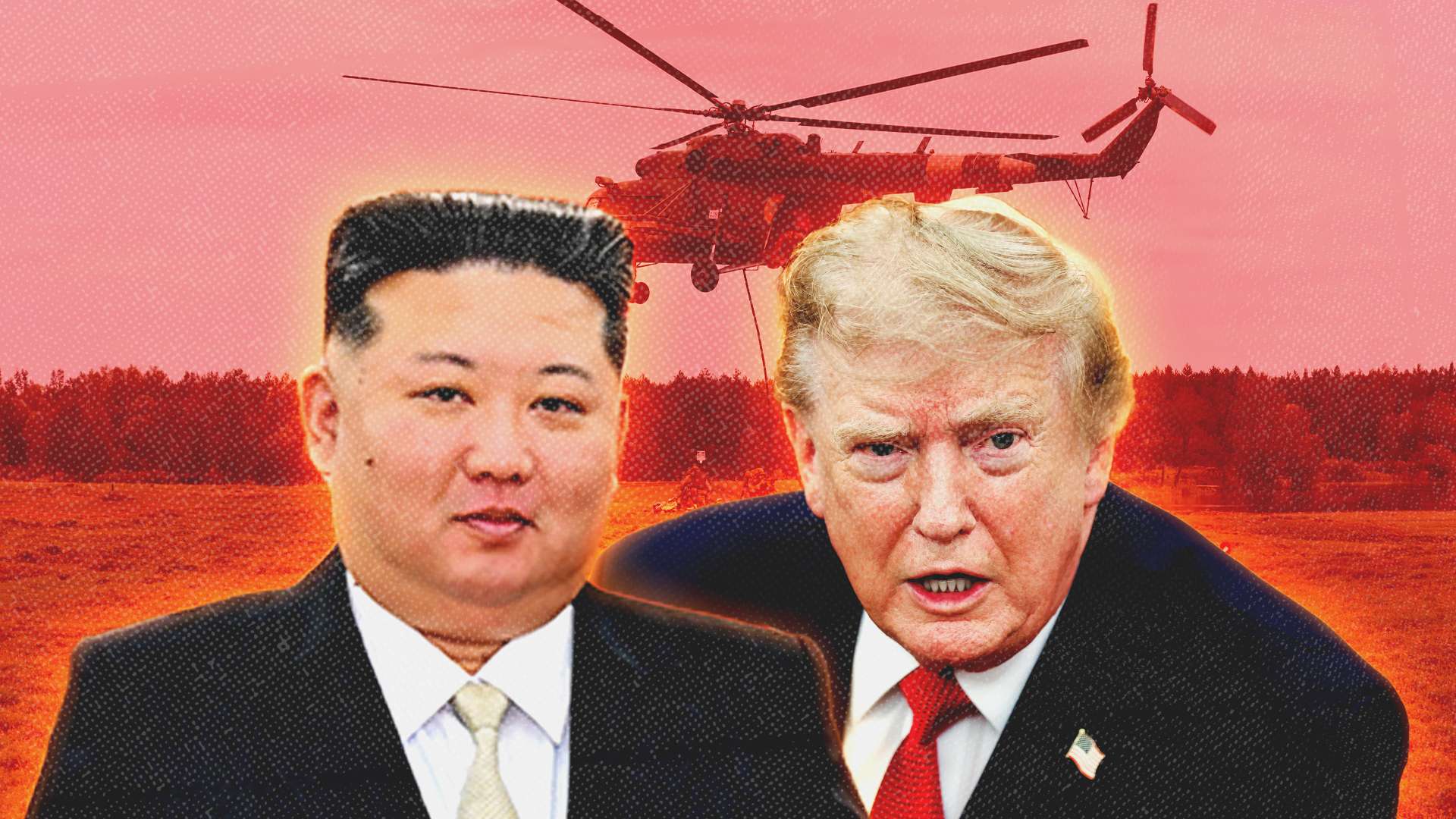
Donald Trump’s move to markedly scale down joint military drills conducted by American forces and those of South Korea distills the core attitude of the current U.S. chief executive: a blend of pettiness and a soft spot for rulers who wield unchallenged authority. He seems intent on disciplining Seoul for withholding backing in the White House’s Iran confrontation, while also trying not to provoke North Korea’s dictator by carrying out exercises alongside our other democratically governed, relatively free allies on the peninsula.
You are reading The Rattler from J.D. Tuccille and Reason. Get more of J.D.’s commentary on government overreach and threats to everyday liberty.
‘My Very Good Relationship with Kim Jong Un’
“Based on my very good relationship with Kim Jong Un, of North Korea, I am not happy with the fact that the United States has, long ago, agreed to participate in Joint Military Exercises with South Korea,” Trump posted Sunday on Truth Social. “These exercises are not only costly, with much of these costs paid for by the United States of America (as usual!), but send a signal that is totally inappropriate and hostile, to a Country that, as long as Donald J. Trump has been President, has been unthreatening and respectful. Therefore, and based on the fact that it is too late to cancel, I have instructed Secretary of War, Pete Hegseth, to substantially reduce the Joint Military Exercises! While somewhat unrelated (?), I recently asked the President of South Korea if they would like to join us in the Denuclearization of the Islamic Republic of Iran, and they said, ‘No thanks!'”
Trump’s aggravation with the Iran war is understandable; it’s a conflict he refuses to either fully commit to or bring to a close as it lingers. There’s scant proof that Iranian officials speaking with U.S. representatives actually command their country’s remaining forces. With no concrete plan in place, the Trump administration is contemplating threats to bomb Oman, a regional ally, if it obstructs a potential Iran deal. South Korea isn’t the sole traditional ally wary of being dragged into a broader conflict.
South Korea also draws a large portion of its energy from the Middle East, obtaining about 70 percent of its oil there. It sits in proximity to Iran’s fellow travelers—China, North Korea, and Russia—making it susceptible to the risks of a widening war with the United States and these regimes. To make matters worse, Trump often appears more at ease with the rulers of those adversarial nations than with the democratically elected leaders of allied countries. He underscored this tendency when he highlighted his so-called ‘very good relationship with Kim Jong Un, of North Korea’ and described the regime as ‘unthreatening and respectful.’
The South Koreans who hear Trump praise North Korea are the same people who see their northern neighbor launch missiles into the sea as a warning and send troops across the border to probe the South’s readiness. They live under perpetual menace from the communist regime to the north, yet the U.S. president seems to reserve his praise for that dictator. Of course, many are wary of participating in the current administration’s overseas ventures. It’s not obvious that Trump has carefully considered his choices or that he believes he has picked the right partners.
A History of Admiring Dictators
Regrettably, Trump has a track record of turning away from friends and maintaining a soft spot for those who oppose American values.
“It’s funny, the relationships I have, the tougher and meaner they are, the better I get along with them,” Trump told interviewer Bob Woodward in 2020 about his dealings with global leaders.
It isn’t only Kim Jong Un who earns Trump’s praise. He has commended President Recep Tayyip Erdoğan of Turkey and President Xi Jinping of China, both times using the label “strong man.” He has also shown warmth toward Russian President Vladimir Putin, though that fondness was severely tested by Russia’s invasion of Ukraine. The president’s continual affections for autocrats have fed conspiracy theories that he’s been compromised by Russian or other foreign intelligence services. Yet a more persuasive explanation is that he simply envies leaders who do not face the same constraints.
“Trump likes and admires dictatorial strongmen,” Timothy P. Carney wrote bluntly for the American Enterprise Institute (AEI) in 2018. “This praise for brutal rulers who do whatever is necessary to control their countries reflects other things we know about Trump. I’ve described his mindset as a ‘dog park’ mentality. Displays of strength earn him respect; displays of weakness invite ridicule.”
Carney further noted that, regardless of how much Trump might envy the unrestrained power of explicit dictators, he remains bound by the U.S. Constitution, the separation of powers, and the courts—checks that limit his authority. But from what he tells interviewers and the world leaders he extols, it’s evident how he might govern if those restraints were removed.
According to a January report in The New York Times: “Asked in a wide-ranging interview with The New York Times if there were any limits on his global powers, Mr. Trump said: ‘Yeah, there is one thing. My own morality. My own mind. It’s the only thing that can stop me.'”
The Times added: “On topic after topic, he made clear that in his view, American power is the decisive factor—and that previous presidents were too cautious to use it for political supremacy or national gain.”
Dictator Envy Is Historically Widespread and the Reason for Checks on Power
Undoubtedly, Trump believes he could make sharper choices and act with greater effectiveness if he did not have to contend with constitutional limits, congressional prerogatives, court rulings, and the other guardrails that were deliberately designed to curtail the reach of federal authority in the United States. Yet such restraints are not unique to democracies; plenty of would-be autocrats—including many U.S. politicians who may not share Trump’s candor—also crave unrestrained power. Checks exist precisely to prevent one person from wielding power unilaterally, regardless of how competent they think they might be if freed from constraints.
South Koreans have ample grounds to be cautious about Trump and his fixation on foreign policy adventurism. Disruptions to Middle Eastern oil shipments, the risk of a broader conflict, and Trump’s evident sympathy for their main regional adversary all factor into their deliberations.
Yet Americans should heed closely what any leader, including Trump, says about dictators. The longing to rule without limits and envy of figures like Kim Jong Un are not rare among political elites across history. The Constitution’s purpose is to cap political power precisely because those in government often chafe at such restraints.
