
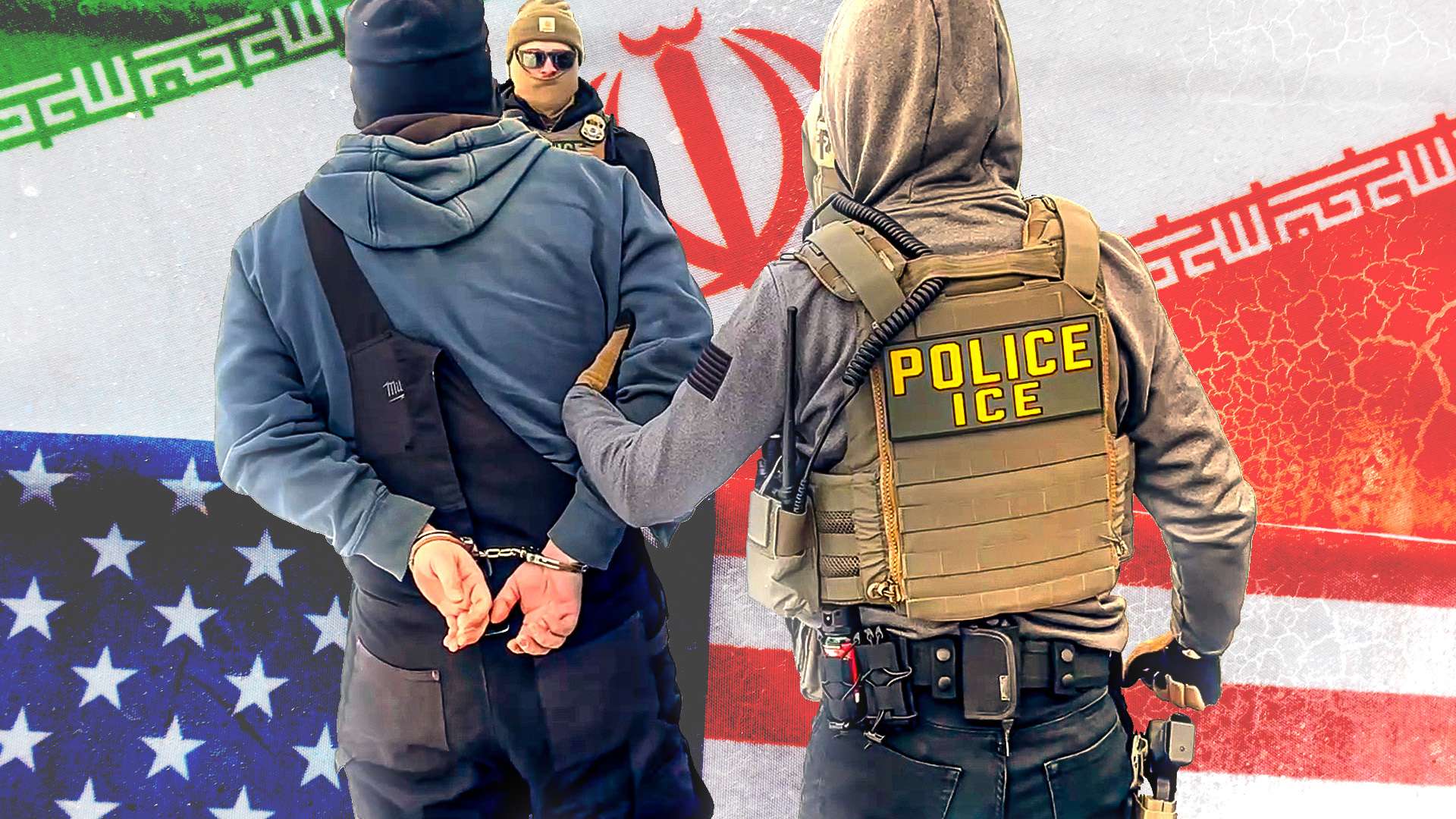
New FOIA disclosures reveal a discreet conduit tying ICE’s Israel office to Qatari authorities and Tehran.
Immigration and Customs Enforcement (ICE) moved specific detainees to Iran at the behest of the Islamic Republic, according to newly released records.
An ICE employee noted in a September 2025 email that “The Iran Embassy just issued passports or travel papers for the three individuals listed below. They asked to be added to the flight departing on the 29th,” suggesting that ICE followed through on the request, while other agency staff scrambled to collect the Iranians from various U.S. detention centers.
ICE flights to Iran have long sparked controversy. While the Trump administration contemplated taking military action against Iran, ostensibly to liberate Iranians from an oppressive regime, it simultaneously sent people back to the same government. Among those targeted were Iranians who identified as gay and had converted to Christianity—both acts illegal under Iranian law.
A set of documents released in response to a Freedom of Information Act (FOIA) lawsuit filed by the nonprofit National Iranian American Council, and first reported by The Intercept, sheds new light on the flights. The materials reveal not only ICE’s cooperation with Iranian authorities but also that the deportations appeared to be a direct White House initiative and that Iran was accidentally handed one deportee.
During the Twelve-Day War between Israel and Iran, on June 19, 2025, ICE’s Acting Executive Associate Director Marcos Charles ordered the deportation of all “removable” Iranians. Another official, whose name remains redacted, described the move as a “White House priority.” That official noted that the operation would be “difficult to execute” because the region’s airspace was shut due to fighting and Iran was “currently uncooperative.”
This development was unsurprising to some observers, given that President Trump had been openly weighing involvement on the side of Israel, a course he ultimately adopted three days after Charles’s email.
A few months after the conflict began, Iran’s government appeared to become far more cooperative about deportations. ICE personnel began discussing a plan to repatriate Iranians via neighboring Qatar in August 2025. An email from an ICE employee—whose name is redacted—claims that the plan “started as an Iranian initiative.”
Ironically, the correspondence indicates that a central point of contact with the Qatari government was Joshua Coster, ICE’s attaché at the U.S. embassy in Israel, a nation that was at war with Iran and regards Qatar as an adversary. Qatar’s Lekhwiya special forces unit accompanied the detained Iranians on the flight.
The initial August 2025 flight plan collapsed because of coordination issues among the Qatari ministries and Iranian counterparts, according to the ICE emails. A subsequent flight was scheduled for September 29, 2025. ICE coordinated with Iranian diplomats to assemble the list of detainees, gathering Iranians from several detention facilities at the Alexandria Staging Facility in Louisiana and finalizing the list with three names added at Tehran’s request.
Details about the Iranian diplomats involved remain unclear. The emails reference the “Iran Embassy,” a presence that does not exist in the United States due to the absence of formal relations between the two countries. Typically, Iranian consular matters for those in the U.S. are handled by Iranian diplomats assigned to the Pakistani embassy in Washington.
Detainees interviewed by an Iranian diplomat from the Pakistani mission reported that the diplomat possessed detailed information about their asylum cases, according to a lawsuit filed by the Iranian American Legal Defense Fund, which seeks to prevent ICE from sharing such information. ICE, for its part, disputed sharing asylum data in its reply to The Intercept.
The emails show that a few days before the deportation flight, ICE had brought an Iranian diplomat to the Alexandria staging site to interview detainees. The diplomat pressed for adding more names to the deportation list, but ICE turned down that request—not for ethical or legal reasons, but due to logistical constraints.
“Consequently, the Iranian Director requested information regarding travel documents for specific cases and asked that certain cases be removed from or added to the charter flight. I confirmed with the Iranian Director that we could not add cases to the charter and that those with valid original travel documents (already listed and approved) would proceed on the charter,” one ICE employee with a redacted name wrote. “Ultimately, the Iranian Director requested that ERO carry out another charter mission to return these cases to Iran as soon as possible.”
Nevertheless, another Iranian was apparently added to the flight at the last moment. “An Iranian alien not included on the final manifest we sent to the Qatari Ministry of Interior was boarded on the flight,” wrote Coster, the Israeli-based ICE attaché, on September 30, describing the incident as “unfortunate.” That individual nonetheless was deported to Iran.
ICE declined to comment for Reason and avoided addressing the error of the deportation when replying to The Intercept.
Two additional deportation flights followed the September 2025 mission: one in December 2025 and another in January 2026. The latter occurred only weeks after a large-scale uprising in Iran, which the government suppressed with force, resulting in thousands of deaths.
In total, ICE removed more than 100 people to Iran. Several deportees were summoned for questioning by Iranian secret police after arrival, a development covered by the BBC and The New York Times.
In June 2025, Charles noted that 244 Iranians had final removal orders while remaining in ICE custody and 2,578 had final orders outside custody, hinting at far more ambitious plans. The Iranian American Legal Defense Fund asserts in its lawsuit that ICE had scheduled a fourth flight for March 2026.
But the United States and Israel launched a war against Iran on February 28, 2026, rendering further deportations nearly impossible. “The United States military is conducting a vast, ongoing operation to prevent this profoundly wicked, radical dictatorship from threatening America,” Trump declared in announcing the conflict, adding, “Finally, to the great, proud people of Iran, the hour of your freedom is at hand.”
Today, that same government remains in control of Iran. It remains unclear what became of the Iranians who were handed over by the Trump administration.
