
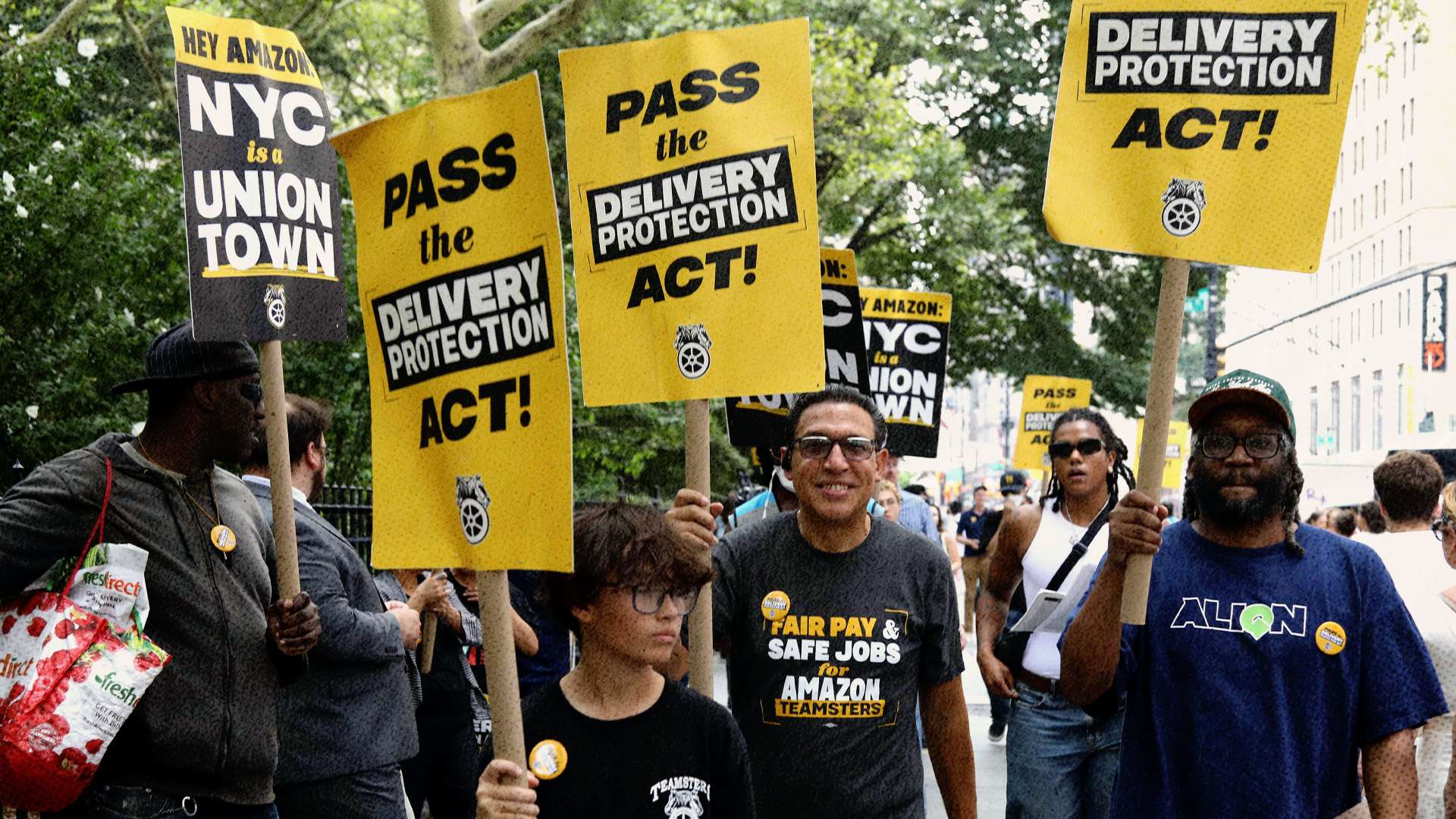
The misleadingly named “Delivery Protection Act” would require companies like Amazon and FedEx to hire last-mile delivery staff directly, rather than outsourcing this service to subcontractors.
Even before considering how costly New York City already is to live in, a measure before the City Council could push the price of delivering packages across the five boroughs higher. Presented under a safety-oriented rationale, the bill—now endorsed by Mayor Zohran Mamdani—appears to be little more than a thinly veiled bid to expand union influence.
Drafted by NYC Council Member Tiffany Cabán in February, the misnamed “Delivery Protection Act” would mandate that firms like Amazon and FedEx employ their last-mile delivery workers directly, rather than outsourcing this function to subcontractors. The last link in the delivery chain—the final steps to a consumer’s doorstep—represents the costliest portion of the operation because drivers must stop at numerous residences in densely populated areas. If enacted, the bill would raise the expense of this kind of parcel delivery.
One prominent justification offered for the bill is safety. Proponents such as Mamdani argue that Amazon’s last-mile service—which relies on subcontractors that hire their own staff—contributes to more traffic-safety incidents in the city. Under this view, removing subcontractors would decrease staff turnover and shift liability directly onto Amazon, potentially reducing incidents and better protecting drivers from harm.
Yet in recent years, Amazon has poured over $12 billion into technology and safety enhancements for its delivery contractors, which the company reports has driven a 48 percent drop in accident rates since 2020. This includes the creation of “DNY7″—a state-of-the-art training facility in Brooklyn where onboarding goes beyond federally mandated safety training—and the acquisition of camera-equipped vans and modern electric bikes.
While proponents cite statistics showing that injury rates among Amazon’s last-mile subcontractors stand at 8.3 per 100 workers versus 2.4 for all private employers, this comparison is largely irrelevant. The meaningful benchmark would be the national injury rate average for couriers, which is 8.0, suggesting that Amazon’s last-mile subcontractors align with industry norms.
The International Brotherhood of Teamsters and the New York City Central Labor Council, AFL-CIO are backing the bill. Under federal labor law, Amazon’s subcontracted last-mile delivery partners can be individually unionized, but the labor contract would not be signed with Amazon itself. Banning subcontracting for last-mile delivery would compel Amazon to hire these deliverers as direct employees, making it easier to organize them.
As attorney Alex MacDonald has noted, this forms part of a broader strategy employed by unions in recent years: when on-the-ground organizing proves difficult, they push for laws like this that “read like a shortcut to organizing.” In other words, what cannot be achieved through collective bargaining is pursued through direct regulation.
But such laws—and NYC’s proposed prohibition on last-mile delivery services in particular—are often argued to be preempted by the National Labor Relations Act (NLRA). As MacDonald argues, the NLRA was designed as a framework of overlapping rights, duties, and zones of self-help that establishes a cohesive national labor code—one that emphasizes “private negotiation and the free play of market forces.” The more progressive locales and labor unions chip away at this carefully balanced scaffolding, the more unstable it becomes, until it risks crumbling altogether.
Ironically, NYC’s last-mile delivery bill is also opposed by those it claims to help: during the City Council hearing, which stretched to seven hours, hundreds of last-mile delivery workers unexpectedly appeared to testify against it. These workers earn about $24 per hour on average and receive employer-sponsored healthcare through the subcontractors.
Amazon’s last-mile subcontractors are, in fact, small businesses. These roughly forty firms reflect a cross-section of New York City, with about 25 percent owned by Black or Hispanic individuals, and another 10 percent veteran-owned, according to Amazon’s testimony. If the legislation passes, these businesses would be at risk of elimination.
Amazon has also warned that enacting the bill could eliminate an estimated 5,000 jobs within the five boroughs, and that the company might have to relocate delivery operations outside of New York. At a minimum, the bill would likely dampen the creation of additional last-mile facilities in the city—in favor of nearby counties or states—and accelerate automation.
Another potential outcome is that New Yorkers could face yet more “regulatory response fees” tacked onto deliveries (or on Amazon Prime memberships), reminiscent of Instacart’s $5.99 surcharge introduced in response to NYC’s recent minimum-wage legislation for grocery delivery.
The Mamdani-backed drive to end last-mile delivery subcontracting in New York City is framed as a safety measure. In practice, it would mainly bolster unions, slash jobs, and raise the cost of parcel delivery. It is an idea that should be sent back to the warehouse.
