
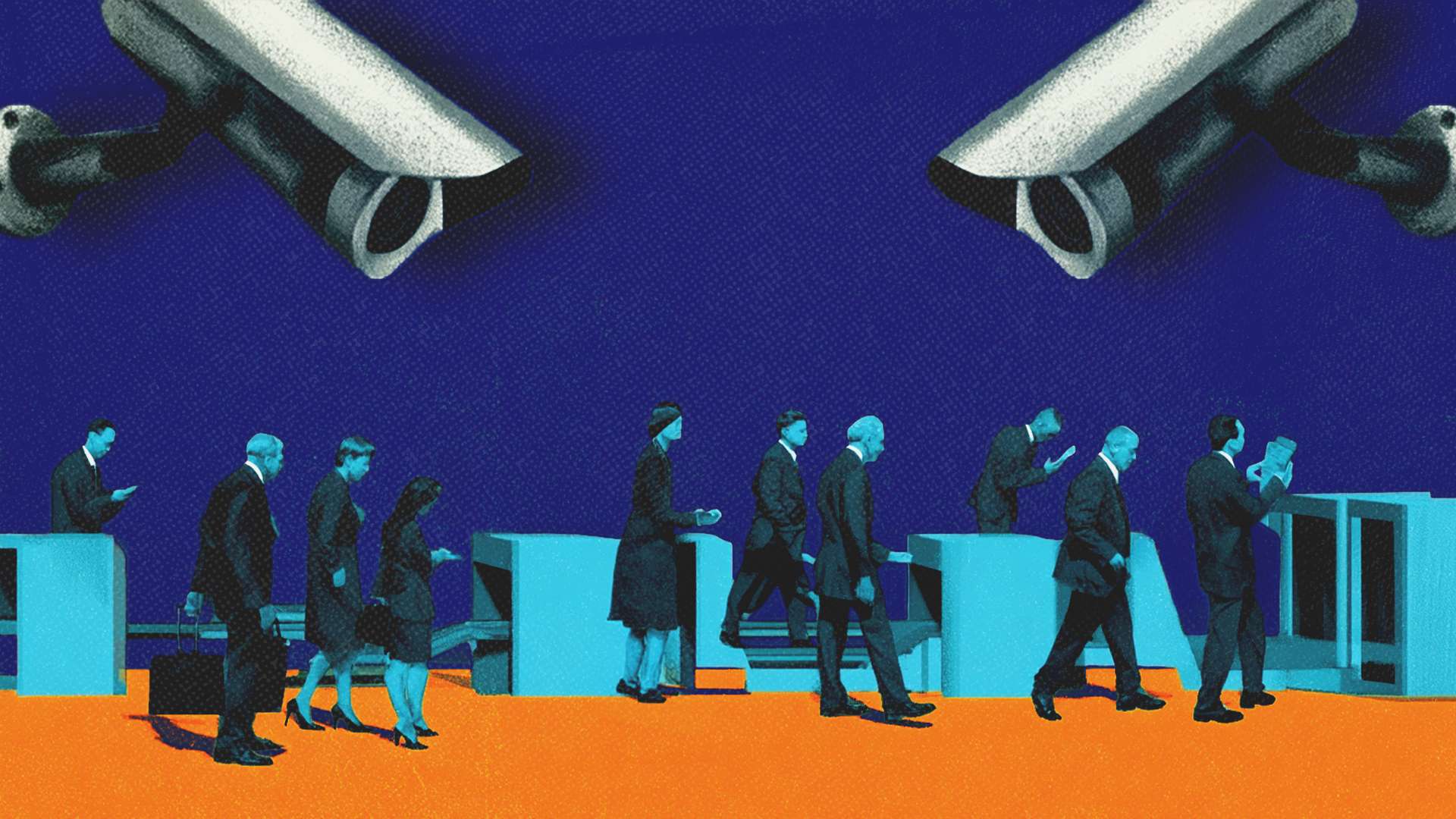
The U.S. government’s actions have become so woven into everyday life that many people barely notice them anymore.
Honey, why did that man photograph you? my preschooler asked as we navigated the Transportation Security Administration (TSA) checkpoint on a family trip.
It’s to verify my identity by matching my face to the picture on file,” I replied. “They want to confirm I am who I say I am.”
As we placed our bags on the conveyor belt for the X-ray scan, another question arose. “Mom—what’s that big machine?”
A body scanner. It’s designed to detect items hidden under people’s clothes.”
“Can it see my privates?!”
“No,” I paused. Modern scanners aren’t meant to reveal such details, though there have been occasions where TSA workers could misuse equipment to touch people inappropriately. Older backscatter X-ray machines could, and did, produce images of naked bodies for the agency’s review.
After passing the metal detector, we waited for our bags. A man ahead of us was pulled aside to have his hands swabbed for traces of explosives. I found myself fielding another question.
“Mom—what is that thing?”
“What thing?”
“The thing they’re rubbing on his hands.”
“That—that is to check if there are substances on his hands that shouldn’t be there.”
To my preschooler, these surveillance steps will certainly feel routine: show your ID, undergo biometric screening, step into the scanner, and sometimes be “randomly selected” for extra screening. My children won’t know a time when air travel wasn’t like this. Facial scans, physical searches of people and belongings, and similar measures did not emerge from natural evolution; they are direct responses to the September 11, 2001 terrorist attacks and the subsequent war on terror. But my children won’t remember that, either.
Just as every baby boomer can tell you exactly where they were when John F. Kennedy was assassinated, people my age can recount precisely what they were doing just after 9 a.m. on 9/11. I was in seventh-grade music class. In other classrooms, friends watched people leap from windows. My mother picked me up early from school, and I distinctly remember that every television channel was packed with coverage. I watched the twin towers fall repeatedly, as if it would never end. President George W. Bush delivered several primetime addresses, and soon American flags flooded the neighborhood and my school.
Some consequences of 9/11 are obvious. Twenty-five years later, the United States government remains entangled in a global war on terror. Service members carry both visible and invisible wounds. The formal conflicts in Afghanistan and Iraq continue to shape the opinions of the public and policymakers alike. Other reminders of the attack and the responses that followed abound—from the memorial at the World Trade Center site and annual stair climbs to a proliferation of scholarly work on terrorism and counterterrorism.
Other aspects of 9/11’s legacy are subtler, especially for Americans who were too young to remember life before the attacks. The U.S. government moved in ways that were either largely kept from public view or are so integrated into daily routines that we no longer recognize them for what they are: explicit expansions of governmental power that have dulled checks on government and eroded civil liberties.
Scale, Size, and Scope
In addition to waging wars in Afghanistan and Iraq and mounting other overseas interventions, the U.S. government underwent its most sweeping reorganization since 1947. The Department of Homeland Security (DHS) began operating in 2003, merging 22 agencies into a unified federal security apparatus. New entities appeared as well, such as the TSA, Immigration and Customs Enforcement, U.S. Customs and Border Protection, U.S. Citizenship and Immigration Services, and the Office of the Director of National Intelligence. Other agencies underwent major structural changes, including the Federal Emergency Management Agency, the U.S. Coast Guard, the Secret Service, the CIA, and the FBI.
Federal defense spending surged from $326 billion in 2001 to about $360 billion a year later. By 2010, the federal military outlay topped $652 billion. Estimates from 2020 forecast that the broader war on terror could cost U.S. taxpayers more than $8 trillion by 2050.
It wasn’t merely the sheer scale or magnitude of government that shifted. To truly grasp how America has been reshaped, we must also recognize changes in the scope of government—the kinds and breadth of activities the government engages in.
The fear generated by the 9/11 attacks drew citizens toward an expansive government. This fear also created a “disarming effect,” whereby many came to accept, or even welcome, measures they would have previously regarded as grave infringements on personal freedom.
The most evident examples involve surveillance. Despite explicit constitutional protections against unlawful searches, a majority of Americans supported expanding government surveillance after 9/11, including wiretapping, collecting cellphone records, video surveillance, and fewer restrictions on government spying.
This support, together with the fear of another attack, paved the way for the rapid passage of the USA PATRIOT Act in October 2001. Among other expansions in the scale and scope of government, the law broadened Washington’s ability to monitor people and relaxed or removed constraints on surveillance. For instance, the act amended the Foreign Intelligence Surveillance Act (FISA) of 1978—the federal statute governing surveillance and data collection for foreign intelligence on U.S. soil. The PATRIOT Act allowed longer periods for searches and surveillance and introduced “roving” wiretaps, enabling agents to track surveillance targets across multiple phones, email accounts, and locations without repeatedly securing new authorizations. It also made it easier to obtain pen-trap (or “trap-and-trace”) orders, enabling broader collection of metadata in investigations.
Other portions of the PATRIOT Act lowered the bar for seeking FISA approval. Additional sections relaxed constraints on sharing private information about U.S. citizens with foreign governments.
Moreover, the PATRIOT Act replaced stricter rules about data collection on businesses with a broader provision authorizing the government to obtain “any tangible thing” that may be relevant to an investigation, including business and library records, financial and travel records, and telephone metadata. The act facilitated broader and more direct surveillance-related coordination and information sharing among officials across different branches of the government.
Americans largely welcomed these changes, with many saying they would be “fine” with the government collecting their personal phone records. Others believed the government had not gone far enough in curbing civil liberties to fight terrorism. It was not until Edward Snowden exposed some abuses of surveillance technologies by the National Security Agency that U.S. citizens clearly denounced the expansion of federal spying. Even today, while skepticism remains about certain surveillance policies, support for some level of surveillance persists.
The Ratchet
September 11 opened the door to permanent changes in the size of government and the nature of its activities. Economist Robert Higgs anticipated this in his 1987 book Crisis and Leviathan: Critical Episodes in the Growth of American Government. Higgs described a “ratchet effect” in which government tends to grow, but rarely shrinks. In ordinary times, there is a baseline supply-and-demand dynamic, with bureaucrats expanding their role when citizens seek goods and services. But a crisis and the fear it brings markedly raise the demand for the government to “do something.”
The government grows steadily until a crisis hits. A subsequent expansion, integration of new governmental functions, and retrenchment after the crisis subsides follow. The result is a higher level of government activity than would have occurred without the crisis—a ratchet-like growth in government.
We can point to many examples from the last century. Before World War II, scientists urged the government to pursue a nuclear program out of fear of a nuclear-armed Third Reich, culminating in the Manhattan Project. In the early Cold War, fear of communism spurred government actions—loyalty oaths, domestic surveillance, and public hearings. More recently, calls to “fix” the COVID-19 pandemic led to restrictions on individual movement, mask mandates, and support for government-issued “vaccine passports.”
Eventually, the crisis that triggered the expansion—be it a pandemic, a threat from nuclear adversaries, or terrorism—fades. Some policies adopted to address the crisis are rolled back or eliminated. For example, COVID-era masking and lockdown restrictions were eventually withdrawn.
Yet the expansion of government is not fully reversed. Policies and programs created during crises become embedded in the normal operations of government. New agencies persist, and crisis-era policies become the default operating mode within a broadened government. The crisis leaves a lasting imprint on government.
Higgs wrote before 9/11, but the framework helps us analyze how the terror attacks opened the door to bigger government—and it helps us appreciate both the financial and non-financial costs of government growth.
Fear Is the Privacy-Killer
Right after the 9/11 attacks, a clear majority of Americans reported feeling fear. This fear spurred demands for swift action by officials. In the weeks following September 2001, nearly half of Americans worried that the Bush administration would not move quickly enough to counter further terrorism threats.
This sense of urgency, if not outright support, among the public was reinforced by incentives facing various government actors.
The Framers of the U.S. Constitution deliberately designed a federal system with checks and balances, dispersing power across federal, state, and local levels. Diffusing power among smaller government units limits federal authority and potentially provides further checks on federal overreach through the courts, which determine the legality of federal actions.
But in moments of crisis, smaller governments tend to align with the political center. Public calls for government action can open the fiscal floodgates for those entities—at all levels—responsible for addressing the crisis. As a result, actors in state and local governments may find it advantageous to harmonize their policies with those of the federal government.
State and local police departments, along with other peripheral government units, quickly assimilated surveillance protocols into their work in the name of countering terrorism. Framed as “first preventers” of the next attack, police forces and local governments rapidly linked their activities to the broader fight against terrorism.
Today, 90 percent of U.S. sheriff’s offices with more than 500 deputies use automatic license plate readers, as do all police departments serving populations over one million. Over the course of the war on terror, local police departments and sheriff’s offices embraced and deployed unmanned aerial vehicles. In 2012, dozens of police departments used drone surveillance; a little more than a decade later, more than 1,400 such entities were operating drones. The justification, then as now, centers on counterterrorism.
Other surveillance technologies, such as cell-site simulators or “stingrays,” have also been adopted by police departments nationwide to combat terrorism. These devices—roughly the size of a small oven—trick cellphones into transmitting location data by simulating a real cell-tower signal.
As time passed, the immediate crisis of 9/11 and the subsequent war on terror faded. Some crisis-era programs dwindled or disappeared entirely. In 2004, for example, DHS scrapped the Computer Assisted Passenger Prescreening System II, a scheme intended to assign a terrorism risk score to every commercial air passenger. The Multistate Anti-Terrorism Information Exchange, a data-mining and information-sharing network, ceased operations in 2005.
True to the ratchet dynamics, however, many expansions endured. Numerous provisions of the PATRIOT Act remain in effect, including those enabling broader surveillance. Likewise, the use of biometrics, artificial intelligence, and other tools by federal and local agencies is now a routine expectation.
Twenty-five years after the attacks, is it possible to unwind these intrusions? Can new ones be prevented? In theory, formal constraints, whistleblowers, and the media can operate as checks on government growth. In practice, these mechanisms may help, but they are likely to be far from sufficient.
But return to Higgs’ framework. The early chapters of Crisis and Leviathan emphasize the role of citizen ideology. Higgs argues that the public’s tolerance for larger government is a prerequisite for the ratchet effect to take hold. In a similar vein, ideology might be the key to preventing future ratchets and perhaps reversing some of the past ones.
With many intrusive policies implemented after 9/11, it was the pushback from everyday people that ultimately caused some to end. Ultimately, it is up to each of us to defend liberty and resist the heavy-handed “protection” that the government offers.
