
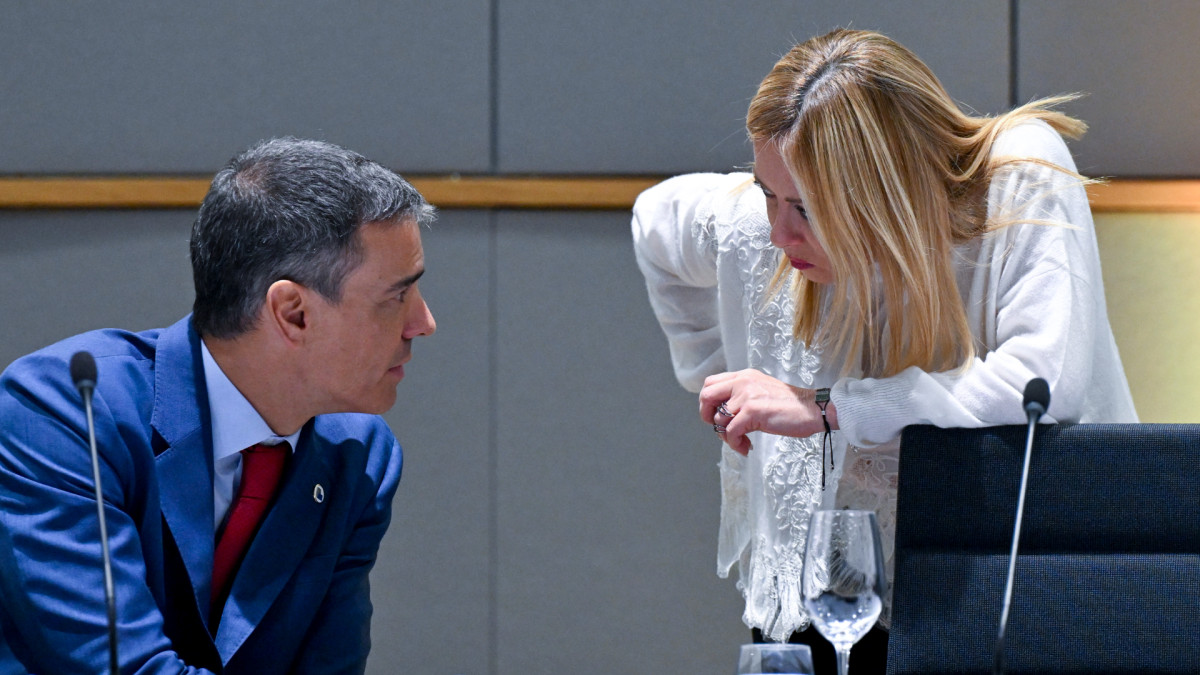
The grave Ceuta crisis, at once humanitarian and territorial, also has significant European consequences, particularly due to the tension between the governments of Italy and Spain. From the outset, Italian Prime Minister Giorgia Meloni stated that Spanish Prime Minister Pedro Sánchez had been weak in the face of the assault, although the rapid return of about 70,000 of the 80,000 irregular entrants who entered the city forced her to qualify her criticisms. On one hand, it is a mistake for Meloni to accuse the government of a friendly, allied, and partner country, and on the other hand, one cannot ignore that highlighting the different migratory policies of both obeys internal reasons, since both Meloni and Sánchez are primarily addressing their voters.
“Controlling the documentation of passengers coming from Spain is nothing more than a useless bureaucratic hurdle in practical terms”
In other words, the temporary suspension by Italy of the Schengen Treaty with regard to Spain is a symbolic and propagandistic operation, even if it is a contemplated and relatively common possibility. Controlling the documentation of passengers coming from Spain (Sánchez has replied with the same measure) is nothing more than a useless bureaucratic hurdle in practical terms. It is worth recalling that last year, for example, 3.2 million Spaniards traveled to Italy and 5.4 million Italians to Spain and that, after that double suspension, barely 10% of passengers have now been subjected to random checks; therefore, this measure should be shelved as soon as possible and not repeated.
For Meloni’s government, Sánchez’s policies would endanger the Schengen system (as Carlo Fidanza, a member of the European Parliament from Fratelli d’Italia, has noted), but this is a distortion because it is not true that anyone who reaches Ceuta or Melilla can freely circulate throughout the entire Schengen area. This is simply not the case because the two autonomous cities have a different status in that treaty, since a prior check is required before one can move to the mainland. Therefore, irregular migrants in either of the two autonomous cities must pass a double screening, hence the temporary controls established by Meloni and Sánchez have no justification.
The lamentable Twenty-Two letter pushed by Meloni, with the incomprehensible complicity of Danish Social Democrat Mette Frederiksen, reflects the objectives pursued mainly by European radical-rights on migration policy and in it Sánchez’s regularization was attributed as a possible attracting factor, something not empirically verified. On the one hand, it should be remembered that four European countries did not join this regressive document (France, Ireland, Luxembourg, and Portugal), and on the other hand, that the President of the Commission, Ursula von der Leyen, later congratulated Spain for its effectiveness in solving the crisis essentially, while also announcing more economic aid to Morocco to curb the crossings. In reality, one cannot ignore that Ceuta and Melilla are the EU’s “external border” and for that reason they would deserve far firmer community attention than what was shown in this crisis.
“Italy and Spain are obliged not to repeat a rift like this and, even if their governments are ideologically at odds, they are mistaken to persist in prolonging restrictive measures”
The episode of the disagreement between Meloni and Sánchez is a mistake because it distances two countries that should cooperate much more to forge a strong complementary counterweight to the Franco-German axis. However, in this crisis, for Meloni it is Sánchez who would be blackmailing Italy, since the prime minister considers the Spanish response excessive, and Matteo Salvini went further by calling Spain’s migration policy a threat to national security. It is true that for Sánchez it is easier to be firm with Italy—a European partner with which this crisis will be overcome—than with Morocco, whose regime he tries never to upset. Italy and Spain are obliged not to repeat a rift like this and, even if their governments are ideologically opposed, they are mistaken to persist in prolonging restrictive measures. Moreover, this has not always been the case: Spain fully stood with Italy in the wake of the severe Lampedusa crisis in 2023. In short, cooperation between Italy and Spain should not have a low profile; it must exceed this situation as soon as possible, and the fact is that the Italian opposition has shown solidarity with Sánchez (Elly Schlein of the Partito Democratico; Giuseppe Conte of Movimento 5 Stelle; Nicola Fratoianni of Alleanza Verdi Sinistra; and even the centrist Matteo Renzi, who believes that Meloni has been mistaken).
The worst part of this crisis has been the initial lack of European solidarity: in 2021 it stood firm against the provocations of Belarusian autocrat Alexander Lukashenko when the entire European Union backed Poland and the Baltic states, which makes the European timidity and inaction in the Ceuta crisis incomprehensible and counterproductive for the union’s own interests. It is very serious that the bulk of governments and European public opinion adopt the discourse of the radical right on migration because it is an essential ingredient in their project to impose a model of ethnic nationalism with increasingly authoritarian and anti-pluralist traits. The famous “pull factor” is nothing more than a myth, besides that opposing regularization has nefarious effects, since opponents know that in practice it is impossible to expel all the “undocumented” from European countries, hence the effective result of ignoring them is not only to render them invisible but to expose them to maximum exploitation.
In this crisis, Sánchez was practically alone at first, being the perfect enemy of all the European right-wing authorities for being the exception in migratory policy—flexible and receptive, hence Vox, for example, immediately identified with Meloni’s theses. The question is to analyze why the Italian prime minister has reacted as she has: on one hand, this crisis with Spain has served her well because it aligns with her xenophobic ideology, and on the other hand, it has helped prove that she is the staunchest defender of national interests. In reality, Meloni has used this matter as a domestic political instrument, as a cohesion factor for her coalition under her undisputed leadership and as a pressure tool against the progressive opposition. That is, the Meloni-Sánchez confrontation has a clear pre-electoral subtext, since Fratelli d’Italia aims to reaffirm its clear political hegemony against the waning Lega of Salvini and the rising Futuro Nazionale of Roberto Vannacci, which already reaches 7% in some polls. After the failure of the judicial reform referendum, Meloni urgently needed to regain political initiative and show toughness on migration issues; it fits perfectly in her strategy. The internal wear within her coalition is becoming evident in the tricky electoral reform negotiations—with parliamentary defections included—and with differences over rearmament (between the “Putinist” Lega, opposed to increasing it, and Forza Italia, Atlanticist and in favor of increasing it). Therefore, the Ceuta crisis has gone well for Meloni, not ignoring her profound hypocrisy: between 2021 and 2026 around 470,000 irregulars entered Italy compared to about 235,000 in Spain (Frontex data) and, moreover, the country will have no choice but to eventually legalize about 1.1 million irregulars it has and, in fact, is shaping a system of work permits for them as a first step.
“It is very grave that the bulk of governments and European public opinion adopt the discourse of the radical right on migration”
In conclusion, the migrant issue is not national, it is European, and it seems that the European Union has not learned: the ‘Fortress Europe’ is impossible and undesirable, in addition to being absolutely incompatible with its theoretical discourse on human rights. The fragmentation of information systems among the Twenty-Seven makes no sense, as does the lack of coordination and cooperation on the matter, and externalizing the deportation of irregulars to third countries, the Meloni approach of Albania, is a total failure. Overcoming this vision would require a truly federal view, which, unfortunately, the European Union currently lacks.
