
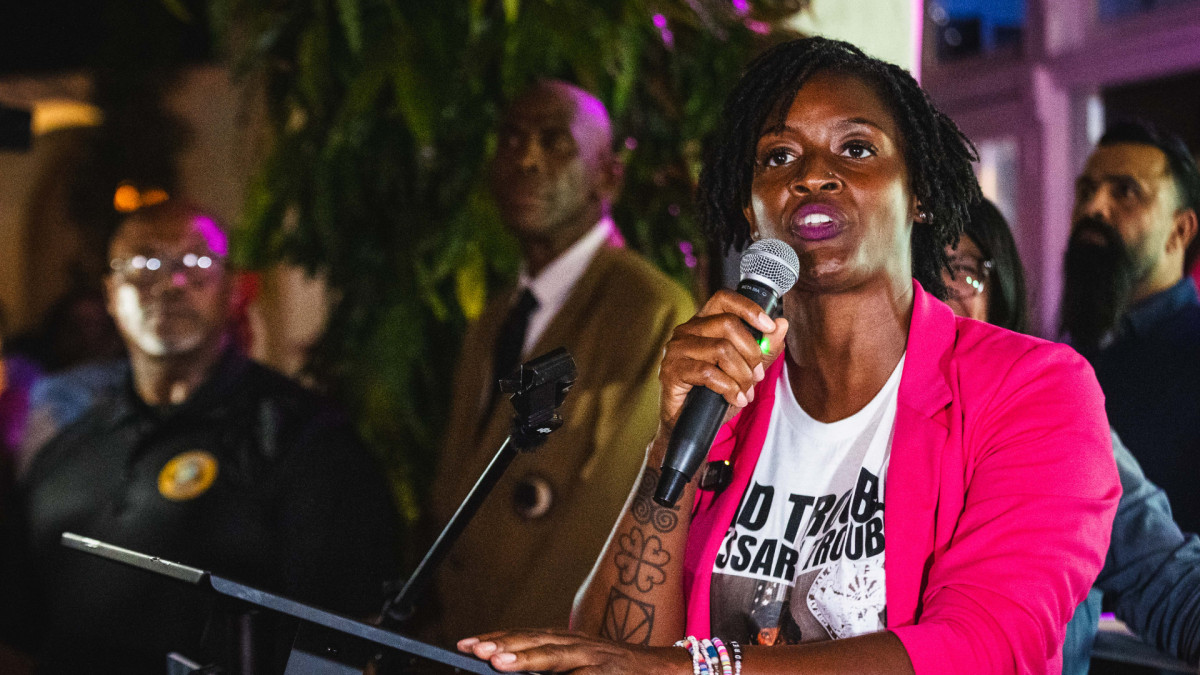
First, let’s lead with the breaking news. On August 18 in Florida, the improbable happened: Angie Nixon, a legislator who had raised and had less than a million dollars available for her campaign, defeated the favorite Alexander Vindman in the Democratic primaries, the former serviceman who became famous as a witness in the impeachment against Trump. It is worth noting, too, that Vindman had raised sixteen million dollars. Nevertheless, Nixon won clearly, and she did so by showing that money at the polls is not always decisive. She defeated the big party machinery, against the logic of the established order. And in November, she will face the Republican Ashley Moody in a race that could make her the first Black female senator from Florida, as well as the first member of the Democratic Socialists of America to hold a seat in the United States Senate. In short, the progressive wave within the blue party shows no sign of stopping.
“Nixon is not an improvised ‘outsider’: she is the consequence of years of fringe activism, of listening to those who had never been heard”
Second, Nixon did not appear from nowhere: she was born in Jacksonville, in the Moncrief neighborhood, where politics resembles survival more than speeches. She studied Political Science at the University of Florida and worked as a legislative aide, a community organizer, and a union organizer. Since 2020 she has held a seat in the State House. Just like El-Sayed, Francesca Hong, or Alexandria Ocasio-Cortez, her rhetoric carries the banner of universal healthcare, affordable housing, improved minimum wage, and paid family leave. She is not an improvised outsider: she is the result of years of grassroots activism, of listening to those who had never been heard, of standing up for a policy built from below rather than through political patronage or cronyism.
Her victory in the Florida primaries (a state politically very important, as, despite internal strife and pronounced social divisions, it tends to lean Republican) is less a win than a signal. A signal of what? That progressivism within the Democratic Party has no brakes. She has now joined a movement that already has its own recognizable names: the ones we mentioned just above. With her name already on the Democratic slate ahead of the November elections, it becomes evident that the fear of bold frontline politics is not always punished: in the case of Francesca Hong, it was punished, but in Florida the Democratic majority tipped toward the radical, toward the real and immediate change, toward those who want visible transformation, and not the comfort of tradition and the continuity of political correctness. And in short, Nixon won, and she did so against the logic that money decides elections.
“Today there is an electorate willing to bet on a social justice message even in a state known as an unwavering stronghold of conservatism and republicanism”
Now, beyond the bid for the midterms, as we have been addressing in Agenda Pública over the past month, what is at stake with this progressive movement is, above all, the direction (and the identity) of the Democratic Party. In this case we are talking about Nixon beating Vindman, but in reality, what we are doing is putting forward the idea that, in these times, money is no longer enough to decide an election and, above all, that the establishment is not invincible. This triumph shows that today there is an electorate willing to bet on a social justice agenda even in a state known for being a bastion of conservatism and republicanism. It has served as a reminder that American politics is changing, that progressive politics is not a passing fad (or something that happens in a couple of cities), but a force that grows, expands, and, in Trump-era fury, dares to defy the impossible.
Then, in November, Angie Nixon will face Ashley Moody (the Republican candidate). It will be a tough duel, in a volatile terrain. But what she has already shown is historic, namely that the progressive tide is advancing at speeds no one anticipated. And as often happens in stories that seem impossible, the unlikely is what best explains the present.
Thus the Progressive Map in the United States Ahead of the Midterms
The Nixon case is not an isolated event: it is part of a map that is being drawn across the country. For instance, in New York, Alexandria Ocasio-Cortez once again swept her district with more than eighty percent of the vote, confirming that her radical message solidifies day by day. In Michigan, Abdul El-Sayed, a physician and union organizer, is preparing to contest a seat in the Senate with the backing of unions and the party’s more combative wing. In Minnesota, Peggy Flanagan, the lieutenant governor, has championed Indigenous rights and social justice ahead of a national candidacy.
“Establishment candidates, with their millions of dollars, along with institutional backing, are beginning to crumble in face of campaigns that mobilize volunteers with small donations”
We are talking about names that recur, that join in, that chain together: Rashida Tlaib in Detroit; Ayanna Pressley in Boston; Ilhan Omar in Minneapolis. They form part of a phenomenon known as the Squad, a vanguard that a few years ago seemed merely anecdotal but is today a bloc with real heft in Congress. And now, with Nixon, even though she is not officially part of that bloc, that influence has extended south to a state that, until a couple of days ago, seemed shielded against any progressive discourse.
Against this backdrop, the rise of the “new left” seems impossible to ignore; this is the confirmation that the Democratic Party can no longer look the other way while its radical wing grows by leaps and bounds. Establishment candidates, with their millions of dollars, along with institutional backing, begin to crumble before campaigns that mobilize volunteers, with small donations, with speeches about wages, housing, and health. The opposition to Donald Trump’s extreme conservatism is no longer embodied by politicians who opt for cautious, traditional rhetoric or demagoguery and theoretical politics. Now, the frontline voices challenging the furious politics of the MAGA movement are those from the streets, from those who were never listened to, from those who do politics in neglected neighborhoods, and above all, from those who do not want to keep sustaining a system that treats health care as a privilege, politics as a weapon-wielding police, nor the Congress microphone as a utopia.
“The only sure thing, right now, is that the furious ways in which Trump has wielded power have already fed and fanned a radical flame that no November outcome is likely to extinguish”
Broadly speaking, this is the map of progressivism at the moment. With a little over two months to the midterms, the moment when the new political will of American society will be defined arrives. It has already been two years since Donald Trump returned to the White House, and both the United States and the rest of the world have changed in unimaginable ways. And the Democratic Party is no exception. These are times of radical changes, and that no one can deny, since the ballot box has given voice to the truth. These are times to consider new voices, to see new faces, to follow new generations, as recent democratic exercises indicate. Yet they are strange times in which, regardless of polls, forecasts, and the clamor of doomsayers, anything can happen. The only sure thing, right now, is that the furious ways in which Trump has wielded power have already fed and fanned a radical flame that no November outcome is likely to extinguish.
