
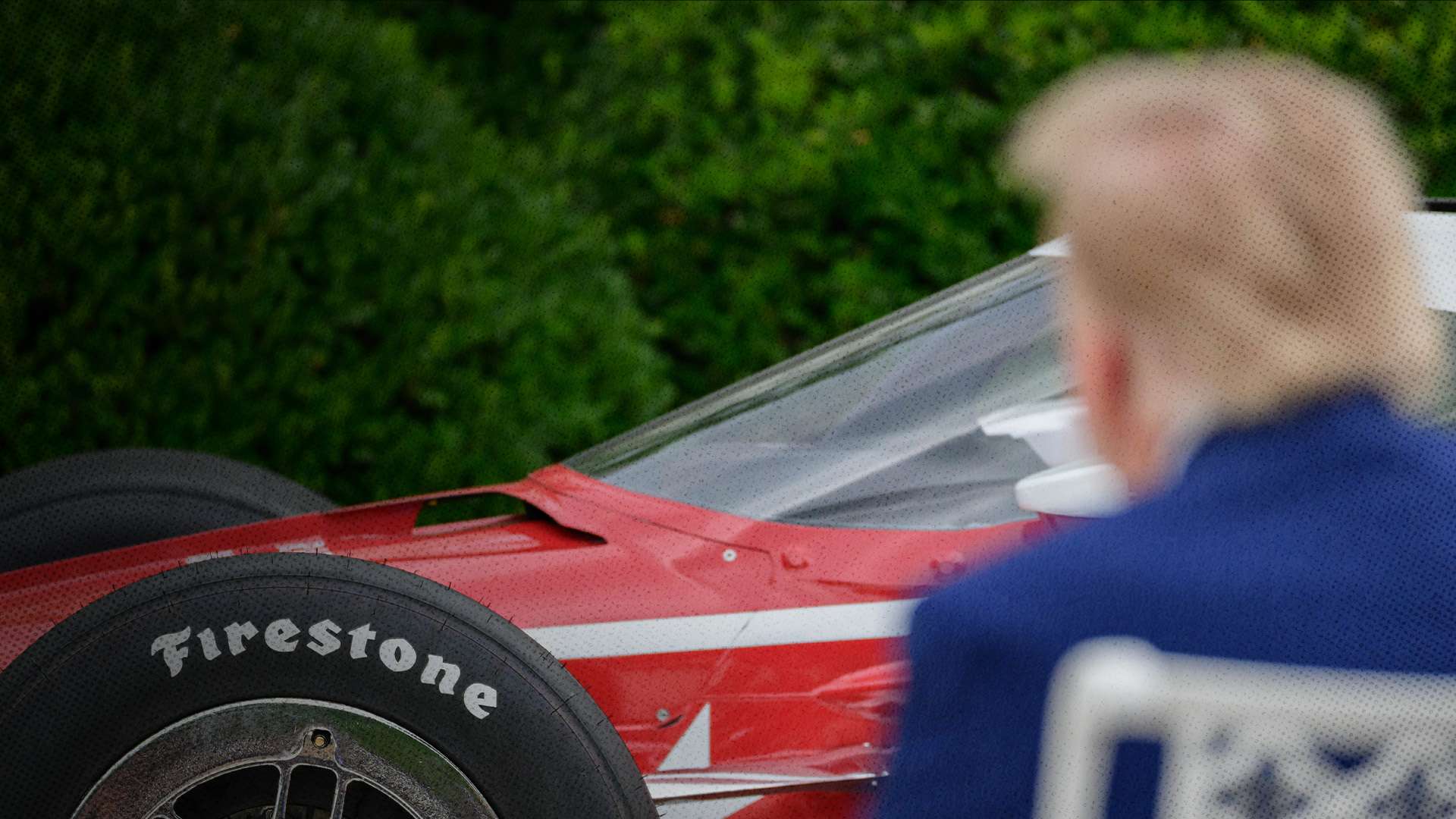
Plus: Should the race be staged again, or was it simply a one-off spectacle? Also, NCAA eligibility remains tangled, and athletic competition can shed light on immigration.
Greetings and welcome to another issue of Free Agent! Wishing everyone a productive new school year, and good times during gym class.
I attended the Freedom 250 IndyCar event on the National Mall this weekend, so I’ve got thoughts to share. After that, we’ll tackle a major development: players moving from NFL rosters into the NCAA transfer portal. We’ll finish with a few reflections on what sports can teach us about immigration.
Also, after 76 consecutive weekly issues since this newsletter began, I’m taking a break. But thanks to Reason’s ongoing pursuit of standout content, my colleague Eric Boehm will steer the newsletter next week. Be kind! I’ll be back after Labor Day, just in time for the NFL kickoff (you can already join our ESPN NFL Survivor group here).
Don’t miss coverage from sportswriter Jason Russell and Reason.
Locker Room Roundup
- You’ll be surprised to learn New York City is not doing a great job maintaining the park that once hosted historic Yankee Stadium.
- The New York Times lost its first defamation case in over five decades when a jury determined it defamed then-Indiana basketball player Kai Spears in 2023.
- English club Wolverhampton Wanderers will drop the “The Liquidator” anthem before games, since it prompted crowds to chant “Fuck off West Brom, we’re Wolves!”
- Bill Simmons had neoliberal reporter Derek Thompson on his show to discuss oligopolies in sports, the socialization of teams, the WNBA, and more. It didn’t land well. (Worse than how this guy puts it.)
- Elsewhere in Reason, a personal piece from our own Matthew Petti: “Border Patrol Detained Me for Hours Without Explanation. They Won’t Tell Me Why.”
- A lost trophy makes for great lore about some of the greatest sports trophies in history. (Relax, they found it.)
Montreal’s Walter Cup disappeared en route.
The PWHL issued a statement saying the trophy “did not arrive as expected at its latest stop,” and added “we are working closely with the shipping company to locate it.”
The Cup was meant to arrive in Lethbridge, Alberta. pic.twitter.com/hQUGwUsigt
— Front Office Sports (@FOS) August 22, 2026
The Freedom 250: A Racing Event, Not a Political Rally
Around lap 28, I found myself mulling over this November’s midterm elections. The race had just resumed after the second caution flag for the Freedom 250 on the National Mall. Kyle Kirkwood led Alex Palou by more than a second, and the field seemed to spread out with a second or two separating the cars.
I perched atop a wall beside the Smithsonian’s Air and Space Museum to get a higher vantage, roughly 30 yards from a sign that warned against climbing. My view was limited to a sliver of the circuit, so I watched the broadcast on my phone with headphones and a touch of hearing protection. FOX’s Jamie Little was interviewing First Lady Melania Trump, who recalled how her father introduced her to racing and that she “loved it, every minute.”
Was this, or the race itself, or any of the surrounding festivities designed to convert me or others into MAGA supporters? Was it a ploy to mobilize voters for Republicans in the midterms?
Not really. In person, political merch was sparse beyond the occasional red “MAKE RACING GREAT AGAIN” cap at the Penske merchandise truck. The out-of-towners beside me were chatty, and politics stayed off the table. Of course, although I missed what many considered the most political moment—the president taking a lap in the presidential limousine around the track—the crowd mostly cheered, I’m told.
Yet this is Washington, where everything gets filtered through a political lens. If your side does well, it’s celebrated; if it doesn’t, it’s vilified—even when the action appears similar. I’d seen online plenty of outrage from some who disliked the event’s politics, but in practice, after nine hours spent at the venue over the weekend, politics hardly registered.
Or did it? On Sunday, the Trump administration’s footprint was unmistakable. Beyond the presidential hot lap and the First Lady interview, Interior Secretary Doug Burgum gave the command to start engines (the National Mall falls under his oversight). Huge banners on city office buildings credited Trump and Transportation Secretary Sean Duffy for the race.
In a sense, all that visibility could be seen as one expansive pitch in support of Republicans and the Trump team. Senator Adam Schiff (D–Calif.) labeled it as one of Trump’s “self-aggrandizing distractions.”
Most people, I’d imagine, did not share that view (IndyCar driver Graham Rahal included).
Seeing race cars roll past Smithsonian museums and national monuments isn’t going to convert the entire country to a party, even if it might nudge some toward a more statist outlook. If Democrats think that’s the case, they’ve got bigger problems to tackle.
Should the Freedom 250 Return to Washington, D.C.?
Nearly everyone important—drivers, congressional leaders, the Trump administration, and Mayor Muriel Bowser (who takes office in January and will be replaced by a left-leaning successor)—expressed a desire to bring the event back to the National Mall. But it began as a one-time affair, and turning it into a recurring event isn’t as simple as asking everyone involved to “do it again next year.”
First, there’s the taxpayer cost, though it’s not as astronomical as some fear. Security spending was around $11 million. Some of the Interior Department’s $68 million assistance to the Freedom 250 organization would have supported the event, though a large portion likely went toward July 4 festivities.
Most of the financial burden fell on Penske Corporation, the parent company of IndyCar. As a one-off endeavor, they indicated they did not plan to turn a profit, according to NBC 4 Washington. The actual budget isn’t publicly known but it dwarfed the $22 million allocated to a Detroit race. The lingering question is how much money would be lost if the event were repeated annually, and whether Penske would accept covering ongoing deficits, or push for a different funding model—perhaps city or federal assistance—to bridge the gap.
There’s also the challenge of sustaining audience enthusiasm, whether for TV audiences or in-person crowds. The participants pulled out all the stops this year; how could they top it next time? The economic impact estimates rarely match reality; most attendees were locals from the D.C. area, though fans from other regions—Indiana, a hotbed for IndyCar—were visible. Local restaurateurs inside the race zone grumbled about road closures slowing business, and some commuters complained about delays (which, in a big city, are hardly a surprise).
A joint racing weekend with NASCAR could help sustain interest. Yet the event would likely need to occur in August to minimize disruption, and NASCAR already has three August weekends booked for the near term.
Additionally, the on-track action wasn’t exactly riveting. Kyle Kirkwood led most of the race, with relatively few dramatic overtakes. It was even a bit funny to watch IndyCar veteran Alex Palou stumble through a day that could have crowned him this year’s champion. It’s hard to imagine strong TV ratings in the future if the racing itself can’t deliver the excitement.
From an on-site perspective, the event ran fairly smoothly. Most attendees agreed they needed more grandstands (perhaps paid seating rather than lottery-based free access), and bigger screens would have helped spectators follow the broadcast better. Security lines moved efficiently, the Metro ran without major hiccups, and I had a wonderful experience with family and friends.
TV visuals looked spectacular, while the in-person vantage points outside the grandstands were perfectly adequate. For me, the appeal lay as much in easy access from the suburbs as in the spectacle itself, and that’s probably why I’d return. There are only a handful of racetracks globally where you can reach the action without a long drive or bus ride, but I’d happily trade a similar drive for an afternoon of dirt-track racing in the countryside.
Prospects of College Re-Entry Are Oddball, Not the New Normal.
If you consider the NFL’s lack of an official minor-league feeder system, it isn’t too unusual for players on the fringe of preseason rosters to return to the NCAA, is it?
That view isn’t widely popular. It feels strange precisely because it’s unprecedented. It’s also unusual to watch a patchwork of federal and state rulings seemingly shifting the rules on a weekly basis, if not daily.
For example, LSU is reportedly adding tight end Dae’Quan Wright to its roster—pending NFL waivers—after his release by the Cleveland Browns. The Tigers are also bringing in defensive lineman Zxavian Harris, cut by the New Orleans Saints. On the basketball side, power forward Jaxon Kohler played for the Utah Jazz in the NBA Summer League but has committed to BYU this season.
All of this might be temporary, as the NCAA now allows most athletes five years of eligibility, and the class that just finished its fourth year is legally contesting to obtain a fifth year as well. If the new eligibility rules endure in the long term, we may avoid a revolving door of athletes re-enrolling every autumn after failing to make strides in professional leagues.
Still, it’s easy to place blame across the board; basically, everyone involved is pursuing short-term self-interest. Schools are eager to bring in former pros to boost wins, since wins attract attention, drive applications, and increase revenue. Coaches want to avoid being fired for losses. Players returning to college without intentions of study are chasing money and playing opportunities.
Even the NCAA and conferences may be pursuing long-term aims—the current disarray is being leveraged as a rationale for advancing the Protect College Sports Act, which would increase federal involvement in the process. For the moment, the power conferences seem ready to ban these kinds of players, a ban that could end up in the courts as well. (Legal billing hours, unfortunately, remain undefeated.)
In an ideal world, the NCAA would enforce its own eligibility rules without outside legislative or judicial meddling. We’d long for a bygone era when student-athletes prioritized academics during class and rivalry-crushing during the rest of the day. That era, however, has passed.
What Sports Can Teach Us About Immigration
I noticed Vice President J.D. Vance posting something about immigration on Monday that struck me as overly simplistic, and sports offers a way to illuminate why.
“If an American company needs workers, it should hire and train Americans,” Vance wrote on X in response to news about a $103,265 visa fee.
Vance makes it sound straightforward: hire Americans and train them to excel, instead of bringing in skilled immigrants. But imagine you’re a certain professional baseball team based in Los Angeles—you can’t simply train one American, even a talented one, to replace Shohei Ohtani. The Dodgers, MLB, and the fan base would all suffer. If you scale that idea to every foreign player in MLB, you see how absurd it becomes when someone argues that only Americans should play in America’s premier league.
If a tech startup spots a promising immigrant employee with a remarkable idea in a narrow specialty, it likely can’t just substitute an American for the same role (even if possible, it would waste precious time and money). Or if a company needs a particular foreign engineer or designer with a precise skill set, the options are either hiring that person (provided the employer and worker can navigate the immigration maze) or not at all.
Reason faces the same challenge. We can improve a writer or video producer, but we can’t conjure up talent from scratch merely by training an American newcomer. Our distinctive ideological mission further complicates the search for the right people to work with us.
There are various kinds of immigration visas that could apply in these scenarios, not just H-1B visas, but the answer remains the same.
Workers are not just interchangeable pieces that can fit any gap with enough coaching. They’re more like puzzle fragments, and markets are the most efficient mechanism for matching each piece to its proper place and role.
Replay of the Week
One more week until college football takes this spot, but I still can’t believe the height of that catch.
JACOB YOUNG CLIMBS THE TALLEST WALL POSSIBLE pic.twitter.com/98AHpzTYV6
— Washington Nationals (@Nationals) August 23, 2026
That’s all for this week. Enjoy watching the real Week Zero clash in college football: North Dakota State at Jacksonville State (Saturday, 5:30 p.m. Eastern, on CBS Sports Network).
