
A federal judge ruled in favor of Florida International University students who challenged their campus’s policy on student expression.
A group of FIU students heading back to campus may have earned a temporary win for free speech, yet their litigation is far from resolved.
Last Sunday, a federal judge in the Southern District of Florida determined that FIU likely violated the students’ First Amendment rights by sanctioning them for a quiet indoor protest, as reported by Axios. In her order, U.S. District Judge Jacqueline Becerra issued a preliminary injunction prohibiting the university from enforcing its expressive activity rule against the plaintiffs.
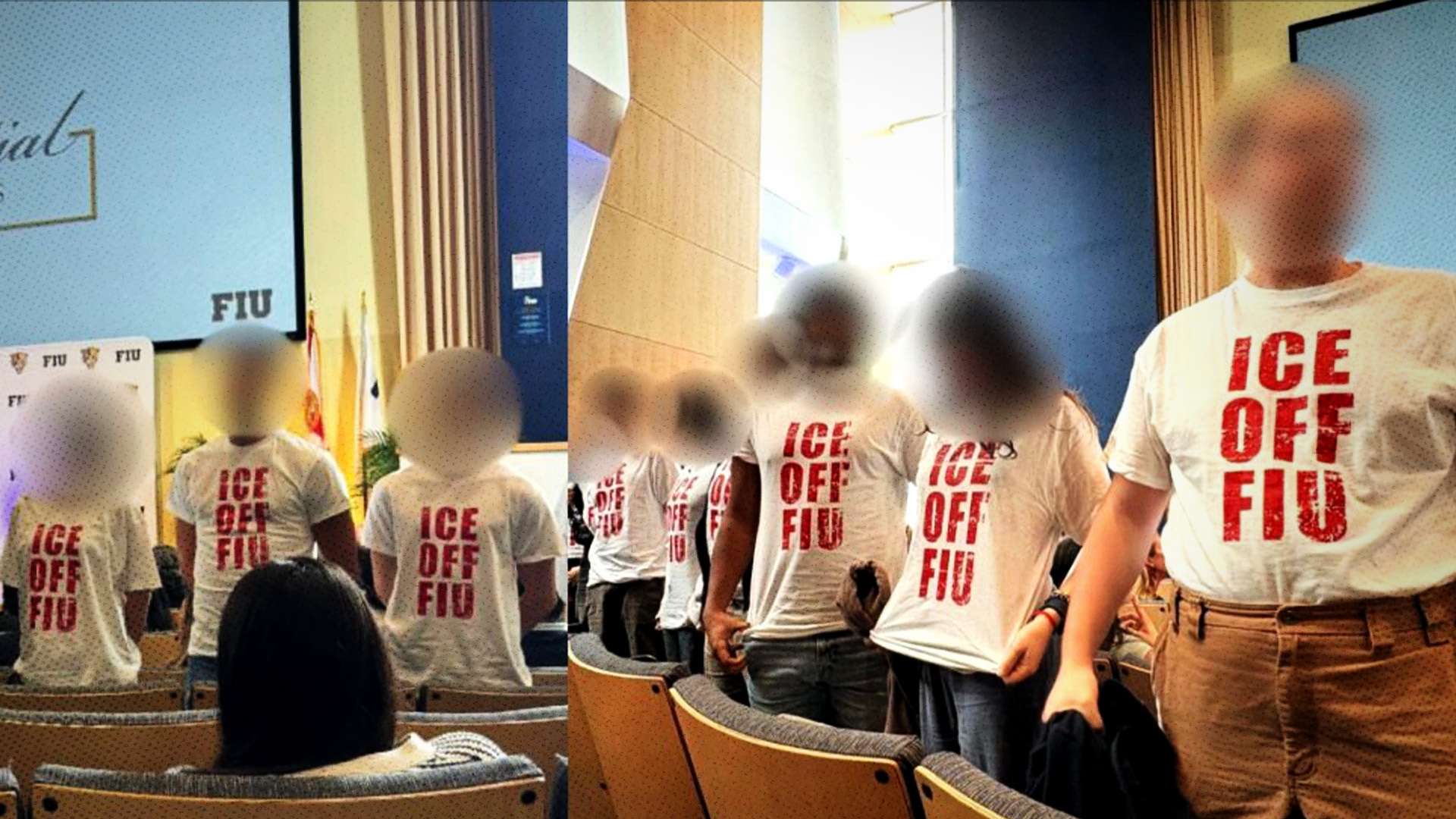
The dispute traces to a March incident when several students wore shirts bearing the message “ICE OFF FIU” and remained silent for a few minutes during a campus talk featuring former MLB star Alex Rodriguez, according to WLRN. The demonstration was a protest against the school’s voluntary collaboration with immigration enforcement on campus.
FIU charged seven participants with misconduct, and six received written reprimands. The university also required the students to produce two-minute “video reflections” explaining their understanding of the expressive activities policy and how they would apply what they had learned moving forward.
The disciplinary actions drew the scrutiny of civil-liberties groups, including the Foundation for Individual Rights and Expression (FIRE). On June 18, FIRE sent a letter urging FIU to drop the charges and revise its expressive activities policy to safeguard such expression inside university facilities.
The university did not act. On August 11, the punished students filed suit against the university and several members of its administration. In addition to seeking compensatory damages, the suit contended that FIU’s Regulation 110(3)—which bars “protests, parades, marches, picketing, demonstrations, and other similar expressive activities” inside university buildings—”blatantly violate[d] the Plaintiffs’ First Amendment rights” and should be declared unconstitutional. The rule also states that “university indoor facilities are designed for instruction, study, reflection, group discussion, research, administrative functions, and other University activities and operations,” and “this provision will be enforced in a content- and viewpoint-neutral manner.”
Becerra, citing the Vietnam War–era free speech precedent Tinker v. Des Moines Independent Community School District, found that the plaintiffs were “substantially likely to prevail” in challenging FIU’s unconstitutional policy. The ruling notes that, based on the evidence submitted to date, it does not appear that any Plaintiff, or anyone wearing an “ICE OFF FIU” T-shirt, spoke or did anything other than sit, stand, or walk.
According to Inside Higher Ed, university officials have “previously maintained that the policy is compliant with the First Amendment and Florida laws.” It remains unclear whether FIU will appeal. A university representative told Axios that the university would “comply with the court’s order while considering our legal options.”
Regardless of one’s view of the message conveyed by the students, FIU’s punishment of the silent protesters ought to concern defenders of free expression. Perhaps the most troubling aspect of FIU’s actions was forcing students to record video apologies for silently and non-disruptively expressing their views. Bret Weinstein, a longtime critic of campus cancel culture, weighed in on the situation, writing on X that “Commitment to freedom of speech requires us to oppose compelled speech every bit as strongly as we oppose censorship.” It is hoped that, by the start of the new academic year, other universities will adopt this principled stance as well.
