
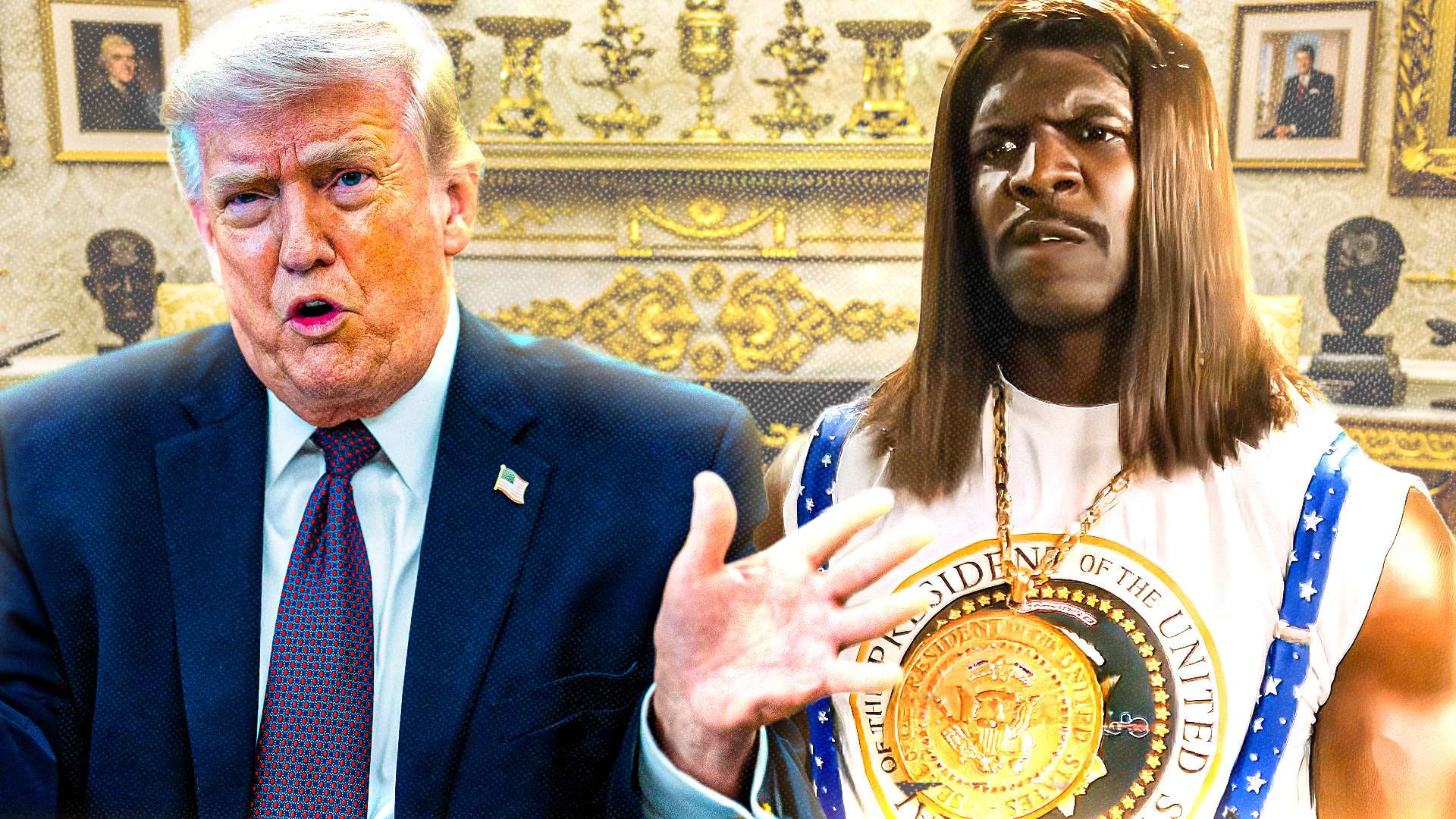
Mike Judge’s cult favorite marks its twenty-year anniversary and continues to feel timely in the way it mirrors contemporary life, particularly outside the realm of partisan disputes.
September 1 marks the two-decade milestone since Mike Judge’s cult classic Idiocracy first arrived, a time-travel comedy in which a sluggish and indolent Army librarian named Joe Bauers is awakened five centuries ahead to discover he is the brightest mind left in a world that has spiraled into chaos. As a narrator notes at the film’s opening, the educated classes defer parenthood, triggering a steady, unbroken drift toward a dumbing down of society. Coupled with a fixation on physical ease—everyone sports athleisure and the then-novel Crocs for footwear—“the intelligent” become an endangered species. Joe ultimately saves the country by substituting water for Brawndo, a popular salty beverage, in industrial agriculture.
Though produced on a shoestring budget of roughly $2.4 million, under a compressed production schedule and amid mixed reviews, the movie—co-written by Judge and his frequent collaborator Etan Cohen—rapidly crystallized into a shorthand for a United States that appeared to be growing less discerning, especially in the political arena. By 2008, online forums were abuzz with questions like whether we were barreling toward the fate depicted in Idiocracy. The November 2008 issue of Reason ran a piece on a scarcely remembered film Swing Vote titled “Idiocracy Now!”, and in 2015 Matt Welch labeled Donald Trump “the Idiocracy candidate.” No elaborate justification was offered in either case, underscoring the film’s enduring cultural relevance.
Idiocracy wears its politics on its sleeve, with Joe (portrayed by Luke Wilson) quickly catching the eye of the White House’s former wrestler-turned-president, Dwayne Elizondo Mountain Dew Herbert Camacho (Terry Crews, decked out in a look reminiscent of a mix between a hip-hop icon and a professional wrestler), famous for punctuating press conferences with bursts of machine-gun commentary. Although released by 20th Century Fox, the movie plays a running gag in which Fox News is anchored by a glamorous female host and a topless male bodybuilder who flexes his pectorals while reading headlines—a nod to late‑1990s spoof programming. By the film’s end, Joe has managed to ascend to the presidency himself. Any perceptive observer watching the 2024 Republican National Convention—especially the moment when a famous wrestling icon ripped off his shirt and proclaimed an unrestrained embrace of Trump—would likely see echoes of Idiocracy. The same improvised spectacle could be recalled by this summer’s UFC Freedom 250 event at the White House. And, frankly, current headlines about President Biden’s cognitive health, Vice President Harris’ sprawling rhetoric, and other political absurdities feel not unlike a page from the film’s script.
Yet beyond the surface satire, the deeper reasons Idiocracy continues to resonate lie in its critique of a culture obsessed with fertility statistics (whether rising or falling), ever-present branding, shallow reasoning, and a general loosening of social restraint. Not all of these tendencies are inherently negative, but we inhabit a society with norms that would have seemed far-fetched twenty years ago. In 2022, science communicator Hank Green argued that the film’s opening monologue on intelligence is, at minimum, read as implicitly pro‑eugenics. Yet that reading feels dubious, especially given how the on-screen “smart” couple—a couple with high IQs who quarrel and come off as ridiculous—undercuts the notion that intelligence alone guarantees virtue. If these are the high-IQ exemplars, the film seems to imply we might be better off without elevating IQ as the sole measure of worth, particularly when less cerebral but more humane characters walk the walk.
Which isn’t to say the future Joe awakens into isn’t a nightmare of pervasive corporate sponsorships and slogans recited as if they were religious creeds. “Welcome to Costco. I love you,” the store’s welcoming refrain, has grown into a caricature of consumer omnipresence. Whenever the ubiquitous beverage Brawndo—the product that even controls the regulatory bodies—gets cited, the line “it’s got electrolytes, what plants crave” almost always follows. The coffeehouse experience has become a mood, with offerings that mix sexuality and caffeine as much as caffeine itself, and other brands follow suit with similarly brazen branding. After being named interior secretary by Camacho, Joe wins the loyalty of his fellow cabinet members by invoking a dated corporate slogan about leadership and by insisting he can speak to plants.
The most-hit TV staple in the film is Ow! My Balls! (a crude riff on Jackass or Judge’s own Beavis and Butt-Head, but with less nuance about the human condition), featuring Hormel Chavez, who bears a name lifted straight from the realm of consumer goods. Beyond President Camacho, there are token characters such as Tylenol Jones, Frito Pendejo, Dr. Lexus, and Beef Supreme. The film’s satire feels increasingly pointed in a country where, according to the Social Security Administration, some parents choose baby names inspired by gun-makers such as Wesson, Remington, Colt, Ruger, and Winchester.
Most troubling is not merely the mental dullness of the society depicted in Idiocracy, but the overt hostility toward any form of intellectual pretension or literacy. Joel Miller has questioned doomsday warnings about a culture that no longer reads, yet there is little doubt that reading and writing have been diminished in the broad cultural landscape for decades. When a conservative publication like the Wall Street Journal op-ed page defends AI-generated drivel while progressive scholars are accused of lowering plagiarism standards to fit current culture-war tactics, we may be enacting our own version of Idiocracy.
Joe’s first address as president lands with more resonance in 2026 than it did a decade earlier, simply because we’re two decades older and probably less discerning as a society. Throughout Idiocracy, the most common insult is to label someone as gay, a crude epithet that has largely faded from mainstream discourse outside the fringes of the online manosphere.
“There was a time in this country, long ago, when reading wasn’t just for a select few and neither was writing. People wrote books and made movies with stories that mattered, stories about who did what and why it mattered, and I believe that the era can return.”
All crude humor aside, Joe’s appeal for renewal would be a welcome stance from today’s leaders and culture-makers. Idiocracy makes us confront much of our reality in a way that feels hard to ignore.
