
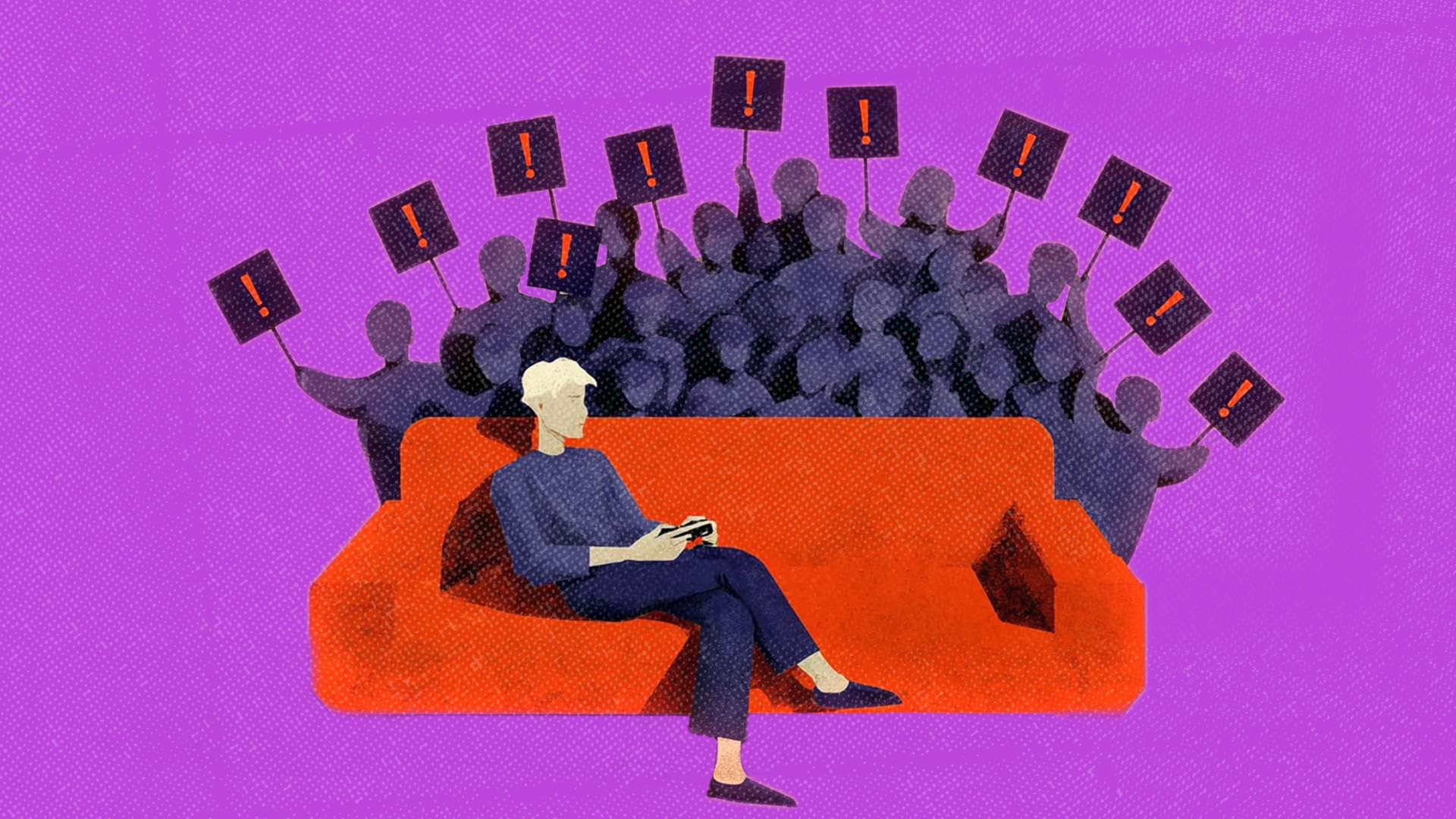
Video games, pornography, and gambling: One of these things just doesn’t belong!
Are men, especially younger men, devoting every waking hour to video games, betting, and porn—and ending up miserable because of it? Those seem to be the implications of a fresh report from the Institute for Family Studies (IFS), which offers some provocative observations and potential reasons for concern…while also treating several distinct habits as if they were the same kind of vice.
You are reading Free Media from Robby Soave and Reason. Get more of Robby’s on-the-media, disinformation, and free speech coverage.
To begin with, video games are not remotely equivalent to gambling or pornography, and grouping all three under a vague “vice” label is a substantial misstep. The authors’ aim, however, is clear: to portray men as collectively sliding into an “addiction economy” that supposedly sours their lives. The report has policy consequences: IFS senior fellow Brad Wilcox and media director James Lynch argue in Compact that the libertine wing of the Republican Party should be curbed.
“The American founders were not libertarian about vice,” they contend. “They understood that a republic whose young men cannot govern themselves will not govern anyone else for long. A political vision for American men requires reawakening the idea that liberty and license are not identical.”
Yet it’s difficult to take their appeals for restricting liberty seriously when the target is so expansive—and in the case of video games, at least, undeservedly so. Still, the IFS study goes to great lengths to fuse video games with porn use and gambling: On X, research fellow Grant Bailey highlights that only about 2 percent of men abstain from all three activities, and Wilcox notes the “staggering” share of young men who engage in all three—something he views as a clear sign of “addiction.”
We have a generation of young men trapped in the “addiction economy”—and the numbers are staggering:
☑️ 1-in-8 use porn, gamble & game daily
☑️ Almost 1-in-4 gamble daily
☑️ 1-in-4+ use porn daily https://t.co/ayewfXxREO pic.twitter.com/R6H72bDU5o— Brad Wilcox (@BradWilcoxIFS) August 25, 2026
So, let’s begin with the obvious question: does someone who plays video games every day suffer from an addiction to gaming? The answer is clearly no.
First, the study doesn’t really establish a meaningful definition of “too much” gaming. It records how often young men play—several times daily, daily, multiple times weekly, or infrequently. But the real question is how many hours per day are spent gaming. A quick break to play a round or two of Super Smash Bros. a couple of times daily is not necessarily as intense as someone who plays once daily for ten hours straight. By that metric, a person like me could be categorized as highly addicted simply because I pause to play the online card game Dominion for five to twenty minutes several times a day. And yet I am not genuinely hooked, nor am I harmed by it.
To its credit, the study does acknowledge some benefits of video games, describing them as “a source of camaraderie and collaboration, which, as we have seen, is often in short supply.” Overall, however, the report tends to downplay how often video games serve as a meaningful forum for social engagement among young men. This includes in-person connections and online teamwork: many players put on headsets to talk with teammates and rivals as they cooperate to solve problems and push past challenges. Yet the authors complain that frequent gaming is “exhausting, at odds with other meaningful pursuits in life, including relationships, and yet another contributor to demoralization.”
Consider that assertion: video games can impede the pursuit of other important life satisfactions. In a sense, there is truth to it. Overindulgence in anything can be detrimental and disrupt other healthy activities you could be pursuing. But these constant diagnoses of what supposedly makes men unhappy rely on a lot of assumptions about what men would do with their time if they weren’t gaming or scrolling social media. Perhaps they would simply exist in inactivity and be bored! Perhaps they would spend hours on the couch watching old television, a technology that predates smartphones and video games by decades. Perhaps they would binge-drink or resort to aggression: while violence was far more common in the past, today it has declined as people find other, better uses for their time.
That does not mean we should accept rising loneliness as the price of a safer society, though it is useful to counterbalance nostalgia with facts. But with calls from both parties to regulate how people—especially young people and young men—spend their free time, policymakers should demand precision about the claimed harms and the proposed remedies. For instance, Meta’s $17.1 billion settlement with multiple state attorneys general will lead to measures intended to curb youth usage, even though the evidence that Facebook or Instagram generally exerts a widespread harmful effect on this group remains limited.
Worth Watching
RIP Tim Curry, one of my favorite actors and a man I genuinely admired. He appeared in so many films and TV shows from my childhood that recalling them all is tough: from his sly, mustachioed Cardinal Richelieu in The Three Musketeers to his earnest portrayal of Long John Silver in Muppets Treasure Island (paired with the ever-playful Muppets) to his numerous cameos on ’90s and ’00s cartoons like The Wild Thornberries, Hey Arnold!, Batman Beyond, and Samurai Jack. There’s even the moment he voiced the Big Brother in a 1984-themed episode of Johnny Bravo—stop everything and watch that clip.
Among his many performances, my favorite will always be Wadsworth the butler in Clue. The ensemble is superb, but Curry’s manic charm is indispensable to its magic.
