
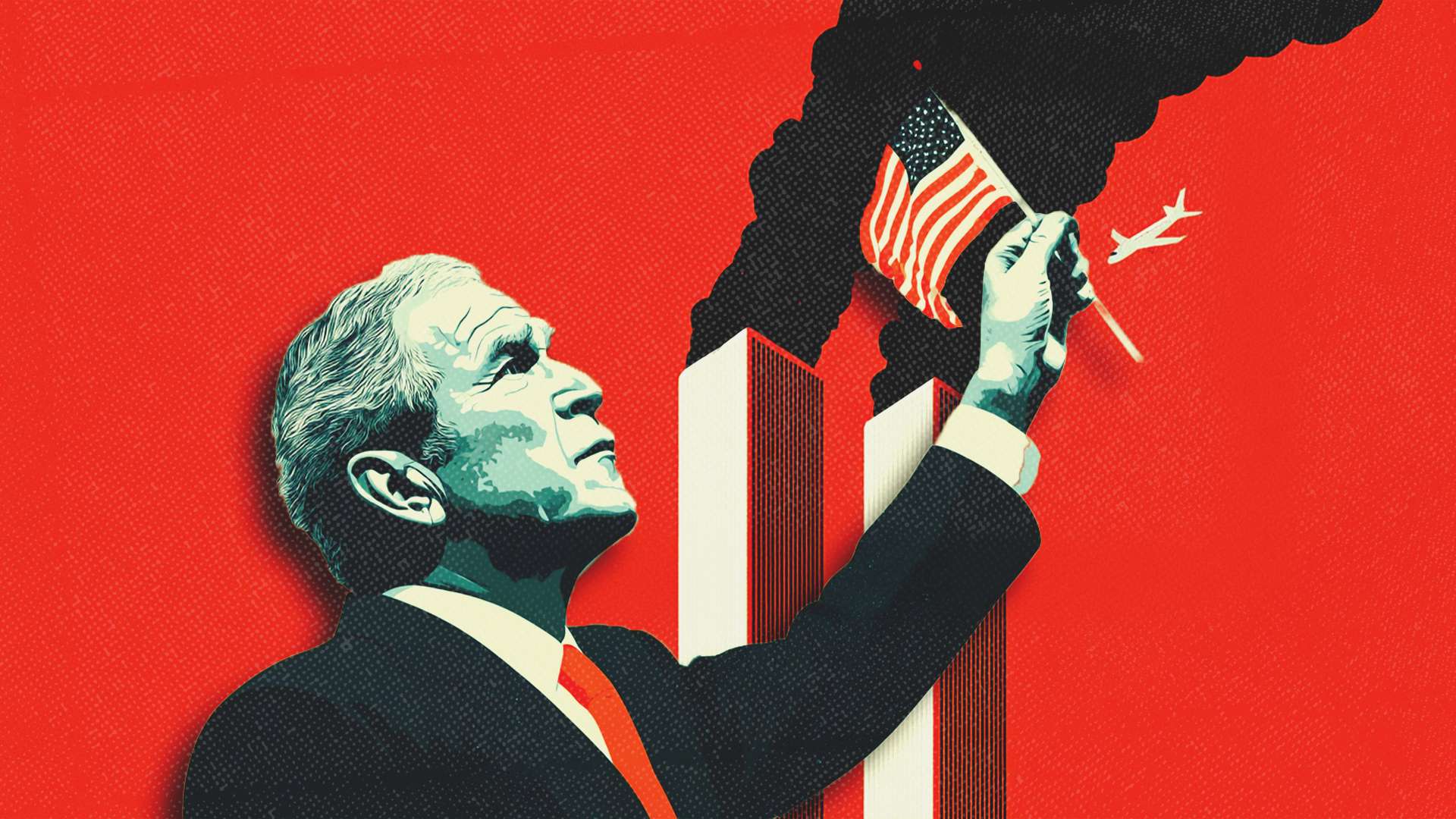
The United States’ shift toward aggressive interventionism was well underway before the 2001 attacks.
For many people in the Washington, D.C., or New York metropolitan regions, the events of 9/11 were terrifying and strangely routine at the same time.
I was a 16-year-old British pupil spending a year at an American high school in Arlington, Virginia, only a few miles from the Pentagon. That Tuesday began like any other: sunlit, warm, and the tail end of summer heat lingering into September. In the second period, someone switched on the television, showing footage of a disaster involving a plane in New York. Tragic, yes, but not yet reason to deviate from the day’s routine. The band teacher turned it off again and went back to class.
Yet it wasn’t long before the day derailed. While I was on my way to the next class, a commotion sounded down the corridor—shrieking and a pandemonium that echoed against the tiled walls. I would later learn that a girl was trying to contact her parents who worked at the Pentagon—and could not reach them. When the principal finally announced that the school would close, rumors and fear had already begun to spread among the students.
What followed was a series of fragments. Students waiting in classrooms for parents to pick them up without transport; some arriving in tears. My mother managed to secure a line and spoke to me briefly. She was stuck on a Metro platform, as trains emptied and service ceased. Even the TV news was frenetic and murky: Another plane was headed for the White House. No, it was bound for CIA headquarters in McLean. There are car bombs downtown. The president has been taken to a secret location. One classmate’s father, who worked at the Pentagon, caught sight of the crash in his rearview mirror as he drove to an appointment with a dentist.
My mother finally reached the school and brought me home. It would be several more hours before my father, who worked just blocks from the White House, could reach us: like many others, he had to walk out of Washington, cross the bridges, and traverse miles of suburbs to get home.
These memories are seared in my mind, horrific enough to feel fresh even decades later, yet they were far from unique. In the days, months, and years that followed, I would hear countless variations of the same tale: a group of students on a trip who’d witnessed the plane’s descent toward the building; a classmate whose father was whisked away by a government helicopter to an unknown location, leaving them to wonder where he had gone; a policy think-tanker whose child attended on-site daycare at the Pentagon. I often reflected on that last story once I became a mother myself. Could I possibly fathom a parent’s terror in such a moment?
It is tempting to view the shock and horror of 9/11—the trauma shared by most of Washington’s foreign-policy elite—as the seed from which many later missteps in policy grew. If someone is hurting, the logic goes, that hurt could justify more hurting in return. And as the subsequent years unfolded—the removal of the Taliban, the invasion of Iraq, the Guantánamo detainee system, the USA PATRIOT Act, and more—it is easy to lay the blame for all of it on that single, painful day.
Yet as the twenty-fifth anniversary of the attacks approaches, it’s essential to recognize the limits of that narrative. The 9/11 events did shape foreign policy decisively, but their impact was less about changing direction and more about intensifying existing patterns. The attacks created a permissive political and psychological climate for a particular vision of foreign policy, but they did not singlehandedly steer America toward liberal interventionism and perpetual warfare. For that, we must look to the 1990s.
The Unipolar Moment
The collapse of the Soviet Union unleashed American predominance. For decades, economic malaise and social stagnation had eroded the USSR as a procession of aging functionaries presided over decline and discontent. The ascent of Mikhail Gorbachev and a flurry of arms-control agreements ushered in an era of détente, while a string of popular uprisings across Eastern Europe severed the USSR from its Bloc dependencies. By Christmas Day 1991, with the Soviet flag lowered over the Kremlin, it was clear to all involved that the United States had emerged victorious from the Cold War.
This outcome fed Washington with the hope of shaping a better world. As President George H.W. Bush told Congress, the dawn of something better might be visible: “Out of these troubled times, our fifth objective—a new world order—can emerge….An era in which the nations of the world, East and West, North and South, can prosper and live in harmony.” The Soviet dissolution, leaving the United States as the lone superpower, offered policymakers a chance to wield America’s overwhelming power to construct that better world.
The end of the Cold War thus carried with it not only a sense of righteous triumph but also a conviction in Washington that a new foreign-policy consensus had to be forged. The early 1990s earned the nickname “Kennan Sweepstakes.” Thinkers vied to become the next George Kennan, whose 1946 telegram shaped a Cold War doctrine, complete with fresh missions and rationales for U.S. engagement abroad. The bipartisan consensus that emerged married Republican hawks and neoconservatives with Democratic liberal internationalists around a form of “liberal hegemony.”
What united these strands was a belief that America—the “indispensable nation”—could remake the world for the better, whether by toppling potential enemies or by engaging in humanitarian intervention. Every administration—from Bill Clinton’s through at least Barack Obama’s—held fast to the view that if America could knit the world closer together and more liberal, it could also make the world more peaceful.
U.S. foreign policy thus grew increasingly assertive. It’s a revealing irony that George W. Bush, elected in 2000, had campaigned on rejecting excessive humanitarian intervention and nation-building, a stance that helped him secure the Republican nomination over the hawkish John McCain.
The nation-building in question stemmed from Clinton’s repeated interventions in the Balkans, aimed at preventing atrocities in the former Yugoslavia. In the wake of crimes like the Srebrenica massacre, U.S. officials embraced the “responsibility to protect”—the idea that if a state cannot or will not safeguard its citizens, the international community must intervene to shield civilians. In practice, “the international community” often translated into the United States.
Indeed, when fighting broke out between Serbian forces and Kosovar separatists, the Clinton administration carried out an air campaign not under United Nations Security Council authorization—where Russian and Chinese vetoes blocked action—but with NATO’s authority. The campaign compelled Serbia to concede to a peace agreement and effectively laid the groundwork for the creation of Kosovo as a new state.
Other elements of U.S. foreign policy in the Clinton era were similarly ambitious and transformative. His administration pressed ahead with difficult negotiations over China’s entry into the World Trade Organization. Worries about China’s growing economy and autocratic government were eased by the notion that deeper trade and interdependence could foster long-term global stability. By integrating China into the international community in this way, policymakers believed China could be steered into becoming a “responsible stakeholder” in the American-led order.
Then there was NATO’s expansion. With the USSR’s fall, NATO had no obvious adversary left, raising questions about its continued relevance. Yet as early as the Bush Sr. era, U.S. policymakers insisted that a reunified Germany remain within NATO, implying that the alliance still had a vital role in European security. It was the Clinton administration that suggested NATO could also welcome states of the former Warsaw Pact. By the end of his presidency, Clinton had greenlit the first round of NATO enlargement and laid the groundwork for more. NATO expansion came to be seen as a mechanism to entrench stability, democracy, and economic reform in Eastern Europe.
NATO’s enlargement went hand in hand with a broader American effort to widen the alliance’s mandate, transforming it from a deterrent force in Europe into a global peacekeeping presence capable of acting when the United Nations could not. More than 60,000 NATO-related troops participated in the Bosnia-focused missions that followed the Dayton Accords of 1995.
What linked many Clinton-era policies was the aim of extending a post–Cold War era of U.S. primacy over both allies and rivals. One manifestation was the belief that the United States should not retreat from European security, keeping European allies comparatively weak on purpose. Another was a policy of “dual containment” against both Iraq and Iran. Throughout the 1990s, the United States maintained a no-fly zone over Iraq, enforced UN sanctions on Iraqi oil, and conducted several bombing campaigns against Iraqi military targets while protecting civilians in Kurdish regions.
As the 1990s drew to a close, American policymakers enjoyed a sense of triumph. No challengers loomed on the horizon; Iraq and similar states were contained; globalization and liberalization were flourishing worldwide. Perhaps nothing captured the mood better than Madeleine Albright’s remark, Clinton’s secretary of state: “If we have to use force, it is because we are America; we are the indispensable nation. We stand tall and we see further than other countries into the future.” At home, the president faced personal scandal, but abroad, America’s destiny as leader and prophet of the post–Cold War world appeared assured.
Turbocharged
In this messianic soil, the seeds of 9/11 were planted. An introspective observer might wonder how a nation that “saw further into the future” could have missed the threat posed by Al Qaeda so comprehensively. Postmortem investigations would later conclude that the attacks would not have been possible without serious lapses in both Clinton’s and Bush’s counterterrorism efforts, as well as broader institutional and intelligence failures.
The 9/11 attacks were, without question, acts of terror and barbarity; thousands of grieving families bore witness to that. Yet they also posed a challenge to America’s post–Cold War self-image. A terrorist organization had devised a plan in the caves of a poor, isolated country (though much of the planning and preparation occurred in Germany) to turn global connectivity against the United States. The assaults came to be seen as an affront to the American-led order that had defined liberal, civilized norms since the end of the Cold War.

The Afghanistan invasion followed as a logical and necessary response to the attacks. The Taliban had sheltered Al Qaeda and its leader, Osama bin Laden; they had, in a real sense, declared war on the United States. The toppling of the Taliban was swift and merciless. Within less than a quarter of a year after the attacks, Kabul fell and an interim Afghan government was established.
But in the climate of the moment, outright military victory did not suffice. Bin Laden and many of his key lieutenants remained at large. “Rogue states” like Iran, Iraq, Syria, and North Korea might need to be deterred. Other “ungoverned spaces” could pose a similar danger in the future.
In response, the Bush administration crafted the “freedom agenda,” a sweeping strategy that sought to tackle these problems at their roots. This freedom agenda reframed the war in Afghanistan as an effort at modernization and nation-building, which was then leveraged to justify a separate war of regime change in Iraq. In each case, U.S. military force was supposed to reshape entire societies. Iraq and Afghanistan were prototypes, proving grounds for the idea that democratization could serve as a catalyst for change across the broader Middle East. “The great strength of this nation,” the 2002 U.S. National Security Strategy document put it, “must be used to promote a balance of power that favors freedom.”
Although American public opinion began to turn against the wars in Iraq and Afghanistan as Bush’s presidency drew to a close, his successors persisted in pursuing similarly transformative aims on the world stage. President Barack Obama, for example, had entered office promising to wind down the global war on terror, only to end up sending more troops into both Afghanistan and Iraq. His administration also engaged in regime change in Libya and covert intervention in Syria.
Obama was building not merely on Bush’s freedom agenda but on Clinton’s invocation of the responsibility to protect. Several of Obama’s foreign-policy advisers—Hillary Clinton, Samantha Power, Susan Rice—were true believers in deploying American power to safeguard human rights and spread democracy. As the Arab Spring swept across the Middle East in 2011 and mass protests in Libya gave way to civil war, the administration authorized a NATO-led operation that quickly evolved from a no-fly zone to shield civilians into a broader campaign of regime change.
America’s Middle East interventions after 9/11 even enhanced other ambitious post–Cold War policies. For example, NATO gained greater momentum toward expeditionary capabilities and “out-of-area” operations. The alliance took an active role in the International Security Assistance Force process in Afghanistan and later in the Libyan campaign. NATO expansion and the war on terror proved to be almost symbiotic: for newer members, offering political support and symbolic troops in Iraq and Afghanistan was seen as quid pro quo for membership, while the sacrifices of their soldiers backed up continued membership.
The Hangover
Public disenchantment with these strategies grew steadily through the 2000s and 2010s. By 2016, Donald Trump was appealing to swing voters by labeling the Iraq War a mistake; by 2020, Democratic contenders were pledging to withdraw the United States from the Middle East. A quarter-century after 9/11, elements of the war on terror still linger across the Middle East and increasingly into Africa—and the conflict is generally viewed as a failure. The Middle East has become less a proving ground for democracy and human rights and more a graveyard for the notion that freedom can be built at the barrel of a gun.
Yet, given 25 years of perspective, it is also clearer how the war on terror fits into the broader arc of post–Cold War American foreign policy. The response to 9/11 did amplify many of the United States’ worst tendencies but did not fundamentally alter its overall trajectory. The fervor of the indispensable nation, combined with the shock of a large-scale terrorist strike—one experienced by many in Washington’s foreign-policy elite—created a permissive environment in which grand theories of global peace and transformation could take hold.
The war on terror remains the most visible and best-known expression of the transformative impulse that characterized the post–Cold War pursuit of liberal hegemony. Would regime-change campaigns in Iraq or Libya have occurred without 9/11? Would America have tolerated two decades of entanglement in the Middle East while China rose quietly? Perhaps not. But twenty-five years on, we should ask how much of what followed the 9/11 attacks sprang from shared trauma and panic—and how much was simply an intensification of existing trends.
