
We examined a number of studies that critics consider seriously flawed and that have been championed by foes of drug reform.
So far, recreational marijuana is legal in twenty-four states plus the District of Columbia, marking a significant shift in how drugs are treated. Yet the push toward legalization has slowed, and in several states activists are launching drives to undo recreational cannabis provisions, including in Maine and Arizona. In the upcoming elections, Massachusetts voters will decide whether to roll back the legalization measure approved in 2016. Ohio’s lawmakers have recently narrowed the cannabis-legalization framework enacted in 2023. A central argument used by anti-weed groups is that legalization has spurred more traffic crashes as a result of more people driving while under the influence. But the body of evidence proponents point to has not convincingly shown that legalization raises the risk of crashes or fatalities.
Driving While High? Last fall, The Wall Street Journal ran an editorial with the headline “More Marijuana Users Are Crash Dummies.” It began by asking how much social and public-health harm Americans will tolerate before reversing course on marijuana promotion, and it cited a “new study” claiming that over 40 percent of drivers who died in vehicle crashes in one county over six years had detectable levels of the drug in their bloodstream. The study in question is accessible only as an abstract and a brief press release tied to a conference presentation of an unfinished report, with no full data to back its conclusions. After the editorial appeared, we tried multiple times to reach the study’s lead author to obtain a copy of the draft and address basic questions. We could not reach him. A public-information official at the American College of Surgeons—whose membership includes the author—told us via email that the work is still under development and no complete study could be provided yet. The press release and abstract alone already cast doubt on the study’s conclusions. The claim that 40 percent of deceased drivers had marijuana in their blood is not reliable because THC testing is typically ordered only in cases where impairment is suspected. Consequently, the sample is likely biased. Moreover, testing the blood of drivers after death does not prove they were intoxicated while driving; THC in the blood usually reflects recent use within several days, and postmortem measurements are notoriously unstable. The press release also lacked any reference to a control group, so we cannot know whether the rate of THC positivity among those drivers exceeded or fell short of that in the general population. In rigorous studies, a control is essential. The analysis also looked at data from a single Ohio county, covering periods before and after legalization in 2023, and found no meaningful shift in the share of drivers with THC in their blood. If the study ever materializes, it is unlikely to shed light on how marijuana legalization affects driving with cannabis in the bloodstream, or to provide evidence that such driving is rising. Yet The Wall Street Journal carried the claim of rising “high-on-pot” driving in its coverage of this pending research.
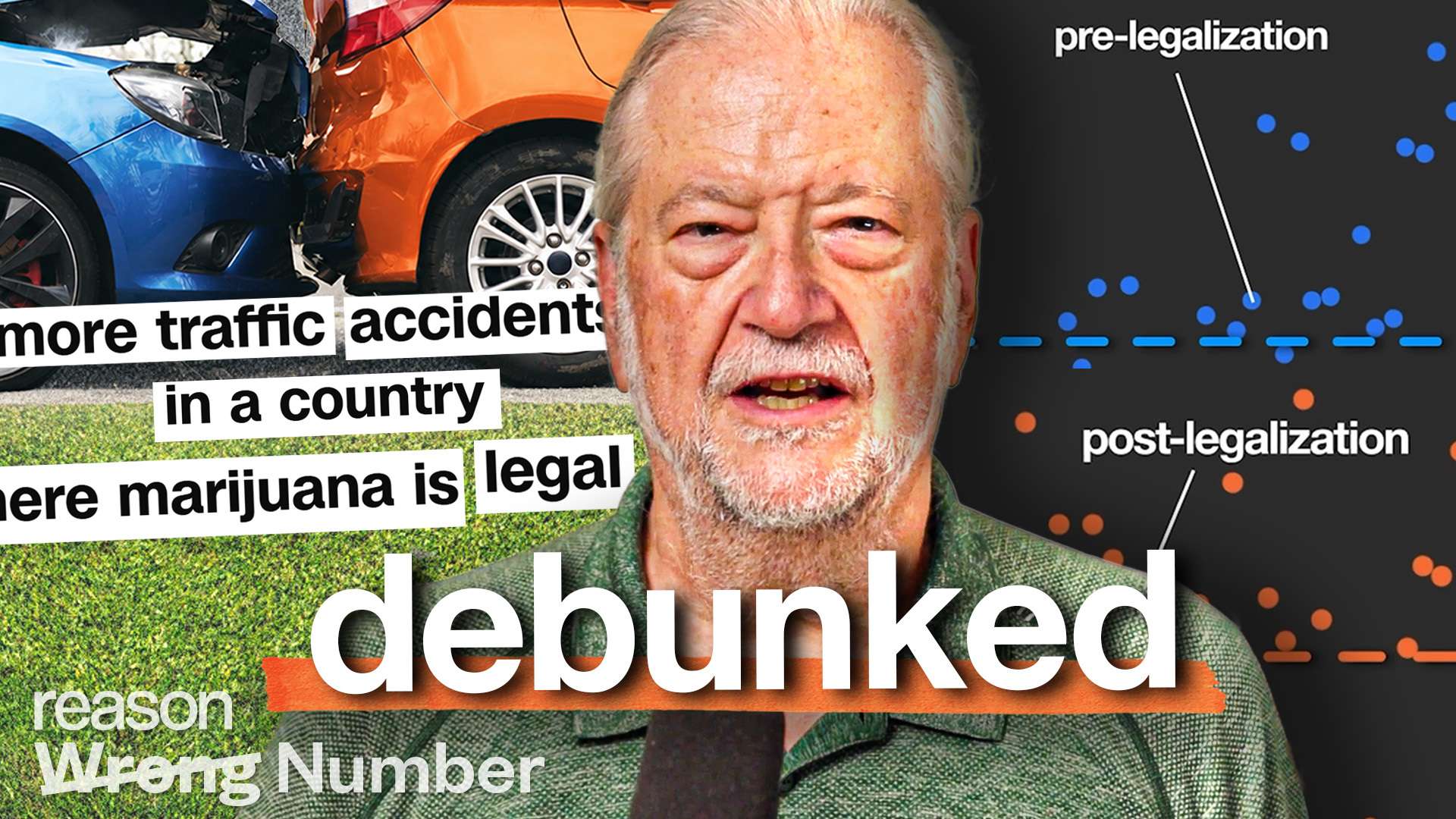
Did Marijuana Legalization Cause a Spike in Highway Deaths? A separate study from the Insurance Institute for Highway Safety claimed to detect a difference in driver behavior before and after legalization by looking at five Western states. It reported that legalization corresponded with a 2.3 percent uptick in fatal crashes. The authors presented the data with a chart: seasonally adjusted monthly fatalities before legalization shown as blue dots, after legalization as orange dots, and dashed lines marking pre- and post-averages. They concluded that the three-year average death rate in states that legalized marijuana rose about 9.5 percent after legalization, compared with a 6.5 percent increase in comparable states that did not legalize. After performing further adjustments, the authors attributed a 2.3 percent increase to legalization. At first glance, the figure seems substantial. Yet I reworked the data into a time-series view to reflect how death rates evolved over the study period, which reveals a different story. The upward slope in the post-legalization period was much less steep than the authors’ chart suggested, and the slowing of that rise undermines the claim of a robust effect. It does not prove that legalization caused fewer or more crashes; it simply shows that a correlation between legalization and fatalities is not evidence of causation, and we cannot determine what truly drove any shift.
In an email exchange, the study’s senior author defended the methodology by saying it included a time variable. The issue is that the time variable was kept constant across periods, so it failed to capture the actual change in the rate at which deaths occurred following legalization.
Flooding Emergency Rooms? The most provocative finding about the apparent hazards of legalized cannabis comes from a Canadian team that analyzed Ontario’s emergency-room records before and after legalization began in October 2018. CNN summarized this work as showing that documented cannabis-related traffic incidents requiring ER treatment jumped by 475 percent between 2010 and 2021. But the figure is misleading for several reasons. First, the total number of people involved is very small. Over the period when marijuana was legalized and marketed, 120,569 people arrived at Ontario emergency departments for traffic-related injuries, and only 125 of them, or 0.1 percent, were judged by the treating clinicians to have cannabis involvement. Moreover, many of those cases also involved alcohol; among cannabis-involved patients, 42 percent had concurrent alcohol impairment. Cannabis alone does not emerge as the dominant factor in impaired driving. With 125 patients over roughly twenty months, the average works out to about six people per month. Before legalization, two people per month presented with “cannabis involvement.” That looks like a 200 percent rise, not the claimed 475 percent. Why did the researchers report a 475 percent increase? They argued that legalization overlapped with the COVID-19 lockdowns, when people drove far less, which would have hidden more cannabis-related injuries under normal conditions. To adjust for this unusual period, they assumed that under typical driving patterns there would have been many more cannabis-related accidents, and they applied a series of adjustments that inflated the estimated rise. That reasoning is not valid. You cannot compare pandemic-era lockdown data with pre-pandemic data because the traffic environment was abnormal. School closures and remote work reduced driving, especially for trips where impairment would be less likely to occur, so one would naturally expect the share of cannabis-involved drivers to be higher during lockdown, even if the absolute number of incidents did not rise.
Another complication is that many of the Ontario ER patients were classified as cannabis-involved based on admitting information rather than objective impairment at the time of the crash. Some of those 125 people were passengers, which weakens the inference that cannabis contributed to the crash. If a non-user gave a ride to a friend who was impaired and an accident occurred, the patient could still be labeled as cannabis-involved, which does not tell us anything about whether legalization bumped the crash rate. The dataset also includes self-reported cannabis use that would naturally be more likely to be disclosed after legalization, introducing further bias. In the end, the ostensible 475 percent rise rests on a small absolute number, an adjustment that inflates the percentage, and a data set with questionable foundations. We contacted the study’s lead author to discuss these concerns, but the spokesperson for the team pointed to the journal publication as having undergone peer review and independent methodological evaluation prior to release.
No researcher has shown a convincing association, let alone a causal link, between marijuana legalization and a meaningful surge in traffic crashes in any state. A long list of outcomes could potentially be affected by legalization—traffic fatalities, teen pregnancy rates, suicides, violent crime, property crime, bankruptcies, educational attainment—and these indicators rise and fall for reasons that are often unclear. If one selects a single social indicator to study, there is roughly a coin-flip chance that it worsened after legalization, creating opportunities for statistical tricks to feign a causal connection. Since states began legalizing cannabis, there has been no clear evidence of social harm attributable to legalization. Predictions of catastrophic consequences have proven exaggerated. Harsh drug laws were justified with the assertion that alternative policies would unleash extensive societal and personal harm. Once marijuana legalization gained traction, sweeping forecasts of disaster faded, leaving only arguments about a supposed 2.3 percent uptick in traffic fatalities. Even if such a finding were solid, it would hardly be a sufficient foundation for a drug-war stance. The real story is that many states implemented legalization, and the sky did not fall. To stay connected with our video series Wrong Number and to access bonus material, sign up with your email address here. By joining, you’ll also have a chance to win a copy of the book Wrong Number: How To Extract Truth From a Blizzard of Quantitative Disinformation.
