
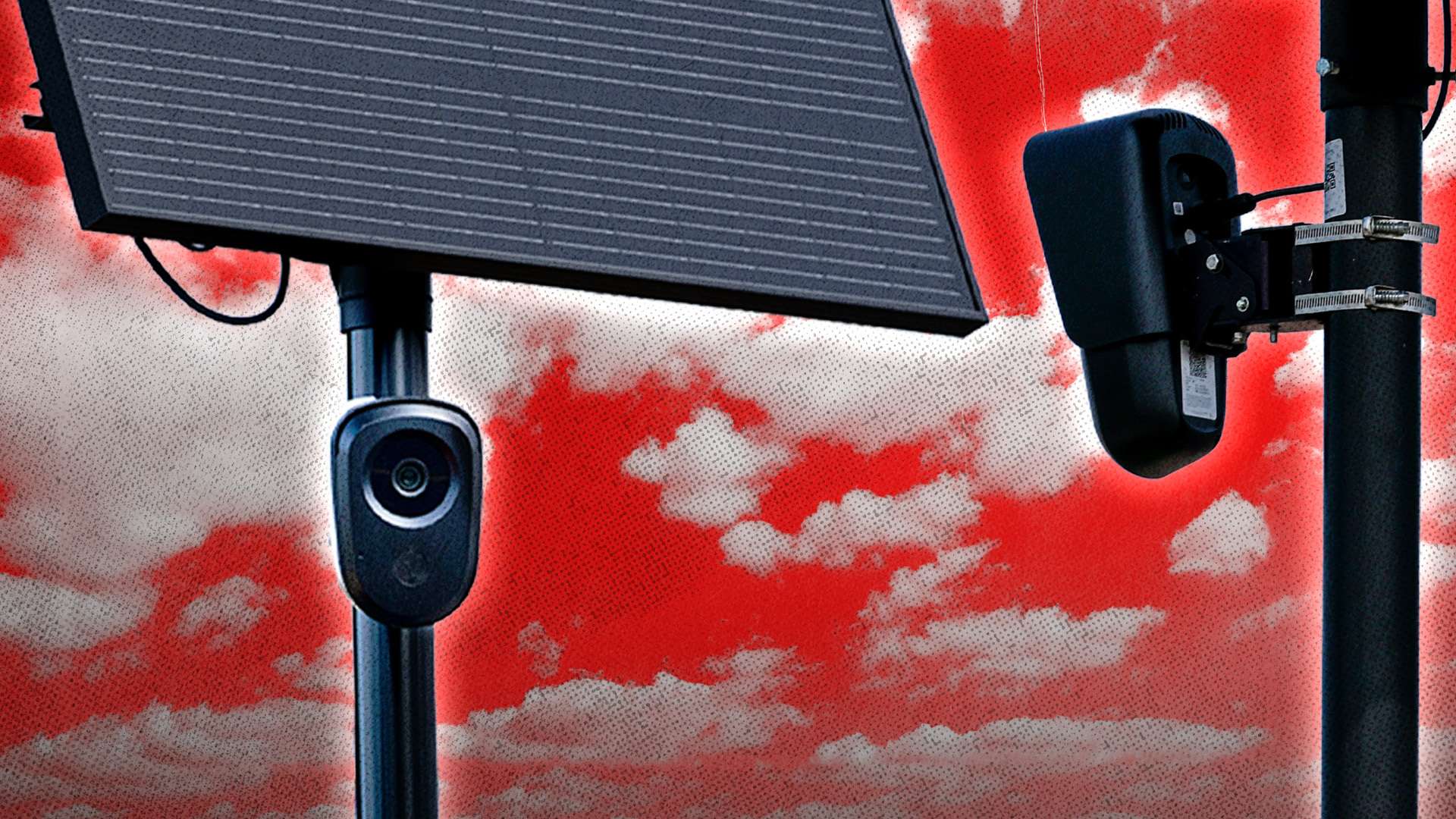
Americans are increasingly aware of the risks linked to broad surveillance through automated license plate readers.
‘What data are you carrying around in your car?’ asks a pictorial warning that has circulated widely among U.S. police departments. The advisory outlines the kinds of details criminals could deduce from the back of your vehicle and implies that stickers revealing sensitive personal information could put you and your family in danger.
Because of what people flaunt, the warning continues, wrongdoers might learn where your children go to school and what extracurricular activities they pursue (a sign that you could be away most evenings and weekends for practices or games). They could also infer your hobbies (which might suggest you possess expensive gear at home or in the vehicle), the breed of dog you own (perhaps a small, harmless type), your place of employment, and your spouse’s occupation (which might indicate frequent, extended absences).
Displaying a “baby on board” sign, the notice adds, marks you as an “easy target” since you may be easily distracted or slowed when you reach your destination. Even a customized license plate could pose a risk, because someone hot-headed might remember it—whether you offend them unintentionally or someone who wants to monitor your vehicle.
‘Always protect your personal information and limit what you share,’ the Schertz, Texas, police department cautions in a typical Facebook post. ‘What might seem like a harmless decal could lead to an unsafe situation.’ In short, drivers are urged to safeguard their privacy by understanding what their cars reveal.
Meanwhile, law enforcement agencies offering that guidance have access to all of this information and more, thanks to a nationwide network of AI-assisted cameras that photograph vehicles billions of times each week. The data gathered by automated license plate readers (ALPRs), about 137,000 of which had been mapped by the end of August, extends far beyond what someone could deduce by glancing at the rear of a car. It enables police to track trips, recognize other nearby vehicles, and even anticipate a person’s itinerary.
Police can search that database on computers or mobile devices, conducting sophisticated queries that specify vehicle characteristics and locations, producing travel maps and route forecasts, and using “convoy analysis” to show which cars have been seen in a target’s vicinity. They can augment that data with information from other government databases and publicly available records. They can do all of this without any judicial oversight and often with little internal supervision.
From the perspective of the companies that install ALPR cameras and their clients, the advantages of that warrantless surveillance system are evident: it helps detect, investigate, and deter crime, functioning as an affordable “force multiplier” that lets law enforcement stretch resources in ways that were previously impractical. But the very technological innovations behind that development raise obvious privacy concerns that judges and lawmakers have begun to address only recently, two decades after ALPRs started spreading as a policing tool.
The Rise of Flock
Glenn Bronson, an electrical engineer and networking expert who began tinkering with roadside cameras in 2013 and tried several times to launch ALPR ventures, understands the potential benefits of the technology. Yet over the years he has grown increasingly uneasy about local governments putting ALPRs in place without public deliberation.
Bronson’s interest in the topic was sparked by a thief who kept stealing metal from his family’s construction business in Connecticut. The burglar would arrive before dawn and walk through the woods to the back of the building, methodically removing and sorting machinery parts, fabrication steel, stainless steel, aluminum, copper, and brass. Then he would haul the loot to the road in front of the building and load it into his pickup truck.
Although Bronson had installed security cameras around the property, the thief apparently disabled one placed low enough to reach and managed to bypass the others, sometimes crawling on the ground to stay out of a camera’s view while stealing material. Yet it occurred to Bronson that the thief could still be caught once he returned to his pickup truck.
In researching the question, he found it legal to direct cameras at roads because it was assumed people did not have a reasonable expectation of privacy in their public movements. Bronson installed his first roadside camera outside his family’s business in October 2013, and the surveillance enabled local police to identify the burglar, who was arrested in 2014.
The cops welcomed Bronson’s help in catching that man and other suspects, which suggested a business opportunity. Even a thief who tries to avoid cameras will, at some point, need to drive away, exposing information that ALPRs can help capture. Bronson continued experimenting with roadside cameras, including do-it-yourself setups and off-the-shelf gear. He pitched them as tools for fighting crime to businesses, homeowner associations, police departments, and investors.
Bronson’s efforts to commercialize the idea ultimately did not succeed. But in the meantime, Flock Safety, an Atlanta-based company that another electrical engineer, Garrett Langley, founded in 2017 with two Georgia Tech graduates, found a much larger path to success.
Langley, who is now Flock’s CEO, tells a parallel origin story. “He was troubled by how easy it had become to break into cars in his Atlanta neighborhood,” as The New York Times reports. “When he asked the police why they could not catch the thieves,” Langley told the Times, they said “they needed the perpetrators’ license plate numbers.”
Flock began with homeowners associations and then expanded to police departments, offering solar-powered, internet-connected cameras that proponents described as relief for overburdened law enforcement. By 2025, Flock reported more than $300 million in annual revenue and an estimated value of $7.5 billion, later raised to $8.4 billion. The company says it has installed more than 120,000 ALPR cameras in about 12,000 communities across 49 states, and it accounts for roughly 80 percent of the U.S. market. It also markets camera-equipped drones that it claims can respond to service calls “anywhere in your jurisdiction” within ninety seconds and a half.
Flock has contracts with roughly 7,000 law enforcement agencies, almost 40 percent of the U.S. total, typically charging around $2,500 per year per camera, plus installation fees. In addition to supplying the cameras, Flock maintains a database of license plate scans and alerts police when one matches a number on a “hot list” of targeted vehicles.
Flock also sells software designed to maximize the value of ALPR data. Flock NOVA, for instance, is described as “a real-time investigative and operations platform” that merges data from the cameras with information from law enforcement records, “public records,” and “approved open sources.” Combined, that yields a vast amount of information that can be tied to individuals by linking license plate numbers with motor vehicle registration records.
Bronson has watched Flock’s ascent with a mix of admiration and concern. “Finding investigative leads should be as easy as shopping online,” the company proclaimed in a Facebook advertisement Bronson recalls seeing years ago. “Now it is.” Bronson keeps a copy of that ad on his wall and finds the pitch disturbingly casual about privacy implications. “I nearly fell out of my seat when I saw that ad,” he recalls. “I could not believe it.”
Bronson, who still calls himself “a roadside camera advocate,” also faults Flock for overpromising the crime-fighting potential of its products. “I want crime to stop,” Langley told a Milwaukee Fox television station a few years ago. When asked whether he pictured “a future with a Flock camera on every street corner,” Langley didn’t hesitate. “I envision that,” he said. “I envision an America where crime no longer exists.”
Langley reaffirmed that prophecy last year. According to Langley, Forbes reported, “Flock’s cameras, airborne and fixed, will eradicate almost all crime in the U.S.” within a decade. “I’ve spoken with many activists who believe crime is the cost of modern society,” he said. “I don’t buy that.” He also rejected the idea that security and liberty must be traded off. “I think we can have a crime-free city and civil liberties,” he said. “We can have it all.”
The Crime-Fighting Potential of ALPRs
Bronson is skeptical. He notes that European experience with surveillance cameras shows criminals adapting to ALPRs through countermeasures such as unregistered plates that can’t be tied to drivers, drop plates that magnetically attach to existing plates and can be removed after a crime, and cloned plates that range from printed copies to metal recreations.
That does not mean ALPRs have no effect on public safety. In recent years, the United States has seen notable drops in crime, especially homicides, but also property crimes like car theft and burglary. Adam Gelb, president of the Council on Criminal Justice, suggests one factor in this trend may be “the spread of public and private surveillance cameras and license plate readers.” Bronson thinks that’s plausible, though he stresses the limits of what ALPRs can realistically achieve.
Georgia has the nation’s highest ALPR rate: roughly 70 per 100,000 residents. The Atlanta metro area alone houses more than 5,000 Flock cameras, about 77 per 100,000 residents. During a recent trip to Atlanta, Bronson saw the company’s cameras everywhere. You notice them “the moment you step off the plane,” and “wherever you drive,” he says. Yet “Atlanta remains rife with crime.”
Like many other U.S. cities, Atlanta saw sizable declines in several types of crime last year, including homicide, shootings, and car theft. Still, Atlanta ranked 171st in WalletHub’s 2025 safety rating of 182 U.S. cities. “The fact that all of these cameras are present and there’s still crime,” Bronson observes, “means it’s impossible for [Langley] to eliminate crime.”
Bronson also argues that it is reckless to pretend that police use of the equipment and software sold by Flock poses no threat to civil liberties. For years he has tracked ALPR adoption and repeatedly notes that Flock cameras have gone up in towns without adequate privacy safeguards and sometimes without any public notice at all.
That lack of public reflection has led to pervasive surveillance, a reality police officials later cited as proof that there is nothing to worry about. After a couple in Greers Ferry, Arkansas, complained about a Flock camera aimed at their home last year, for instance, Police Chief Kallen Lacy pointed to the ubiquity of such electronic sentinels. “There are over 5,000 cities in the country that use [ALPR cameras] in 46 states,” he said, “so there is no constitutional violation there.”
The broad acceptance of ALPRs “was all based on the [premise] of no expectation of privacy in public,” Bronson contends. Consequently, he notes, politicians have scrambled afterward to address public objections by installing safeguards that should have been in place from the start.
“You have to include everyone’s input and be clear from the outset about what you’re doing,” Bronson says. “This backlash that’s happening now didn’t have to occur if that had been done.”
Bronson nevertheless praises Flock for hosting “transparency portals” that “share general information with the public” about a jurisdiction’s monthly database queries, hot-list hits, and data sharing with other agencies. “This is a simple and brilliant way to deploy such a system and keep the public at least somewhat informed,” he says.
Activists have built on such information by tracking plate captures, database queries, and camera locations on sites like DeFlock, Eyes on Flock, and Have I Been Flocked? Langley is not fond of these efforts. In a video interview with Forbes last year, he condemned “terrorist organizations like DeFlock,” which crowdsources to map ALPR cameras, comparing them to antifa and saying their “primary motivation” is “chaos.”
Langley walked back that characterization in July, adopting a more conciliatory tone in response to the recent backlash against Flock cameras. “My remarks were a mistake, and I apologize,” he told Forbes. “There are groups today that have real, valid criticisms of the business, and I think what’s changed for us is that, as we’ve listened to them and heard them out, we’re trying to find this balance. We believe in a world where we can have safety and privacy.”
Does the Fourth Amendment Constrain ALPRs?
That balance has remained elusive so far, largely because Fourth Amendment doctrine has not kept pace with the capabilities of AI-powered ALPR surveillance. In the 1983 case United States v. Knotts, involving a radio transmitter hidden in a chloroform canister sold to a suspected methamphetamine manufacturer, the Supreme Court held that “a person traveling in an automobile on public thoroughfares has no reasonable expectation of privacy in his movements from one place to another.” But the Court refined that principle in later cases, leaving unclear the extent to which the Fourth Amendment limits ALPRs.
Several state and federal courts have rejected challenges to specific uses of ALPR data, ruling that they do not qualify as searches under the Fourth Amendment. At the same time, courts have acknowledged that broader uses, particularly when combined with advances in technology, could raise constitutional concerns.
In the 2020 case Commonwealth v. McCarthy, for example, the Supreme Judicial Court of Massachusetts upheld the use of ALPRs to prosecute a drug suspect. The cameras, installed by the state police, were positioned on both sides of two bridges. Barstable police reviewed three months of data from the cameras, which supported their belief that Jason McCarthy was crossing the bridges to meet a heroin supplier. After building a case against McCarthy, police used real-time ALPR information to locate and arrest him.
“The defendant has a constitutionally protected expectation of privacy in the whole of his public movements,” Justice Frank Gaziano conceded in the unanimous decision. Five members of the U.S. Supreme Court agreed on that point in the 2012 case United States v. Jones, which concerned GPS tracking of vehicles. And six years later in Carpenter v. United States, involving cell-site location data collected by mobile towers, the majority invoked the same principle.
That reasonable expectation of privacy “potentially could be implicated by the widespread use of ALPRs,” Gaziano said. But “that interest is not invaded by the limited extent and use of ALPR data in this case.”
Earlier state and federal cases “articulate an aggregation principle for the technological surveillance of public conduct, sometimes referred to as the mosaic theory,” Gaziano noted. “When collected for a long enough period, the cumulative nature of the information collected implicates a privacy interest on the part of the individual who is the target of the tracking.”
Such “a detailed account of a person’s movements,” Gaziano explained, “encroaches upon a person’s reasonable expectation of privacy because the whole reveals far more than the sum of its parts. The difference is not a matter of degree but of kind. Prolonged surveillance reveals types of information not disclosed by short-term monitoring, such as what a person does repeatedly, what he avoids, and what he does in combination. Aggregated location data reveals a highly detailed profile, not simply of where we go, but by easy inference, of our associations—political, religious, friendly and romantic—and of the pattern of our professional and leisure activities.”
Although Gaziano perceived a distinction “of kind,” he was unclear on the exact line. “While we cannot say precisely how detailed a picture of the defendant’s movements must be revealed to trigger constitutional protections,” he wrote, “it is not the level produced by four cameras at fixed points on the ends of two bridges.”
Last June in Chatrie v. United States, which involved data about cellphone users’ movements collected by Google’s Location History feature, the Supreme Court reaffirmed the point Gaziano was making. Like Carpenter, the majority found an exception to the “third party” doctrine, which says people generally do not retain a reasonable expectation of privacy in information they share with others. “An individual has a reasonable expectation of privacy in records about his cell phone’s location,” Justice Elena Kagan stated in the majority opinion, “and police intrude on that constitutionally protected interest when they demand that information.”
By similar reasoning, people have a constitutionally protected interest in records of their movements compiled by ALPR cameras. That argument, which rests on the “reasonable expectation of privacy” standard established by the 1967 case Katz v. United States, features in ALPR lawsuits filed by the Institute for Justice and other civil liberties groups.
ALPRs also arguably implicate an older, property-based test that the Court continued to apply after Katz, which focuses on physical intrusions that enable surveillance, such as “spike microphones” pushed through walls or GPS trackers attached to cars. The Kansas Justice Institute (KJI), which challenged Wichita’s ALPR network in a state lawsuit filed last July, notes that such systems depend on state laws that intrude on private property by requiring motorists to affix license plates to their vehicles.
Kansas Lawsuit: ALPRs Turn a License Plate Into the ‘Functional Equivalent’ of a ‘GPS Tracking Device’
“Under its traditional use, verifying payment of registration taxes and adequate insurance, a government-mandated license plate might not have been a trespassory search,” the KJI complaint states. “But when paired with Wichita’s ALPR dragnet surveillance program, it is now the functional equivalent of affixing a GPS tracking device, which constitutes a trespassory search.”
‘Creepy’ and ‘Deeply Intrusive’ Surveillance
It remains to be seen how receptive courts will be to these arguments. A constitutional challenge to ALPRs in Norfolk, Virginia, illustrates the potential hurdles.
As of 2024, Norfolk had deployed at least 176 ALPR cameras, about 76 per 100,000 people, which was nearly as high as Atlanta’s rate. “The cameras are strategically placed to capture everybody’s daily travel,” the Institute for Justice noted in October 2024 when it filed a federal lawsuit alleging that the city’s camera network violated the Fourth Amendment. “They’re straight-up surveillance cameras, set up to monitor people 24/7 as they go about their lives.”
The complaint claimed that Norfolk was “gathering information about everyone who drives past” any of its cameras and keeping it in a searchable database for at least 30 days. The system “violates the longstanding societal expectation that people’s movements and associations over an extended period are their private business,” it argued. “And because the City does all this without a warrant—letting individual officers decide when and how to access an unprecedented catalog of everyone’s movements in Norfolk and beyond—the City’s searches are unreasonable.”
Although U.S. District Judge Mark S. Davis found the challenge plausible enough for the case to proceed, he ultimately ruled in the city’s favor in January 2026. “Federal and state courts analyzing ALPR claims have almost uniformly concluded that neither taking photos of a vehicle’s license plate on a public road nor maintaining and querying an ALPR database constitutes a warrantless ‘search,'” Davis wrote.
He noted that it is well established that pole cameras or security cameras recording public areas do not violate an objectively reasonable expectation of privacy. As for the resulting database, he added, the plaintiffs had not shown Norfolk’s ALPR system was “capable of tracking the whole of a person’s movements.” The city’s police chief had conceded “you can hardly drive anywhere for long without encountering a camera somewhere.” But Davis pointed out that the cameras were “grouped into 75 clusters in Norfolk rather than distributed across 176 isolated locations.”
Although the information those cameras capture can be more precise than the cell-site data involved in Carpenter, Davis observed that it is less comprehensive and collected less frequently. For similar reasons, he added, it differs from the GPS tracking addressed by Jones. Yet, like other judges in similar matters, Davis acknowledged that “the constitutional balance could conceivably tilt the other way” as “the number and capabilities of ALPR cameras expand.”
Three months after that ruling, the Institute for Justice filed another ALPR challenge, this time in California. The federal complaint notes that more than 1,000 employees of the San Jose Police Department can access data collected by the city’s 474 ALPR cameras. And because San Jose shares its information, it can also be viewed by nearly 300 other government agencies across California.
That “creepy” and “deeply intrusive” system “violates the Fourth Amendment,” the lawsuit argues. “Pervasively tracking a person’s movements and then storing them in a government database is a ‘search.’ It creates precisely the kind of suffocating surveillance atmosphere the Framers sought to prevent.”
Lax Oversight Invites ALPR Abuse
Having broad access to ALPR data compounds the privacy concerns at the heart of these lawsuits. Institute for Justice attorney Michael Soyfer notes that “government employees search San Jose drivers’ data thousands of times every day with almost no oversight, creating a situation ripe for abuse.” The Kansas-based KJI also points to similar issues in its challenge to Wichita’s “warrantless ALPR dragnet,” which encompasses roughly 200 Flock cameras.
The city’s database can be accessed by “virtually every police officer in Wichita,” plus “hundreds of other law enforcement agencies,” the KJI complaint states. Wichita police are supposed to use the database only for a legitimate law-enforcement purpose. But Wichita police Lt. Brian Safris has admitted that it’s “not even possible” to ensure every search adheres to that rule.
That problem isn’t isolated to Wichita. In Norfolk, WHRO reported last April that police often give “incomplete and imprecise reasons” for ALPR searches, using labels such as “suspect,” “suspicious,” and “investigation” or “inv.” Such vague tags hardly align with state laws requiring officers to declare a “specific purpose”—including the offense type—so as to determine whether a search is legitimate.
The KJI case notes several instances in Kansas and elsewhere where officers used ALPR systems for unapproved purposes, including stalking former partners and romantic interests. By August, the Institute for Justice had identified more than 100 such incidents nationwide.
When abuses are discovered, they may trigger disciplinary action, dismissal, or criminal charges. But given lax internal oversight and the absence of independent monitoring, it’s likely that the cases that become public are only the tip of the iceberg. And the risk of abuse is multiplied when data from one agency is shared with many others.
She Spent 7 Months in Legal Hell After Cops Used Flock Surveillance To Identify the Wrong Car
Wichita’s Police Department, for example, officially shares its ALPR data with dozens of Kansas law-enforcement agencies, which in turn may share the information with others. The city does not necessarily know when its partners do so. And when Wichita officers serve on federal task forces, they may disclose ALPR information to the agencies they assist, even though the city does not have formal ALPR arrangements with those bodies.
The broad dissemination of ALPR data means that even a department with relatively strict internal rules cannot control how the information is used elsewhere. “Once the surveillance data is shared,” The Wichita Eagle noted in 2022, “Wichita police officials have no control over how those outside agencies use it and no way to flag unlawful searches of its license plate reader database.”
That loss of control raises challenges that go beyond officers misusing ALPR databases for personal purposes. In 2024, for example, Illinois lawmakers barred state and local law enforcement agencies from sharing ALPR information for immigration enforcement. Despite that law, records suggest Immigration and Customs Enforcement obtained informal access to data gathered by Flock cameras in Illinois via officers friendly to federal agencies.
Other states, including California, Colorado, New Jersey, Oregon, Virginia, and Washington, have similarly attempted to stop immigration agents from using ALPR data to round up unauthorized residents. But the ever-widening circle of agencies and officers with access to that information makes such limits hard to enforce.
The same goes for policies intended to curb the use of ALPR data to enforce abortion bans. California, for instance, prohibits sharing ALPR information with agencies in other states, and a 2022 law bars California officers from helping “the arrest of any person for performing, supporting, or aiding in the performance of an abortion or for obtaining an abortion.” A 2024 grand jury report found that the Sacramento Police Department and the Sacramento County Sheriff’s Office nevertheless were “sharing ALPR data with anti-abortion states.”
Second Thoughts About Flock Cameras
Policy makers did not give much attention to privacy concerns or the prospect of abuse when they began negotiating contracts with Flock and other ALPR companies. But that is starting to change. By the end of August, the Institute for Justice counted 137 local governments that had canceled or refused to renew their ALPR agreements. DeFlock listed 153 cities “rejecting” ALPRs, including camera deactivations. Although this represents only a small fraction of Flock’s customers, it signals a new awareness of the risks highlighted by ALPR critics.
A few examples reinforce that impression. In December in Oregon, the Eugene Police Department (EPD) announced it had terminated its Flock contract after identifying “vulnerabilities and limitations that raise concerns about the system’s ability to meet EPD’s operational needs, data security requirements, and community expectations.” Two months later, CBS reported that Mountain View, California, had “turned off its Flock cameras after the police chief said out-of-state agencies were accessing data collected in the city.” In May, Dayton, Ohio, said it was indefinitely suspending its Flock contract after discovering that, contrary to policy, its ALPR data had been shared for immigration enforcement purposes thousands of times.
These second thoughts reflect objections raised by local residents. In Scarsdale, New York, last year, the town ended its Flock contract after more than 400 residents signed a petition voicing concerns about “the broad and lasting implications of deploying such a surveillance system.” Although polling on the topic is limited, a NextGen survey conducted in August found that 63 percent of Arizonans opposed police use of ALPRs and 82 percent were “concerned” about “misuse.” Around the same time, a Spry Strategies poll of likely voters in Knox County, Tennessee, found 58 percent opposed Flock cameras, including 42 percent who were “strongly” opposed.
Flock appears to be rattled by these signals. In August, the company announced new “safeguards” intended to “strengthen privacy, accountability, and security.” The package included “case codes” to give agencies “more control while increasing oversight,” “mandatory multi-factor authentication” to bolster “data security,” and a recommendation that police keep ALPR data for seven days rather than the previous default of 30 days, unless tied to an active investigation.
Robert Frommer, an attorney with the Institute for Justice, was unimpressed. “This is yet more window dressing,” he said in a press release. “Flock suggests that police departments limit their retention periods to 7 days, while admitting that decision remains entirely up to the departments themselves.” Flock also suggests that police departments conduct their own audits, but “there can be no effective review of audit records when the auditors are understaffed.” Frommer warned that “the police cannot police themselves,” which is why his organization is pursuing federal court action to place courts and judges back in the driver’s seat.
Alongside its Fourth Amendment litigation, the Institute for Justice has proposed a model statute that would generally require a warrant to access “historical location information,” with exceptions for exigent circumstances, stolen vehicles, and toll, parking, or traffic enforcement.
Bronson suggests several narrower legislative fixes, including explicit penalties for ALPR database abuse, easier access to relevant public records, and limits on new ALPR capabilities. He emphasizes that lawmakers should anticipate potential developments that could intensify the privacy concerns raised by ALPRs.
Devices can be modified to detect Bluetooth signals, which might appeal to Flock and other firms seeking to deter vandalism of their equipment. If a saboteur has Bluetooth in his car, Bronson notes, that will be “the last thing the camera saw before it was cut down.”
That enhancement would enable tracking of drivers or even pedestrians carrying cellphones or other Bluetooth-enabled devices. And even if it is not initially presented as a feature for ALPR customers, its use could eventually expand to law enforcement agencies. “You can track everybody by their Bluetooth,” Bronson says.
That scenario would be consistent with what has happened since Flock began pitching ALPR cameras to homeowners’ associations nearly a decade ago. Devices sold as simple crime-fighting tools evolved into a nationwide dragnet with far-reaching consequences that Americans are only now beginning to recognize.
