
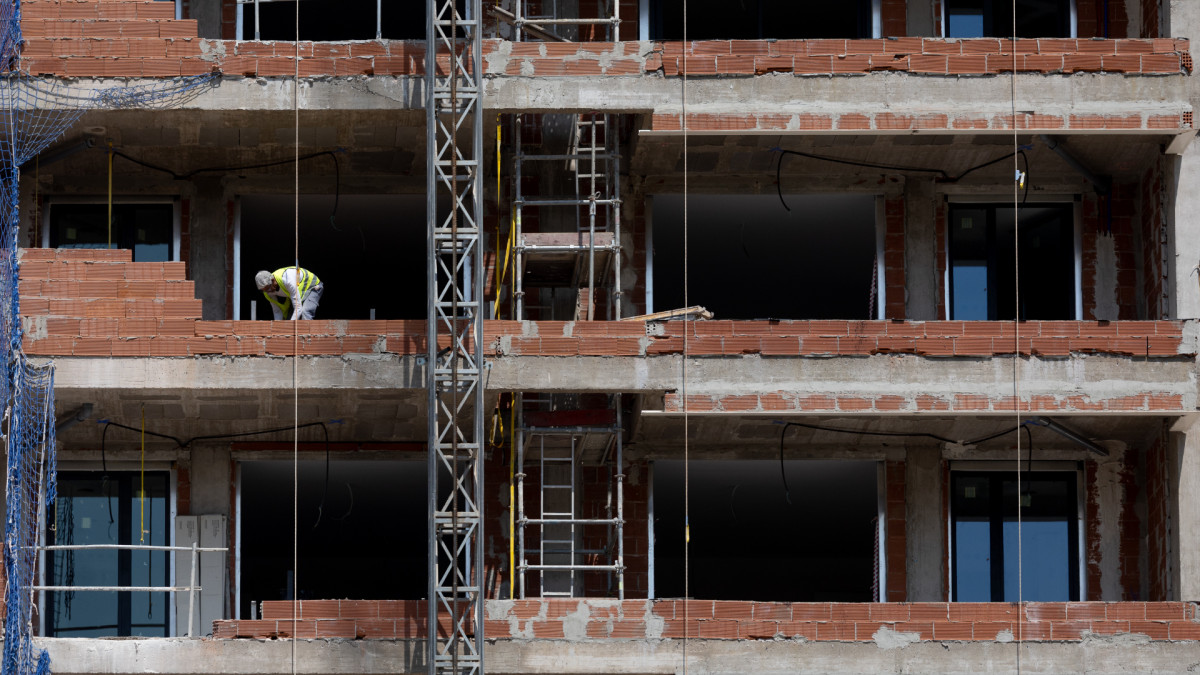
Housing has become one of the few issues capable of crossing much of the political divisions among Spaniards. The 88.7% believe that access to housing has worsened since the start of the legislature, according to the latest Cluster17 survey for Agenda Pública. Against that broad majority, only 1.3% perceives any improvement.
The 73.9% of citizens state that housing access has worsened “significantly” and a further 14.8% that it has worsened “somewhat”. A 9.4% believes the situation remains roughly the same. The survey, conducted between August 22 and 25 on a sample of 1,637 people, also asks about the evolution of the economy, employment, purchasing power, public services or institutional quality. None of these areas receives a diagnosis as negative as housing. Purchasing power and the cost of living come in second place, with 77.2% who believe they have worsened.
The discontent also reaches Socialist voters
In this case, voting memory does not reveal a divided scenario, but only nuances the intensity of the assessment. Among those who voted for the PP in the 2023 general elections, 99% consider that access to housing has worsened. Among Vox voters, the percentage is almost identical, at 98.8%.
“81.9% of those who voted for the PSOE consider that access to housing has worsened, compared to only 0.9% who perceive an improvement”
On the left, 81.9% of those who voted for the PSOE believe that access to housing has worsened, while only 0.9% see an improvement. Among Sumar voters, the balance is similar: 80.4% see deterioration and barely 1.4% a favorable evolution. For their part, 91.2% of Junts voters feel that access to housing has worsened.
The agreement among citizens ends when the question turns to the economy. Among socialist voters, 89% believe that the Spanish economy has improved, even though eight out of ten also think that access to housing has worsened. Among Sumar electors the gap is similar, while 93.6% notice an economic improvement.
The assessment of housing thus escapes, to a greater extent than other issues, the government-opposition logic. Voters of the party that supported the investiture can hold a favorable view of the economy’s trajectory and, at the same time, share a very negative diagnosis of the housing market.
Almost eight in ten Spaniards believe their purchasing power has worsened
The housing issue represents the extreme end of a diagnosis that extends to many of the areas included in the survey. In addition to access to housing, Cluster17 asks about the evolution since the PSOE has been in government of the economy, employment and wages, purchasing power, public services, institutional quality, territorial coexistence, equal opportunity and Spain’s international influence. The results show meaningful differences between some matters and others.
“The assessment of housing escapes, to a greater extent than other matters, the government-opposition logic”
The Spanish economy is the clearest exception: 50% think it has improved since the PSOE took office, versus 40% who believe it has worsened. In employment, wages and working conditions, the positions are almost evenly split, with a 43.5% who see an improvement and 43.3% who indicate a deterioration.
Perception changes markedly when the questions approach material conditions. 77.2% believe that purchasing power and the cost of living have worsened, while only 10.7% see an improvement. The balance is also negative for the quality of public services, which has worsened for 66.8%, and for institutional quality and the fight against corruption, at 62.9%.
The remainder of the indicators also do not yield a favorable result. 51.3% believe that equality of opportunity and social cohesion have worsened; 49.5%, territorial coexistence, and 49% Spain’s international influence. Only the economy shows a clearly positive balance across the entire set.
The difference between certain indicators and others helps to better understand the housing result. There is no uniform pessimism about everything that happened during these years: half of Spaniards acknowledge an improvement in the economy, though employment divides optimists and pessimists almost evenly. That negative consensus appears, above all, when asked about the cost of living, public services and, especially strongly, housing.
Younger people bear the greatest discontent
When discussing expectations and the economy, the generational perspective varies greatly. Spaniards aged 25 to 34 are the group that offers the most negative balance in seven of the nine areas analyzed. Housing tops the list: 96.1% believe access has worsened and none of those surveyed in this age group sees an improvement.
But the discontent does not stop there. 87.1% believe their purchasing power and the cost of living have worsened; 76.7% say the quality of public services has deteriorated; and 70.1% rate the quality of institutions and the fight against corruption as poorer. They are also the most critical on equality of opportunity and social cohesion (59.6%).
“That negative consensus appears, above all, when asked about the cost of living, public services and, especially, housing”
The difference even extends to the economy, where the overall result was favorable. Among those aged 25 to 34, 52.4% think the Spanish economy has worsened and only 36.5% see an improvement. In employment, wages and working conditions, a similar pattern emerges: 53.5% indicate deterioration versus 32.7% noting advances.
The result leaves a fairly clear split between how people view the economy and their everyday experience. A significant portion of Spaniards — including many PSOE and Sumar voters — may consider that the economy has improved and, at the same time, affirm that they are living worse in terms of housing access, cost of living or public services.
This dynamic will be one of the Government’s most important challenges at the start of this political and electoral year. On issues such as immigration, the Government finds support from its voters and opposition from other parties, but the scenario painted by these data is different. The negative judgment does not come only from opposition voters; it is also found among voters of the governing party, and it is not part of a broad rejection of all indicators of its management. These are citizens who can acknowledge an economic improvement and, nevertheless, fail to see it in some of the conditions that most directly determine their standard of living.
The pan-European polling firm Cluster17 has established itself as one of the most accurate in Spain. Its mid-2023 general election survey was the second most accurate for votes and the third for seats, according to Electomanía. In 2024, with the Agenda Pública survey, it achieved the most precise estimate of the Catalan elections and, also with this outlet, the third most accurate in the global ranking of seats and votes in the European elections.
For a sample of this size, the conventional 95% precision margin stands at ±2.4 percentage points.

Natalie Foster
I’m a political writer focused on making complex issues clear, accessible, and worth engaging with. From local dynamics to national debates, I aim to connect facts with context so readers can form their own informed views. I believe strong journalism should challenge, question, and open space for thoughtful discussion rather than amplify noise.