
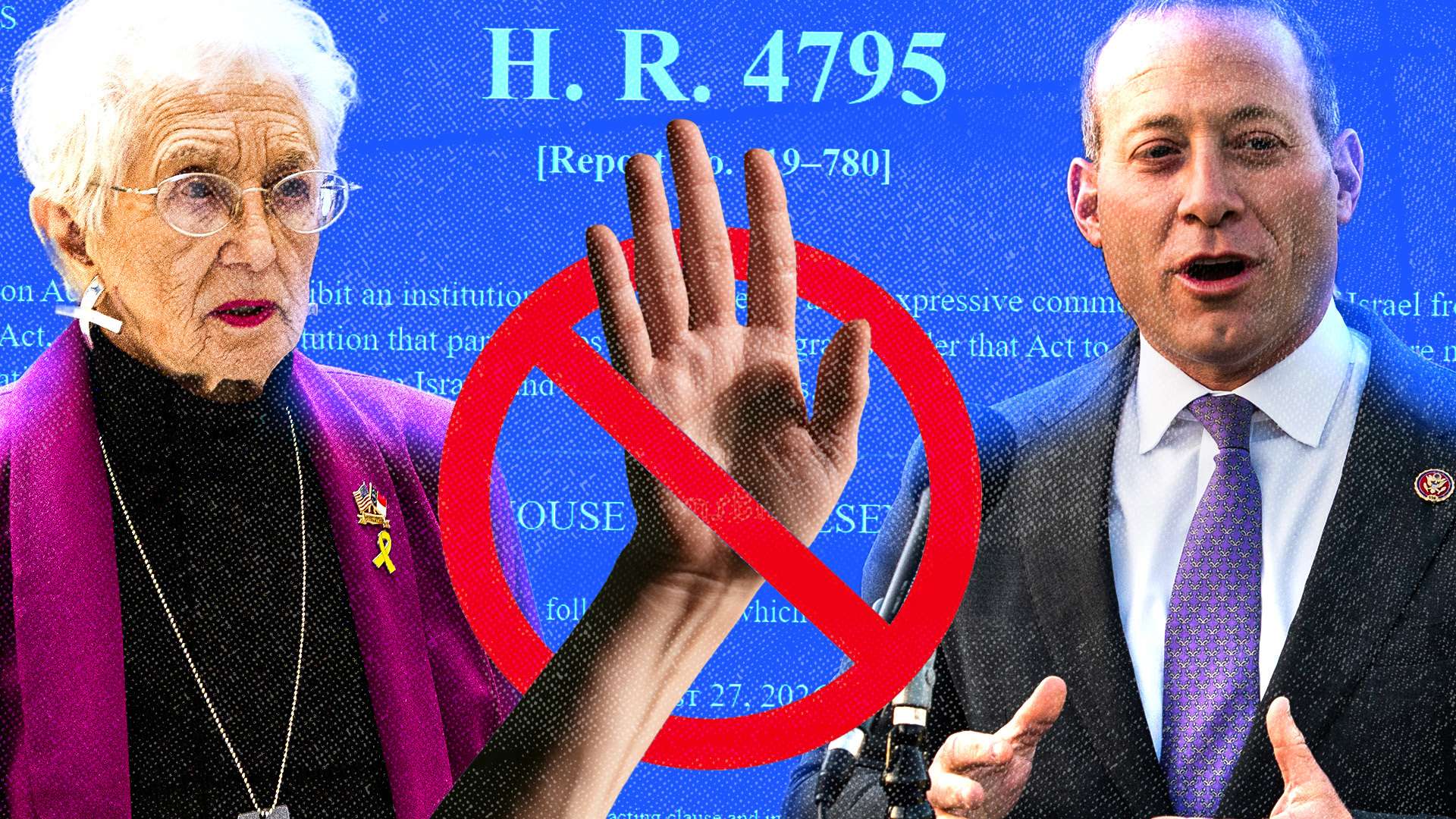
The bipartisan measure, which cleared the House, targets university-led boycotts of any “major strategic partner.”
Lawmakers across the aisle keep devising inventive detours around the constitutional right to boycott. In 2017 and 2018, members from both parties pushed a proposal that would leverage export controls to criminalize encouraging a boycott of Israel, with penalties reaching up to 20 years in prison. The following year, a bipartisan coalition sought to bar “furnishing information” to an international boycott movement targeting Israel, but the vote was delayed because of opposition from libertarian-leaning Rep. Thomas Massie (R–Ky.) and other Republicans.
On Thursday, the House of Representatives approved the Protect Economic and Academic Freedom Act, authored by Reps. Virginia Foxx (R–N.C.) and Josh Gottheimer (D–N.J.). The measure would require universities receiving federal funds to certify that they “will not engage in a nonexpressive commercial boycott of a major strategic partner of the United States.” It relies on a single definition of “major strategic partner,” drawn from Section 4 of Public Law 113–296, which states: “It is the sense of Congress that Israel is a major strategic partner of the United States.”
The bill still awaits Senate approval before it can go to the president.
Foxx asserted that the measure “cuts off any possible taxpayer support for these concrete campaigns of antisemitism in the form of BDS and academic boycotts of Israel,” invoking the acronym BDS for the Palestinian-led movement. Yet Lara Friedman, head of the nonprofit Foundation for Middle East Peace, argues that the proposal extends far beyond merely controlling public funds.
The legislation would open the door to False Claims Act lawsuits against universities accused of boycotting U.S. partners, Friedman notes. By compelling universities to “prove a negative” to avoid lawsuits, the bill would push them toward prioritizing maximal engagement with those partners, she adds. In short, the Protect Economic and Academic Freedom Act would amount to a form of affirmative-action preference for foreign nations.
Additionally, the congressional report attached to the measure constitutes a sweeping challenge to Americans’ constitutional right to withhold their money. It contends that the First Amendment protects the expressive aspects accompanying a boycott, not the commercial choice to refrain from doing business with a given entity. Friedman describes this as “an alarming and novel interpretation of the Supreme Court’s prior decisions,” which “renders the entire notion of a ‘right to boycott’ meaningless, with troubling implications that extend well beyond Israel-Palestine concerns.”
Even some prominent pro-Israel voices who typically oppose BDS voiced opposition to the Protect Economic and Academic Freedom Act, including Rep. Jerry Nadler (D–N.Y.) and the advocacy group J Street, which stated that it “believes the most effective way to counter antisemitism on college campuses is through open debate, education, and renewed efforts to achieve a peaceful resolution to the Israeli-Palestinian conflict—not through punitive legislation aimed at curbing the freedom to boycott.”
Friedman, Nadler, and J Street also highlighted that the bill’s definition of “Israel” could be read to include Israeli settlements in the occupied territories, effectively barring selective protests against a particular policy. And this is not merely theoretical. When Ben & Jerry’s announced in 2021 that it would cease operations in the settlements while continuing to operate within Israel, several states penalized the company under their own anti-boycott statutes.
About ten years ago, the Israeli government launched a broad campaign to counter the BDS movement within the United States, with a focus on college campuses. In 2015, Israel’s parliament held a hearing on the global threat posed by BDS, and then-foreign minister Yair Lapid warned that a foreign boycott of settlements could effectively trigger a wider boycott of Israel in many places. The newly created Ministry of Strategic Affairs received a $36 million budget to combat BDS, and the 2019 documentary The Lobby USA showed the ministry coordinating with campus-oriented activist groups across the United States.
In response to the Gaza conflict, several American student bodies—such as Yale University and multiple University of California campuses—voted to sever ties with Israel, though none of these actions were fully carried out. The Protect Economic and Academic Freedom Act would explicitly bar universities from disengaging from “conferences, teaching exchanges, cultural exchanges, study abroad programs, joint research, and other collaborative educational activities” with U.S. partners.
After the 2024 surge of campus protests, Foxx and Gottheimer resumed the push against anti-Israel student activism. Foxx’s office told Reason in May 2024 that she has been examining whether protesters “have financial ties to designated Foreign Terrorist Organizations.” Meanwhile, Gottheimer urged the Department of Education to probe high school students for antisemitism and pressed social media platforms to remove what he described as “terrorist” content.
The Trump administration also wielded executive powers in its anti-BDS efforts. Most notably, it imposed sanctions on Italian academic Francesca Albanese, who authored a United Nations report advocating boycotts and legal actions against businesses connected to the Israeli military. Albanese, who is suing the U.S. government over the sanctions, was barred from visiting her American children and had her husband’s Washington apartment seized by the U.S. Treasury.
Although these steps targeted Israel’s adversaries, they set a precedent that could compel Americans to engage in commerce with a wide range of entities. Several states have expanded their anti-BDS laws to bar boycotts of industries such as fossil fuels, mining, agriculture, timber, and firearms, or even companies whose policies oppose LGBT rights or abortion access.
“The road to erasing the U.S. right to free speech or protest on ANY matter in the country is being paved with laws designed to shield/advance Greater Israel and Israeli impunity,” Friedman observes.
