
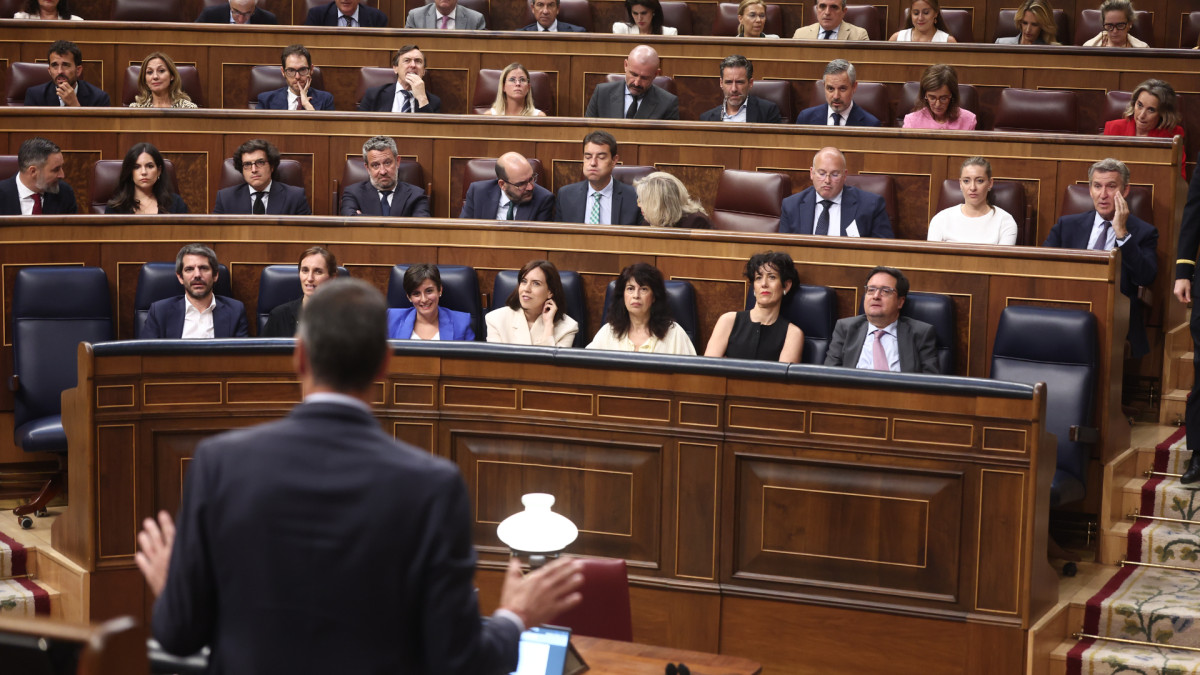
There is an idea that periodically returns to Spanish politics: the notion of the two Spains. It is a historically loaded expression and far too easy to use, so it should be handled with care. Spain is not today divided into two clearly delimited blocks, nor can society be reduced to a progressive half and a conservative half. The data from the Cluster17 survey that we published for the start of this political season and which we have analyzed in recent days allow us to recognize a different division. Rather than two closed electorates, two large ways of interpreting the same country emerge.
The electoral snapshot is familiar: The People’s Party (PP) leads with 30.1% of voting intention; the PSOE obtains 28.1%; Vox reaches 16.1%; Sumar 6.1%; and Podemos 3.6%. Those percentages show who is ahead, but they are only the first step to understand how citizens perceive the economy, housing, immigration, institutions, territorial coexistence, or Spain’s international stance.
What emerges when looking beneath the vote is a division that does not operate the same way across all issues. There are problems, such as housing, where electorates far apart share a diagnosis; in other cases, the gap appears even before discussing solutions, because some believe the situation has improved and others that it has worsened. And all of this coexists with significant movements in voting within the blocs themselves and even between them. Electoral mobility therefore does not erase, the distance between perceptions.
“The distance appears even before discussing the solutions, because some see the situation as improved and others as worsened”
That combination also helps to understand one of the apparent paradoxes of the survey: that the electoral map can remain relatively stable while there are very high levels of discontent on specific issues. Citizens may agree that housing or purchasing power has worsened and, at the same time, make completely different assessments about the economy, immigration, institutions, or the government’s continuity.
A Different Economy, Depending on Who Looks at It
Exactly half of Spaniards believe the Spanish economy has improved since the start of the legislature, compared with 40% who think it has worsened. The overall balance is positive, but it changes radically when distinguishing by vote recall.
Among those who voted for the PSOE in 2023, 89% consider that the economy has improved. Among Sumar voters, the figure reaches 93.6%. In the PP it is almost the opposite: 76.9% think it has worsened. In Vox, 87%. The recall of vote thus alters the diagnosis much more than the intensity with which a given evolution is valued.
At the same time, 77.2% think that purchasing power and the cost of living have worsened. A portion of those who believe the economy is moving better therefore rate negatively variables much closer to their everyday experience.
“A portion of those who believe the Spanish economy is moving better therefore rate negatively variables much closer to their everyday experience”
Both responses are compatible because the questions measure different things. Politically, that distance is precisely what matters: recognizing an overall improvement in the economy does not imply that improvement has reached purchasing power, the cost of living, or housing.
Housing Breaks the Divide
In housing, however, the pattern is very different. 88.7% of Spaniards believe that access has worsened since the start of the legislature, the most widespread negative diagnosis of the entire battery. And here the vote hardly changes the direction of the answer. It is held by 99% of those who voted for the PP and 98.8% of Vox voters, but also 81.9% of Socialists and 80.4% of those who supported Sumar.
“The 88.7% of Spaniards believe that access has worsened since the start of the legislature, the most widespread negative diagnosis of the entire battery”
Thus, a Socialist voter can consider that the Spanish economy has improved —as the vast majority of this group says— and at the same time share with a Vox voter a very negative assessment of housing.
In other words, the data indicate that party identification does not order all perceptions with the same intensity. And it is precisely in housing, one of the topics that will shape the upcoming elections, where there is a widely shared diagnosis. Knowing which causes citizens attribute to this diagnosis and which solutions are most supported should be among the next steps.
Immigration Again Separates the Diagnoses
With immigration, differences between electorates return to be very wide. Across the population as a whole, 40.5% believe it generates more problems than benefits, compared to 29.7% who highlight the benefits and 27.9% who think both effects balance out.
Among Vox voters, 92.7% think immigration generates more problems than benefits. In the PP, that figure is 65.3%. Among those who voted for the PSOE, the opposite occurs: 50% highlight the benefits, 37.4% think both effects balance, and only 10.9% point to more problems. Among Sumar voters, 65% highlight the benefits and only 2.9% the problems. The distance is enough for the main electorates to start from diagnoses nearly opposite on the same issue.
“The distance is enough for the main electorates to start from diagnoses almost opposite on the same issue”
Cabe señalar que el trabajo de campo se realizó, además, en plena crisis de Ceuta, con la inmigración y el control fronterizo ocupando una parte central de la conversación política.
Neither does the crisis seem to have provoked, at least for now, an electoral swing: the PSOE hardly varies compared to the previous Cluster17 poll for Agenda Pública, in November 2025. What is very visible, however, is how much the perception of immigration is linked to the respondents’ political stance.
Catalonia, Amnesties, and Institutions
49.5% believe territorial coexistence has worsened during the term, versus roughly 23% who see an improvement. Among Socialist voters, the balance is much more even, and among Sumar supporters positive ratings predominate; in PP and Vox, the perception of deterioration is overwhelmingly majority.
The question about amnesty draws a similar division, though the aggregated result is favorable: 43% of Spaniards believe it has aided coexistence in Catalonia, vs 34% who disagree. The agreement hovers around 80% among Socialist voters and exceeds 85% among those of Sumar. In PP and Vox, the opposite answer dominates.
These data allow us to state that territorial politics continues to clearly separate the perceptions of the main electorates. Likewise, institutional quality and the fight against corruption reproduce a similar distance. 62.9% believe they have worsened during the legislature. The figure falls to 34.9% among Socialist voters and to 25.3% among Sumar voters, while reaching 93.6% in PP and 95.8% in Vox.
Even International Influence Is Viewed Through the Vote
45% think Spain’s international influence has worsened, compared with 40% who believe it has improved. Also here the result changes almost entirely depending on vote recall.
41.0% of Socialist voters and 85.3% of Sumar voters consider Spain’s influence has improved. Among PP voters, 93.9% think it has worsened; in Vox, 94.8%.
It is one of the most pronounced gaps in the entire survey. A question relatively distant from everyday experience yields almost inverse valuations among the main electorates. That does not mean that every international event is necessarily interpreted through a partisan identity, but it does mean that the overall balance of Spain’s position in the world is strongly associated with voting.
Two Electoral Blocs, but Also Battles Within Them
The left-right division coexists with significant movements within each space. Vox retains 84.1% of its 2023 voters and attracts 15.3% of those who then voted for the PP. Conversely, 7% of Vox’s former voters would now opt for the PP.
On the left, Sumar preserves only 40.7% of the electorate that supported its candidacy in 2023, when Podemos was part of it. 26.1% move to the PSOE and 20.3% choose Podemos. There are also transfers between blocs: 9.5% of those who voted for the PSOE in 2023 now say they intend to support the PP.
The two major spaces are, therefore, very separated in many of their perceptions, but their electorates are not stowed in compartments. The electoral battle takes place also within them. The PP may lead the voting intention and at the same time come under pressure from Vox, while the PSOE can retreat from 23J and offset part of that loss by bringing in former Sumar voters.
This combination allows distinguishing between two phenomena that are often conflated. One thing is electoral mobility and another is the distance between the perceptions of the major electorates. The vote can move between PP and Vox or between PSOE, Sumar, and Podemos without the enormous differences we have observed on the economy, immigration, institutions, or Spain’s international influence disappearing.
“One thing is electoral mobility and another is the distance between the perceptions of the major electorates”
Even transfers between blocs can coexist with that polarization. That some PSOE voters shift to the PP does not mean political borders have disappeared, just as Vox’s high loyalty does not make all its voters a homogeneous group. The electoral snapshot shows movement; the other questions in the survey show that, on some issues, that movement occurs on a terrain of extraordinarily distant perceptions.
There you can see a feature of contemporary Spanish politics. The competition unfolds simultaneously between blocs and within them. Parties need to differentiate themselves from the opponent across the aisle, but also avoid that another party within their own space better represents their voters’ concerns. And the issues that favor one competition or the other do not have to be the same.
Sánchez Divides the Country Almost in Half
44.6% think Pedro Sánchez should call early elections, and 41.7% prefer that he serves out the term. The other options —a vote of confidence or his replacement by another Socialist— are far behind.
The balance disappears when looking at the electorates. 73.9% of those who voted for PSOE want Sánchez to serve the full term, as does 85.9% of Sumar voters. 81.4% of PP voters and 90.8% of Vox voters prefer early elections. Junts introduces a notable difference compared to the opposition parties: 59.1% of its voters prefer the legislature to end, versus 28.4% who opt for elections.
The question concerns the outcome of the legislature and does not equate to an evaluation of Sánchez or a measure of government approval. Even so, it yields a national result that is very tight, based on positions that are very clearly defined within the major electorates.
And that difference matters. The country does not appear divided almost in half because the majority of citizens waver between continuity and elections, but because there coexist very large groups that offer almost opposite answers. The overall deadlock is, to a large extent, the result of adding up opposing certainties.
“The country does not appear divided almost in half because the majority of citizens waver between continuity and elections, but because there coexist very large groups that offer almost opposite answers”
Something similar happens when comparing this question with the balance of the legislature. It is possible to consider that housing, purchasing power, or public services have worsened and yet prefer that the Government complete the term. Likewise, a positive assessment of some area does not necessarily imply backing its continuation. The final political decision does not appear to be reducible to an automatic sum of satisfactions and dissatisfactions.
That helps explain why high levels of discontent in specific issues do not automatically translate into large electoral movements. Citizens evaluate different areas simultaneously and do so from preexisting political positions that also condition the overall reading of the legislature. Two people may agree that access to housing has worsened and reach completely different conclusions about whether Sánchez should continue.
“Two people may agree that access to housing has worsened and reach completely different conclusions about whether Sánchez should continue”
Either way, España shares some problems in a breadth that party debate can obscure. What is shared much less is the evaluation of the country in which those problems occur. And that distance helps to understand what lies beneath the vote: in the face of the same economic reality, the same migration crisis, or the same political decision, citizens may be constructing very different balances about what has happened to Spain.
There, in all its limitations, lies the old image of the two Spains. They do not appear as two equal, closed, perfectly coherent halves. There is movement between parties and even between blocs, there are differences that do not always follow the party boundary, and issues, such as the Crown, that disrupt a strictly ideological reading. But, notwithstanding all that complexity, several questions at the center of political debate end up producing two very different diagnoses.
The next elections will decide, as always, who governs. But the competition is also played out on an earlier terrain: which problems manage to structure the debate and which interpretation of the country ends up prevailing over the others. Because, facing the same reality, each voter may be deciding on a different Spain.
