
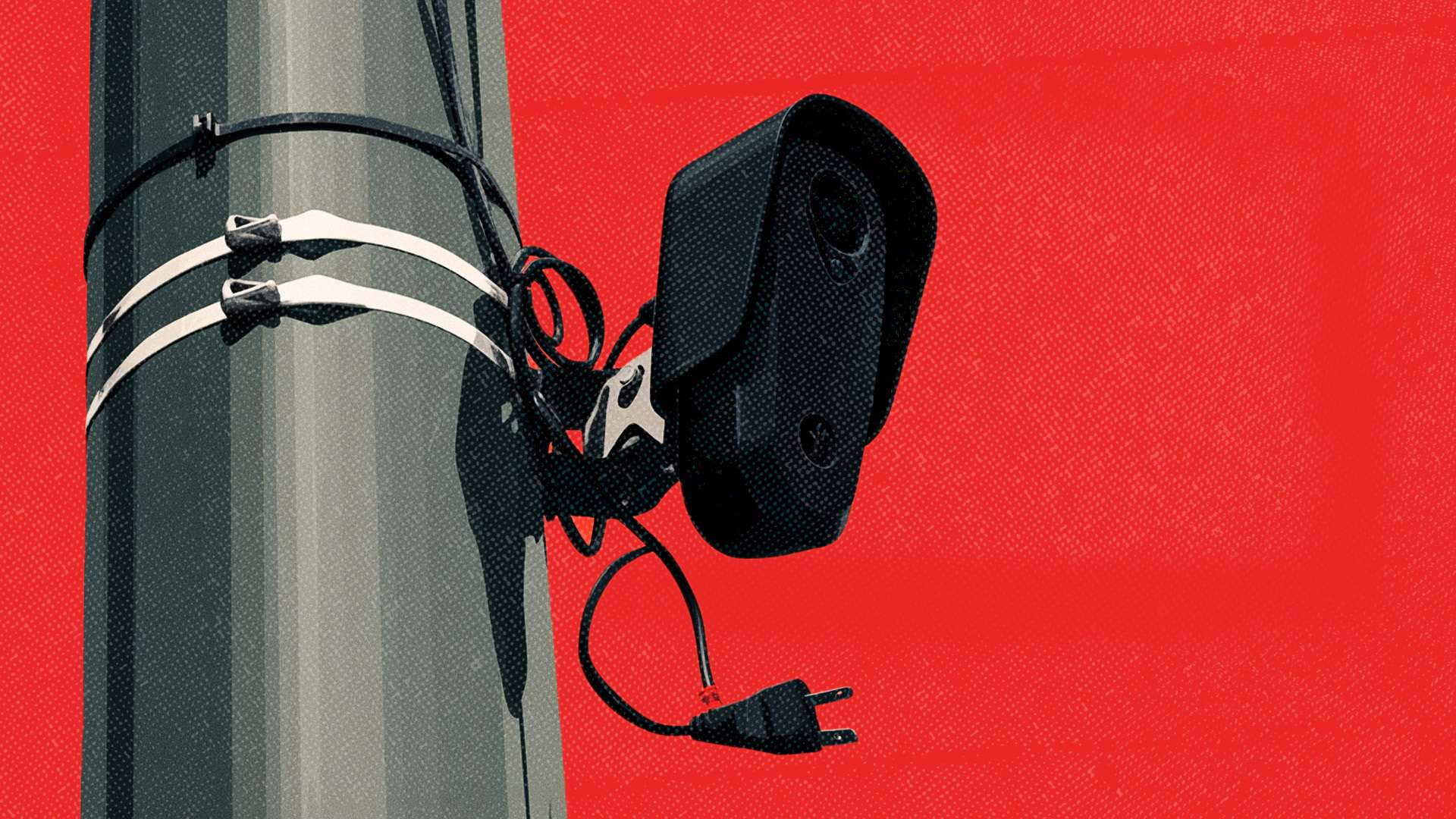
Criticism from supporters of the former president and fresh polling data indicate that broad use of automated license plate readers is meeting resistance across the political landscape.
Reps. Thomas Massie (R–Ky.) and Eric Burlison (R–Mo.) unveiled this week the Flock-Off Act, a measure designed to block federal dollars for automated license plate readers (ALPRs) except at international borders or for toll-collection purposes. “The federal government shouldn’t hand out ‘security’ grants to towns and police departments that have crossed the line and turned their communities into a version of 1984,” Massie stated on Wednesday. “Taxpayers shouldn’t be compelled to underwrite a surveillance state.”
The bill, which targets Flock Safety—the leading ALPR supplier—in a pointed way by name, is co-sponsored by Rep. Ro Khanna (D–Calif.) alongside four Republicans: Reps. Lauren Boebert (Colo.), Paul Gosar (Ariz.), Chip Roy (Texas), and Victoria Spartz (Ind.). It underscores the bipartisan, cross-ideological backlash against AI-aided ALPRs, which numerous municipalities installed with little regard for privacy or the risk of misuse. In the last year or so, people from across the political spectrum—national lawmakers, local legislators, and police officials—have begun to grasp the consequences of a nationwide surveillance framework that operates largely outside judicial review and with minimal oversight.
“On the right, the cameras are often criticized as governmental overreach,” noted Vox contributor Caitlin Dewey last week. “On the left, critics frequently tie the cameras to corporate surveillance, biased policing, the erosion of abortion rights, and immigration enforcement.”
Civil liberties advocates—such as the Institute for Justice, the American Civil Liberties Union, and the Electronic Frontier Foundation—have warned about ALPR surveillance for years. Yet revelations about flagrant police misuse of ALPR databases—ranging from stalking ex-partners to tracking rivals or adversaries—have helped shift public sentiment closer to those organizations’ concerns.
A national YouGov poll conducted last week found that 46 percent of respondents would oppose using ALPRs for law enforcement in their communities, with 31 percent of those opposed being “strongly” against. Only 38 percent favored ALPRs, while 17 percent were undecided. A year earlier, the same poll showed 45 percent in support and 33 percent opposed, including 20 percent who were strongly opposed, with the remainder undecided.
In both polls, Democrats and independents tended to oppose ALPRs more than Republicans. Yet the latest results also reveal growing hesitancy among Republicans: 33 percent of them opposed police use of the technology, up from 29 percent the previous year, including 20 percent who held strong views, up from 18 percent in 2025.
A few weeks prior, an Arizona-oriented NextGen survey—conducted in a state that Trump carried in 2016 and again in 2020—found even stronger opposition to Flock cameras: 63 percent of registered voters were against police use of ALPRs, and 82 percent were worried about potential misuse. A Spry Strategies poll of likely voters in Knox County, Tennessee—a solidly Republican and conservative locale—arrived at a similar conclusion, with 58 percent opposing Flock cameras, 42 percent of whom were “strongly” opposed.
Florida Governor Ron DeSantis, among the most outspoken Republicans skeptical of broad ALPR deployment, signaled where the conservation of civil liberties is likely headed. He told reporters last week that ALPR cameras are “out of control.” He added, “I’m all for law enforcement having tools to hold criminals accountable… No one’s been tougher on law enforcement than me. But I don’t want this to morph into a surveillance state.”
Notably, DeSantis pointed to shocking examples of what can occur when officers nationwide gain easy, largely unsupervised access to ALPR databases: the ability to track motorists, infer their travel patterns, identify nearby vehicles, and, when cross-referenced with other records, assemble a comprehensive portrait of individuals’ lives. The Institute for Justice has documented “well over 100 incidents of ALPR abuse,” suggesting this may just be the tip of the iceberg given weak oversight and widespread, often informal sharing of ALPR data. “When I see, like, a police officer using this to track, like, an ex-girlfriend,” DeSantis remarked, “I’m thinking, what on earth is going on?”
Local officials have begun asking analogous questions. The Institute for Justice counts “157 local governments” that canceled or chose not to renew ALPR contracts since early 2025. While that figure represents a modest slice of the roughly 7,000 U.S. law enforcement agencies that employ Flock’s technology, the trend does not bode well for a company whose chief executive previously dismissed privacy concerns and who has criticized “terroristic organizations” like DeFlock for mapping more than 138,000 ALPR cameras across the United States.
In contrast to the political divergence seen in the YouGov results, Congressional responses to ALPRs have been driven largely by Republicans. The Surveillance Accountability Act, introduced by Massie in April, would generally require a warrant to search ALPR data—an approach aligned with what the Institute for Justice favors. Yet it has only one additional cosponsor among Massie’s colleagues—Boebert—so far.
Another measure, the PRIVACY Act, introduced by Rep. Keith Self (R–Texas) on July 15, has drawn somewhat more backing. It would prohibit federal agencies from using state or local ALPR information to bypass warrant requirements and has attracted half a dozen cosponsors, all Republicans, including Burlison.
Meanwhile, the Protection Against Mass Surveillance Act, proposed by Rep. Tim Burchett (R–Tenn.) on July 21, would bar federal bodies from purchasing or accessing automated surveillance systems that identify, track, or record individuals. It has seven cosponsors, including Burlison and six other Republicans.
Even though these bills do not herald a nationwide uprising, the conservative Republican reaction demonstrates that worries about ALPRs are not confined to libertarian or left-leaning circles. The Epoch Times, a publication with strongTrump-aligned readers, recently offered sympathetic coverage of the anti-Flock backlash, highlighting concerns about ALPR data being misused for personal purposes, misidentification of suspects, and infringement of the Fourth Amendment protection against unreasonable searches.
Last week, Sen. Josh Hawley (R–Mo.) announced an inquiry into Flock’s handling—collection, retention, and dissemination—of data produced by its artificial intelligence-backed surveillance cameras. He argued that “the vast majority of people captured in those records did nothing wrong,” adding that Americans do not surrender their privacy rights when they drive to work, drop their kids at school, or attend church. The Supreme Court’s position, he noted, is that a complete, retrospective record of a person’s movements differs in kind from ordinary public observation.
Texas Agriculture Commissioner Sid Miller, a conservative Republican, recently urged Gov. Greg Abbott to suspend state funding for ALPR systems until lawmakers have had a chance to study their risks and craft firm constitutional safeguards. Miller emphasized the cumulative effect of ALPR deployments: “Enough cameras can reveal a person’s routines, associations, and private activities. That lays the groundwork for mass surveillance.”
Miller’s stance appears to echo the view of David Dunmoyer, associate vice president for campaigns at the Texas Public Policy Foundation, who praised Flock for triggering a nationwide conversation about privacy and freedom in a July 29 Daily Wire piece. He described the company’s cameras as “an assault on your constitutional freedoms” and urged several reforms: require a warrant, set a reasonable retention limit in days rather than years, bar sharing with out-of-state and federal agencies without a Texas judge’s sign-off, publish audit logs, and give Texans standing to protect their privacy.
Although several Trump allies have voiced similar concerns, their criticisms have yet to make a dent in the president’s stance. The administration’s National Drug Control Strategy describes ALPRs as “a critical technological tool for domestic drug interdiction, acting as a significant force multiplier for law enforcement on our nation’s highways.” The administration has also leveraged ALPRs extensively for immigration enforcement—a usage resisted by blue states that have sought to curb federal access to ALPR data for enforcing immigration laws.
“You weigh the pros and cons,” Trump told a reporter regarding the Flock matter a few weeks ago. “It’s under study right now. We’ll have an answer or our views on it in the coming weeks.”
