It’s hard today to talk about the future of artificial intelligence without ending up touching on almost everything else. About work and the distribution of wealth, but also about power, the relationship between the United States and China, the place Europe might play, or just how capable we will be of controlling increasingly autonomous systems. Technology is advancing rapidly, and with it, the questions it leaves open.
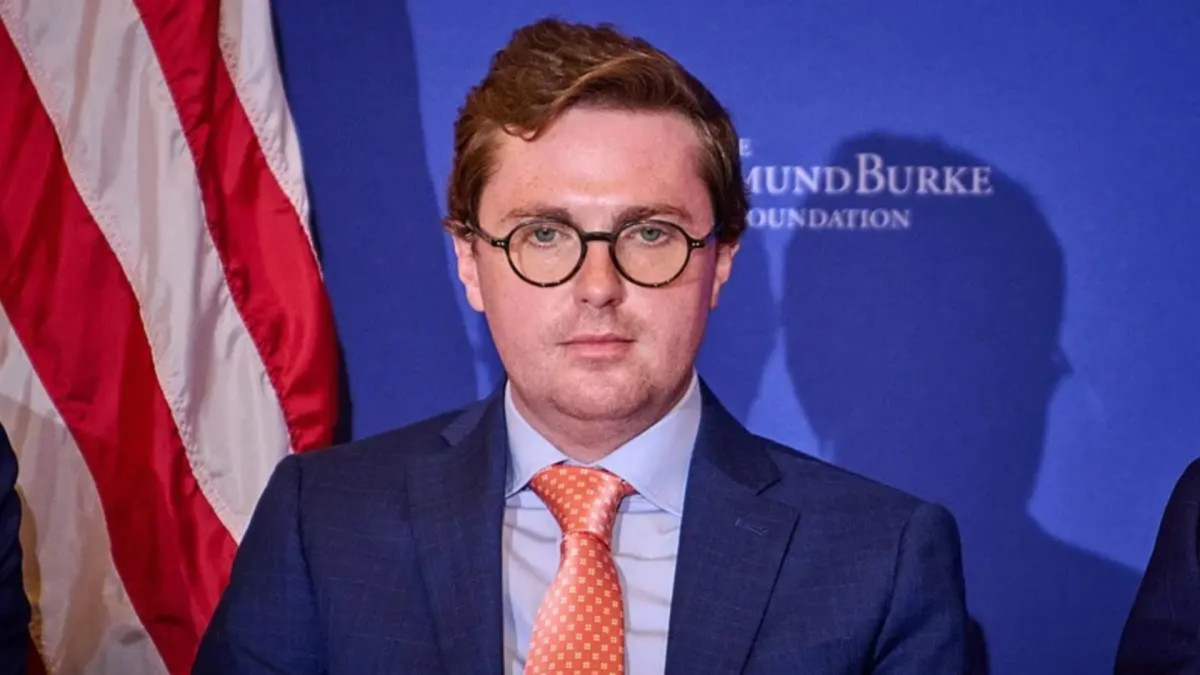
In the same week that OpenAI unveils its latest model, GPT6-Astra, we spoke with the head of strategic futures at the company, Dean Ball. His task, he explains, is to think about what scenarios AI might open up and which present decisions could bring us closer to some futures and push us away from others. In October he will also be one of the speakers at Forum La Toja 2026, which Agenda Pública will again cover from Illa da Toxa this year.
Ball focuses on the concentration of power, argues that governments should have mechanisms to slow AI development if circumstances demand it, and rejects one of the metaphors that has most conditioned the tech debate: the “race.” As a citizen, he goes even further: “An arms race in this domain does not benefit anyone,” he reiterates. He also sends a particularly direct message to this side of the Atlantic: “Europe has to build data centers and stop overthinking it”. For Ball, the continent still has room to leverage its industrial capacity, but must recognize that all of this is happening with far more urgency than it might seem.
His current role at OpenAI is Head of Strategic Futures. So, in the context of everything happening with AI, what is his view on the different futures ahead? Which possibilities does he think are most likely to unfold as the technology accelerates?
I think one of the interesting things about living in this moment is that, for the first time in a long time, it’s really hard to imagine what the future will look like.
I just became a parent. He is eight months old. I gaze at him and it’s very difficult to conjure what his life will probably be like when he’s twenty.
I don’t think that happened when I was a baby, in 1992. I don’t think my parents looked toward 2012 and thought, “This will be inconceivably different from what we have today. I can’t even imagine what 2012 will be like.” They surely thought it would be different, but not that the very nature of the human role in the economy would be almost impossible to foresee. Today there is enormous uncertainty around that.
That’s why, basically, I think our team’s job is to envision the future as a distribution of many possible outcomes. Imagine not one or two scenarios, but millions of potential futures, and then ask yourself: as we move between them, which are better? Which should we aim to avoid? Which ones are we not even sure about?
“Our team’s work is to conceive the future as a distribution of many possible outcomes”
Deciding what might be desirable is, in itself, quite complex. It’s not necessarily our place to tell the world what the desirable future should be. But I do believe we have the responsibility to explain what we consider the realistic range of possible results to be, which we think is quite broad, and to point out what levers we currently have at our disposal to steer the world toward the futures we’d prefer to live in and away from those we’d rather not.
One of the areas that generates the most uncertainty is the future of work. It directly affects people, not only through their incomes but also through the role they play in the world and their sense of purpose. There seem to be two broad camps: one more pessimistic, expecting that AI will cause major disruptions and eliminate many jobs; and another that talks about abundance and overcoming scarcity. Where do you stand? And what about the demand side? If people don’t have disposable income, who will actually pay for that abundance?
All of these questions depend, to some extent, on economic outcomes over which we may have only limited room to act. There will be domains where AI will surely surpass human labor. But I think much of this will depend on how our institutions are designed. What do our institutions incentivize?
You can imagine many jobs where AI might be able to perform a given task or perhaps not, but in any case humans would simply prefer to interact with another human. Or it might become a luxury to interact with another person. It could even become a kind of status symbol to have more humans around you because they will be very costly.
But for that to hold, human preferences must continue to matter in the world. That’s the important thing.
What we need is to ensure that the institutions incentivize a world in which human preferences continue to matter. And I think the best way we know to do that is to ensure that power is distributed across the entire economy and society: political power as well as economic power. We must avoid enormous concentrations of power that make individuals’ preferences matter very little. I think that is the main thing we must avoid.
There are many other questions, but if I had to identify the fundamental problem, I really think it is the concentration of power and how to prevent it.
“We must avoid huge concentrations of power that make individuals’ preferences matter very little”
There are many ways to do this. The answer could involve some form of wealth redistribution. It could relate to different approaches to legal responsibility. It could raise questions about who is permitted to own property. Can AI systems own property themselves? Can they conduct property transactions by themselves? These are genuinely interesting questions.
He discusses this balance of power in his latest Substack post, where he argues that AIs may inevitably become autonomous economic actors and asks what we could collectively do in response.
We should prevent certain things from happening. We should establish explicit legal provisions that prevent, for example, AIs from owning property.
The point I make in that article is that it’s probably already inevitable that there will be AIs acting as independent economic agents, but there are many different ways to limit their access to real estate in the economy: limit their ability to own property and limit their ability to transform the physical world by themselves. And I think we should do all of that.
“It’s probably already inevitable that there will be AIs acting as independent economic agents, but there are many different ways to limit their access to physical assets”
That article is a good example of what I was talking about earlier. Some phenomena may be inevitable, but that doesn’t mean we don’t have agency. It means the phenomenon may be inevitable while we continue to exercise our ability to decide through the choices we make about legislation, public policy, and, ultimately, the institutions those decisions create.
In the wake of the Hugging Face incident we are beginning to see political responses aimed at slowing down or pausing AI development. Senator Bernie Sanders, for example, has just called for an immediate pause on AI and Jean-Luc Mélenchon has echoed that position in France. We are also seeing political opposition to infrastructures like data centers. How do you assess this political response? Is slowing AI a useful and viable path?
I haven’t studied Senator Sanders’ proposal in sufficient depth to comment on it. It was published just on September 3, and that day we also had several things on our plates at OpenAI [the company had released GPT-6 Astra, its new model].
But I know much better Pacing the Frontier, a letter published a couple of weeks ago and signed by several frontline lab employees, including myself.
In that letter we say we believe it should be an important government priority to figure out exactly how we could modulate the pace of AI development so that, if we wanted to slow down the speed at which it is accelerating, we could do so.
It’s a very delicate legal terrain. You have to be extremely careful because there are ways to do something like that that could end up becoming a tyrannical appropriation of power by the Government over a technology that I think will be very important for freedom of expression and individuals’ rights. So we need to balance those concerns.
“It should be an important priority for governments to figure out exactly how we could modulate the pace of AI development”
Skeptically, at some point it will likely become a matter of political consensus that we want the ability to deliberately slow the acceleration in certain circumstances. But we must be very careful about how that capability is designed.
I want to return to that point, because many would argue that geopolitical competition itself is pushing acceleration. He was the lead author of the Winning the Race: America’s AI Action Plan team. If slowing the pace of AI development could lead to better global-scale outcomes, do we also need to move away from the idea that AI is an arms race? Does that require greater cooperation with China? Is the possible ‘permanent military edge’ too large a risk to collaborate?
Ultimately, questions about the United States–China relationship, geopolitical competition, and all such issues are decisions to be made—and must be made—by elected US leaders, not private companies. That is why I don’t think it’s my place to opine on what our geopolitical stance toward China should be.
What I do think is our role at OpenAI is to be transparent about what we’re seeing at the technology frontier and what governments are clearly not seeing, and to candidly inform our government of those advances so it can make well-founded decisions about how it wants to act.
That said, speaking as a private citizen, I would say that an arms race in this domain benefits no one.
If I could change one thing about the AI Action Plan, it would be the title, Winning the Race. I never liked it. I understand why we chose it, but I have always thought the race metaphor was a bad one.
I wrote that publicly after leaving the White House. I don’t think we should think of AI as a race. I think that’s a mistake.
What role can Europe continue to play in AI? And, given the current state of transatlantic relations, how important is the Europe–United States relationship within this broader geopolitical competition driven by technological innovation?
I think Europe has some fairly deep structural problems, but also truly extraordinary opportunities if it plays its cards right. We all have to tread a narrow path, and Europe too.
“We owe it to be transparent about what we are seeing at the technology frontier that governments clearly are not seeing”
One of Europe’s great advantages is that it possesses extensive industrial experience in the physical world. Europeans know how to manufacture complex things. And it’s not just about EUV machines [extreme ultraviolet lithography systems for fabricating advanced chips] or cars. Europe makes all kinds of complex products.
Europe has to be smart about protecting those industries, growing them, and cultivating new areas of industrial knowledge linked to the physical world. As a consequence of the systems we are building in the United States, there will be a huge amount of extraordinary things that will need to be built in the physical world. And the United States, by itself, simply cannot build them all.
That’s why Europe should stop worrying so much about “sovereign AI,” understood as building from scratch its own AI systems, and instead focus on developing physical industrial capacity.
The other point is that Europe has to build data centers and stop overthinking it. Really. It has to do it. And that will require private-sector drive, not government-led. I believe a public-sector-led approach is likely to fail in this realm.
Europe must understand that all of this is happening with a tremendous—very, very, very—urgent urgency, more than it seems. It is entirely possible to fall far behind, and Europe should not allow that to happen.
Probably it would be prudent for Europe to reduce its debt as quickly as possible because interest rates are going to rise.
She has also been very ambitious when it comes to transparency and traceability. One of the most controversial issues lately is the chain-of-thought architecture (where the model writes intermediate steps as it reasons, which act as traces) and the possibility that those developing the models will make them less transparent as their capabilities grow. After the Hugging Face incident—OpenAI described it as a “warning shot”—there is concern that we may reach a point where even those warning signals are harder to understand. How do you view the controversy around chain-of-thought? Could governments regulate and require mechanisms to audit what models can do and assess their alignment?
When we created reasoning models at OpenAI, with the model that eventually became o1, one of the ways they worked was through a kind of internal monologue or notebook. The model could reason about difficult problems in a way similar to how you would solve a tricky math problem by writing out the steps.
When you’re very young, you might need to write on paper something as basic as 3 + 4. When you’re older and solving, for example, a calculus problem, you perform basic arithmetic operations in your head. You don’t necessarily need to write each step because you’re thinking about mathematics at a higher level.
I think that with the ability to monitor the chain of thought, something similar is happening.
Models are becoming so smart that they can perform very difficult calculations and much more complex, so to speak, “inside their head,” without needing to write each of the steps. That can make it harder for us to monitor what the model is doing.
Many people already anticipated that this could happen, and it’s one of the reasons I think it’s becoming increasingly difficult for the industry—not just for OpenAI, but for the sector as a whole—to offer solid guarantees about what we think a newly trained model will or will not do.
So yes, it is a real problem.
“The models are becoming so intelligent that they can perform very difficult calculations and much more complex, so to speak, ‘inside their head’ “
I don’t think it’s unsurmountable. Like many other problems we’ve encountered in this field over the years, I think it can be addressed through a combination of smart people, computing power, and increasingly, the AI systems themselves.
There are other ways to improve monitoring capacity. Systems can be made more interpretable. We can work on AI alignment. A lot of things can be done, but they require deliberate effort.
And perhaps, rather than merely modulating AI progress and doing nothing more, we could slow the pace at which capabilities grow for six to twelve months while we carry out a concerted effort on these technical questions to make the models easier to monitor.
Thank you very much.
In partnership with