
In recent weeks, conversations have emerged regarding the role of AI in drafting law review pieces, and legal scholars have offered a wide spectrum of opinions. For me, deciding whether AI involvement should be prohibited or merely discouraged presents a genuinely challenging dilemma.
Within empirical legal studies, I would argue that the process of contemplating a project and the act of composing the paper are largely distinct undertakings. Empirical analyses are typically conceived and executed with painstaking attention to detail, and the principal figures and tables are generated before any narrative prose is drafted. The increasingly common practice of preregistration further discourages researchers from altering what is regarded as the core contribution—the empirical analysis—during the final stages of writing. Admittedly, the framing and interpretation of results may undergo adjustments during drafting. Yet those sections are precisely the ones most empirically minded readers approach cynically. In practice, many empirical scholars read a study by first inspecting the tables, figures, and methods to form their own conclusions about what the data indicates before evaluating the authors’ interpretation of it.
That said, I recognize that this sentiment about AI’s role in writing may not be shared across other legal subfields. When the main contribution is doctrinal or non-formal theoretical, the process of articulating the argument can inject precision and rigor, exposing limitations and subtleties that the thinker-writer must acknowledge. The conversation becomes more intricate because AI usage is not uniform. AI could be employed to draft from scratch, to paraphrase, to edit, or to refine—and the extent to which AI writing substitutes for thinking would likely vary across these particular use cases.
Regardless of one’s normative stance, I thought it valuable to gain a descriptive sense of how common AI involvement actually is in legal research. So that is what I aim to report here. Since I do not personally subscribe to the view that AI-assisted writing should be stigmatized (though I am open to persuasion), I will refrain from naming specific articles or authors and will present only a few aggregate findings.
The Data & Method
Here is my disclosure about AI usage: throughout data collection and analysis I relied on Codex 5.6 Sol configured for extra high effort. When I say “I did X,” it typically means that Codex carried out the task. Now I will briefly outline the dataset and the methodology so readers understand what is being measured. I gathered every article published since January 1, 2025 from the flagship law reviews in the top tier, as determined by the 2026–27 US News ranking.
Because of a three-way tie, the sample includes fifteen law reviews. In addition to the 2025 and 2026 articles, I also collected pieces published between January 1 and May 28, 2020. GPT-3 was released on May 29, 2020, so this historical set serves as a baseline. In total, the corpus comprises 571 articles containing 17.3 million words, with the following distribution:
- 2020 (before May 29): 133 articles
- 2025: 273 articles
- 2026: 165 articles
Using Claude Sonnet 5, I partitioned each article into abstract or opening summary, main body, footnotes, and other material not to be analyzed, such as the Table of Contents, headers, and appendices. I then processed every article through Pangram 3.3.2 in chunks of roughly 4,000 words each.
Pangram is a highly accurate detector of AI-authored text. Its own model card indicates a false-positive rate of about 0.02% for academic writing, and an almost nonexistent false-negative rate of 0.00%. An independent study by Brian Jabarian and Alex Imas corroborated the tool’s quality.
To be precise, I am not claiming Pangram is perfect. In fact, I observed that the tool often misses AI-generated complex contracts, such as stock purchase agreements or definitive merger agreements, likely because the language models producing these contracts reproduce human language from public documents verbatim. It is at least plausible Pangram would perform less than ideal on law review articles as well. This is precisely why I included the 2020 benchmark.
Pangram estimates the fraction of each chunk that is AI-written and the fraction produced with AI assistance. I refer to these combined portions as the “AI signal.” If Pangram flags any chunk as containing AI signal, my coding agent reviews and—if needed—cleans the chunk to ensure that no artifacts could cause a false positive, such as incorrectly OCR’d characters. Finally, I re-examine every chunk with AI signal to ensure artifacts are absent. (In this last step, the pronoun “I” denotes me, not the coding agent.)
The Findings

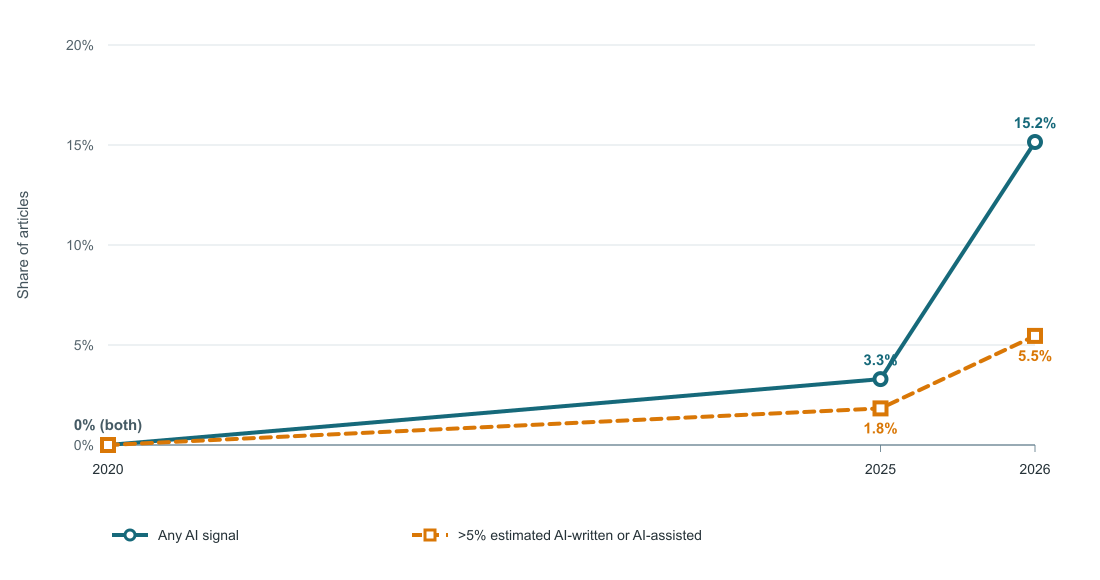
There is no AI signal in the 2020 benchmark, suggesting that false positives were unlikely or nonexistent in this analysis. In 2025, AI usage was scarce: 9 of 273 articles (3.3%) exhibited any AI signal, with 5 articles (1.8%) showing an estimated AI-generated share above 5%. The overall AI-generated word share across all 2025 pieces stood at 0.20%. By 2026, AI signals became substantially more common. Pangram identified 25 of 165 articles (15.2%) as containing AI-written content. On the article level, this represents roughly a 4.6-fold increase over 2025. A two-sided Fisher exact test produced a p-value of 0.000012, indicating that the rise is statistically significant. Nine articles (5.5%) in 2026 appear to contain more than 5% AI-generated words, with AI words accounting for about 1.10% of the total words across all articles published that year.
Next, to gauge the intensity of current AI involvement in writing, we can categorize the 2026 articles by the estimated share of words affected by AI.
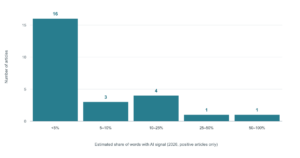
Nine of the twenty-five articles contain more than 5% AI-generated words, with one article appearing to be predominantly AI-written (the precise share is 64.6%).
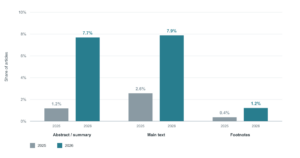
The AI signal is mostly concentrated in the main text and the abstract or summary. Footnotes show comparatively little AI involvement. This outcome surprised me somewhat; I would have anticipated AI usage in footnotes and parentheticals—areas often regarded as tedious—would be especially amenable to automation. Four articles exhibit signal solely in the abstract/summary, nine only in the main body, and the remaining twelve across multiple sections.
So What?
The results indicate that AI involvement is broadly dispersed across articles in T14 flagship law reviews, with a clear uptick relative to the prior year. This implies that at least some individuals are employing AI more extensively in their writing. The analysis cannot conclusively identify who that might be. For minor cases, it could be that law student editors revise an author’s phrasing with AI support, which the author then approves. Yet, even allowing for that mechanism, it seems unlikely to explain AI signal affecting more than five percent of an article’s words.
The analysis also does not specify the exact manner in which AI has been integrated into the writing process. The broad patterns do not distinguish between workflows such as polishing, editing, or composing from scratch. For normative purposes, these distinctions could matter, at least to some degree.
More generally, while I provide evidence of rising AI usage in law-review writing, I am not presuming this development to be inherently good or bad. The one caveat pertains to Claude’s output. While I stay somewhat agnostic about AI-assisted writing, I am less tolerant of reading prose that merely covers the surface and fails to address the epistemic implications. It seems worthwhile to state that plainly.
—
